If you are interested in semiconductors / chips / optical components & modules / optical fiber communications
Welcome to follow us!
We often say that fiber transmission relies on the principle of total internal reflection, so that light can be continuously confined within the core without leaking out.
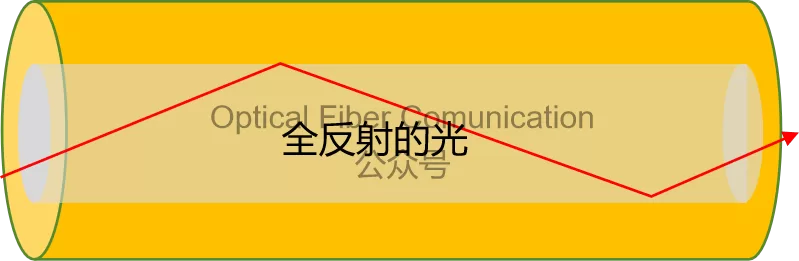
In fact, when light undergoes total internal reflection at the core-cladding interface, its electromagnetic field slightly penetrates into the cladding, forming what we call the evanescent wave, but its amplitude decays rapidly with depth into the cladding.
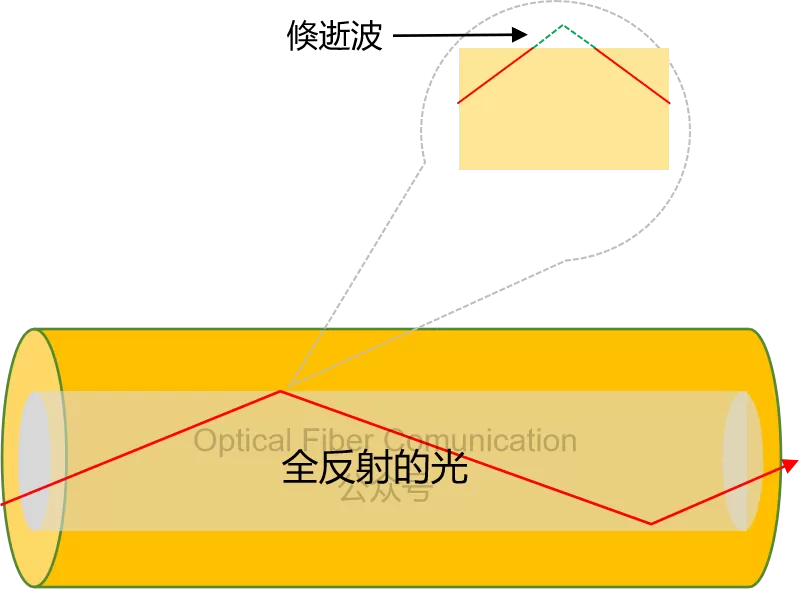
Therefore, light does not instantly turn back at the interface, but produces a tiny lateral displacement, namely the Goos-Hanchen shift, before returning to the core.
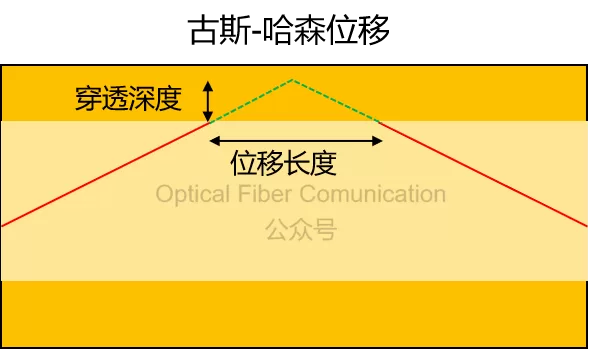
Both this displacement and how deeply the evanescent wave can penetrate can be precisely calculated with formulas. As long as the medium itself does not absorb energy, all the light energy will eventually be reflected back, and the evanescent wave itself does not cause energy loss.
So what can we do with evanescent waves?
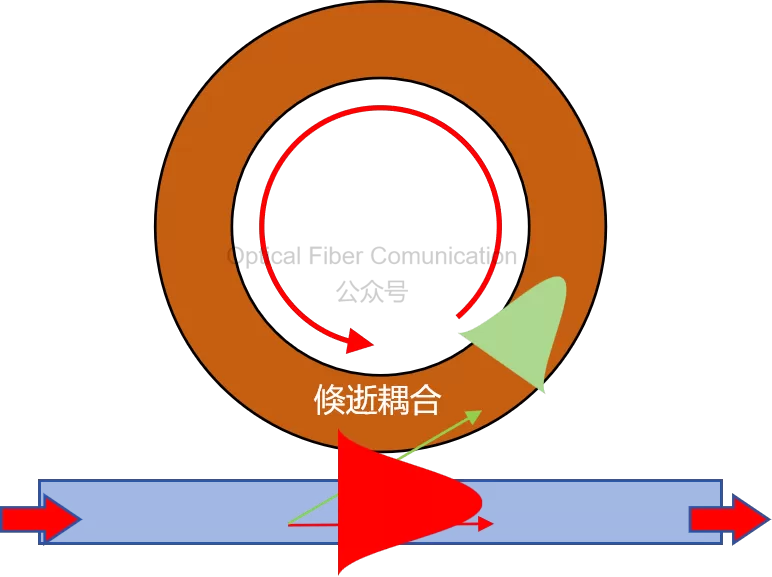
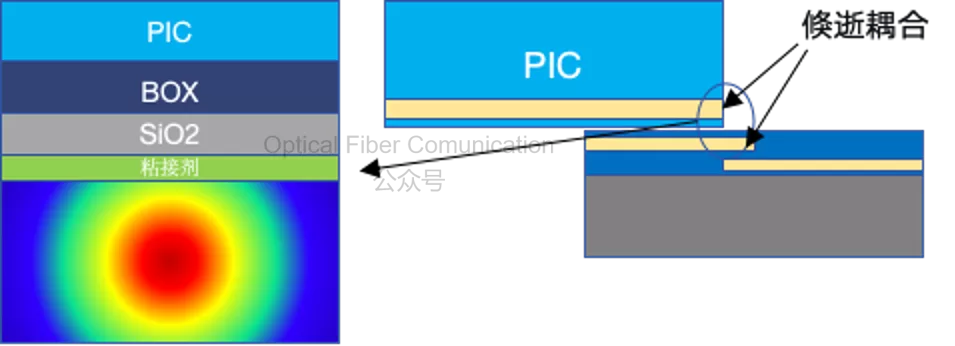
When we reduce the distance between two parallel fibers (or waveguides) to a scale comparable to the penetration depth of the evanescent wave, light energy begins to transfer steadily from waveguide A to waveguide B through the evanescent wave as a “bridge”.

A typical application is the microring resonator. It consists of a ring waveguide and one or more straight waveguides. Microring Resonators: Coupling, Modulation and Wavelength Division Multiplexing

When the phase of the light satisfies the matching condition, it can be efficiently injected from the straight waveguide into the ring waveguide through evanescent coupling, producing resonance within the ring.
For a specific case, in our article Glass Substrates: Pluggable Connection Solutions in CPO Packaging, evanescent coupling is also used to transmit optical signals between non-contact waveguides.
Thanks for reading!
Related reading:
Silicon Photonics Coupling: Wedge and Slot SSC Mode-Spot Converters
Nvidia: CPO External Light Source Coupling Scheme with Polarization Tracker
Welcome to follow us!
Enjoy this article?
Subscribe to get new optical communication insights delivered to your inbox. Free, unsubscribe anytime.