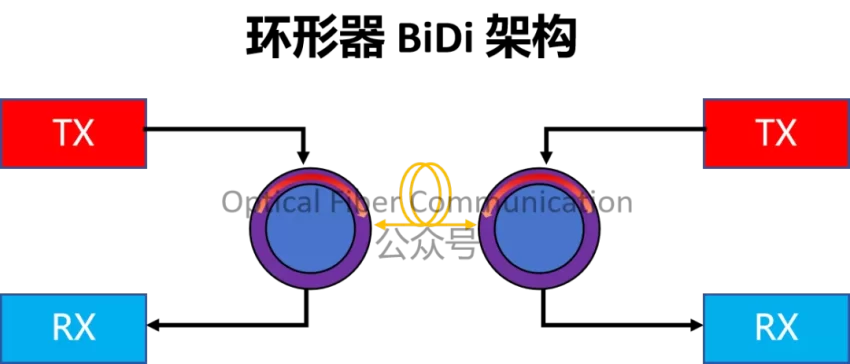
We previously explained in “Nvidia: CPO External Light Source Coupling Scheme with Polarization Tracker” how Nvidia solved the polarization instability caused by the CPO external light source.
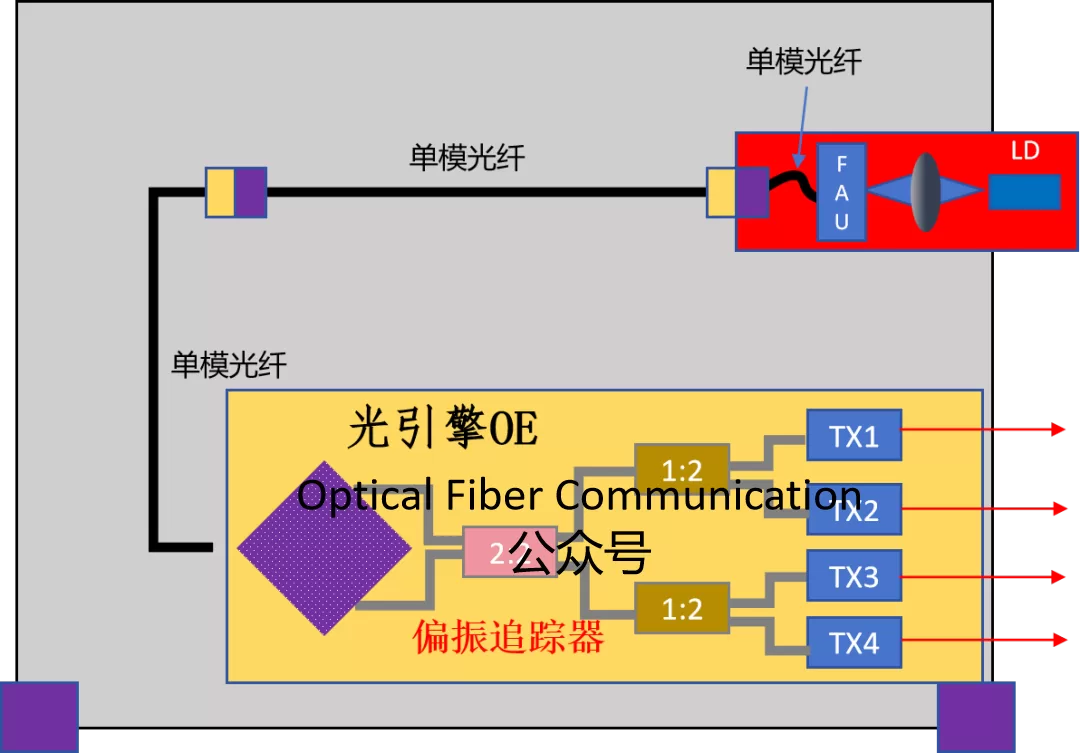
Today let’s continue to see how Nvidia achieves wavelength-independence and completely symmetric hardware at both ends in the BiDi bidirectional transmission architecture.
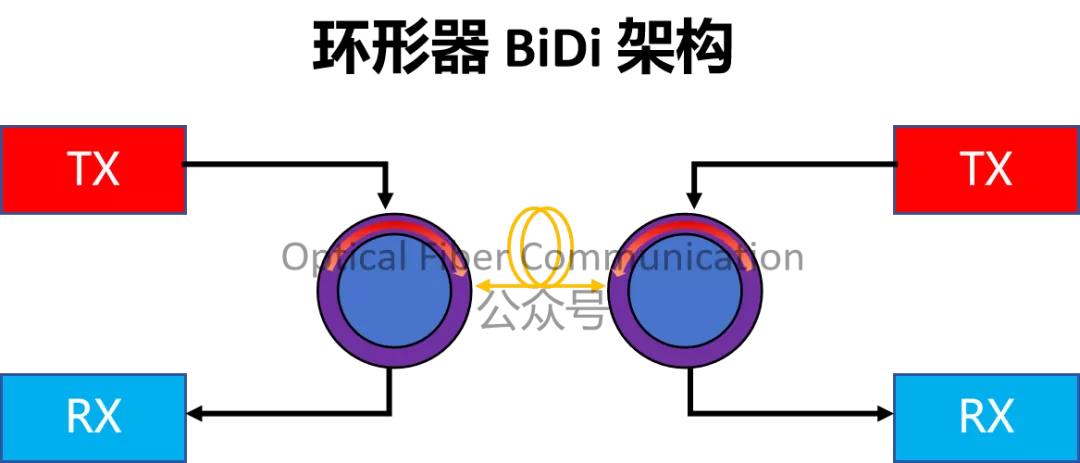
In traditional bidirectional transmission schemes, a circulator structure can be used. This approach can achieve identical hardware at both ends, but it is difficult to package and the device cost is very high.
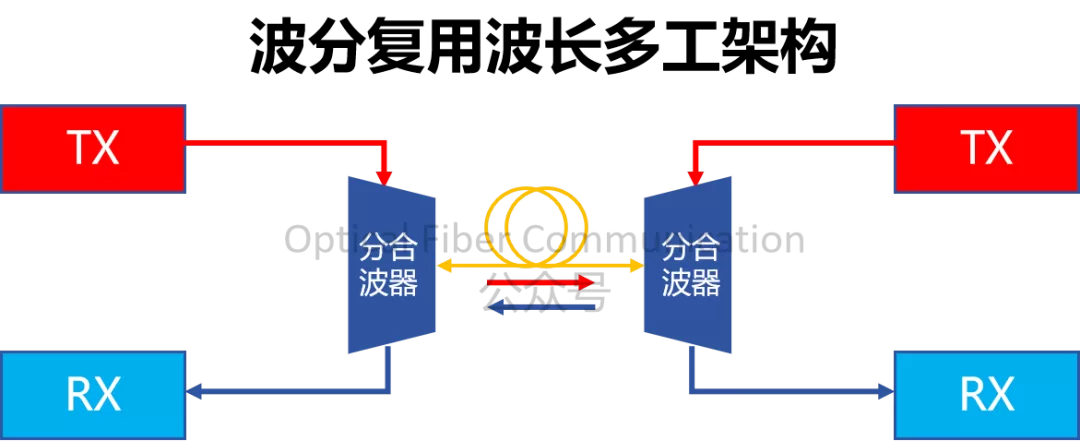
You can also use MUX/DeMUX multiplexers, but different wavelengths must be used to distinguish uplink and downlink. This forces the modules to be used in pairs and cannot be freely plugged or replaced, and you also need to stock two part numbers.
We know that single-mode fiber itself has two polarization states, TE and TM. Since that is the case, we can directly use the polarization state to distinguish uplink and downlink channels, without occupying any other resources.

During actual transmission, the fiber is affected by structural defects, bending, mechanical stress, and temperature changes, causing the polarization state to change and producing differential group delay.
Whether it is the ELSFP laser in a CPO system or the silicon photonics device at the receiving end, both are very sensitive to the polarization state of light. In other words, the BiDi system itself must handle dual-polarization-related issues.
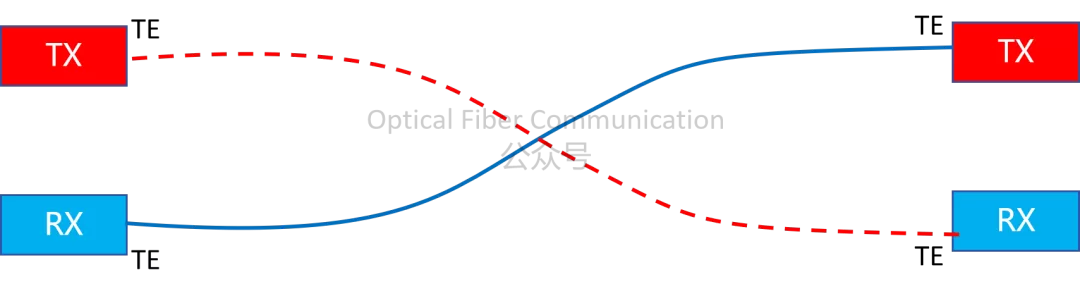
One thing to clarify here: the transmit end of a silicon photonics chip, including the laser, modulator, and transceiver, is designed to operate only in the TE polarization mode. One reason is that TM-polarized light has higher loss in silicon photonics waveguides.
Therefore, a 2D grating coupler (2D GC) is needed to couple the two TE modes output by the silicon photonics into the S and P orthogonal polarization states of the fiber.
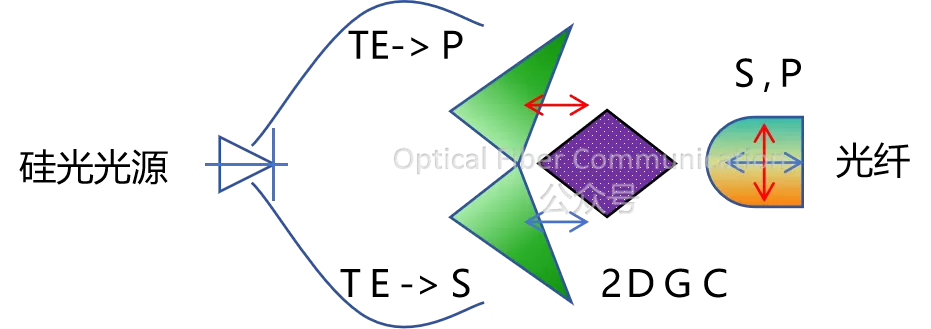
At the same time, the 2D grating coupler can also decouple the S/P polarization signals in the fiber and restore them to two TE mode signals.
Terms like TE, TM, S-polarized light, P-polarized light, O-light, and E-light are just different descriptions of polarization states in different scenarios; their physical meanings are the same.
As mentioned earlier, after light travels a certain distance in the fiber, the polarization state will undergo random perturbation, so a polarization tracker is needed at the receiving end to compensate for this perturbation and avoid crosstalk between signals.
Regarding the polarization tracker, you can still refer to “Nvidia: CPO External Light Source Coupling Scheme with Polarization Tracker“.
If you want to save cost, you can first use a basic single-side polarization tracking scheme.
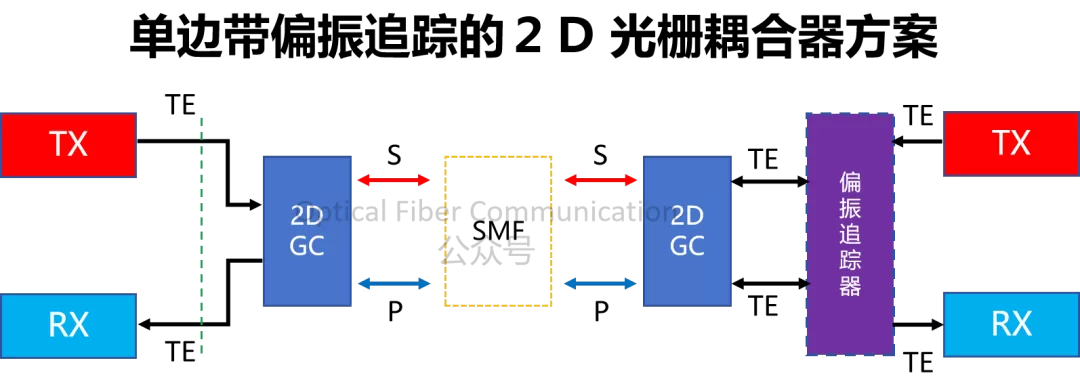
But the hardware structures at the two ends are asymmetric, and the modules cannot be swapped; moreover, the reverse transmission side has no tracker for compensation, which will introduce large polarization-dependent loss.
For this reason, Nvidia adopted a completely symmetric structure at both ends, with both transmit and receive sides configured with TX/RX, polarization tracker, and 2D grating coupler.
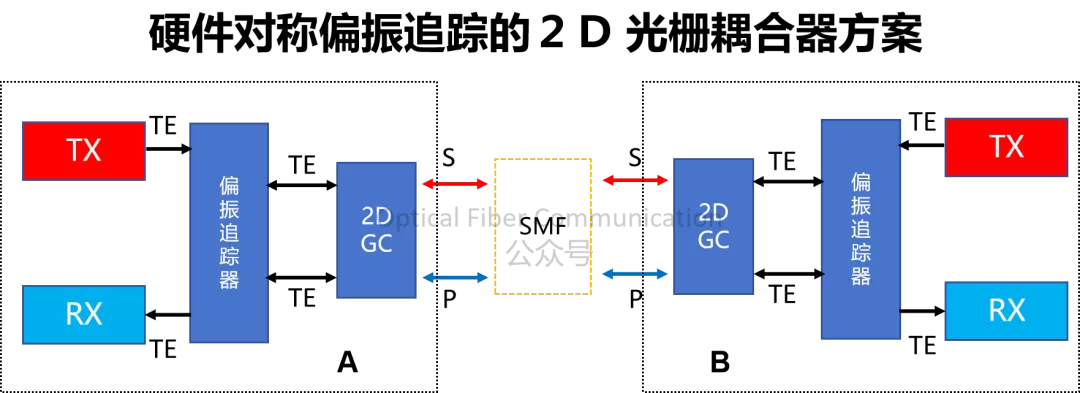
During operation, when end A transmits and end B receives, the polarization tracker at end B works while the tracker at end A is in bypass state; when end B transmits and end A receives, the tracker at end A works while the tracker at end B is idle.
In this way, the hardware at both ends is completely identical, and the modules can be directly swapped without distinguishing end A from end B.
To summarize: Nvidia’s scheme uses polarization states to distinguish uplink and downlink, achieving symmetric hardware, wavelength-independence, and bidirectional cross-transmission. The modules at both ends can be directly swapped, completely solving the pairing problem that traditional wavelength-based BiDi must face.
Recommended reading:
Sumitomo: Progress on High-Power Dual-Lattice PCSEL Solution Supporting CPO
Source Photonics: 400G/lane EML Solution and 3.2T Optical Module Roadmap and Views
Thanks for reading!
Add WeChat WaytoICT to join the Semiconductor & Optical Component Industry Chain Group 2.
Welcome to join our community and access high-value technical documents, trend research reports, and various supply-demand business opportunities in the fields of semiconductor chips, optical components, and optical modules.

If you are interested in semiconductors / optical components / optical modules / optical fiber communications
Welcome to follow us!
Enjoy this article?
Subscribe to get new optical communication insights delivered to your inbox. Free, unsubscribe anytime.