In martial arts, speed is king. The development of optical transport networks also prides itself on “speed,” which has become the capital that major vendors use to show off. From per-wavelength rates of 10G, 40G, 100G, 200G/400G, to 600G, 800G, 1T…, the iteration cycle is getting shorter and shorter. If 10G is a vintage car and 100G is a commuter car, then 600G/800G is a supercar, and the ultra-high-speed 1.2T is a high-speed rail.
But a car cannot go as fast as you want. Just like the channel bandwidth in communication, no channel can increase its information transmission rate indefinitely. Constrained by physical devices, modulation, and spectral range, there is a maximum theoretical capacity on the communication channel, namely the “Shannon limit.” So how is the current development of coherent transmission rates in optical WDM networks going?

At present, many vendors have released 600G and 800G modules, and there are already 1.2T modules in data center interconnect (DCI). The line-side optical module evolution for coherent optical transmission has also been planned to 1.2T, using a 130G baud rate with 5nm process. So, given that 200G/400G are now widely commercialized, should operators deploy 600G or 800G modules in metro and backbone WDM, or wait for the “high-speed rail” of 1.2T?
From the Perspective of Different Modulation Rate Performance
As we know, coherent 600G supports PM-QPSK at 4 bits per symbol, PM-8QAM at 6 bits per symbol, and PM-16QAM at 8 bits per symbol. Compared with 200G, it also adds PM-32QAM (10 bits per symbol) and PM-64QAM (12 bits per symbol) modulation. The baud rate of 600G can range from 25 to 72 GBaud, and may vary by vendor. 800G uses the same modulation formats as 600G, but as we understand it, its baud rate is currently fixed at 96 GBaud regardless of the modulation used.
(1) 200Gb/s: Uses PM-QPSK, mainly applied to long-haul transmission. The 200G rate of 800G has a baud rate of 96 GBaud. The 200G in a 600G module also uses QPSK, but its baud rate is only 64 GBaud. As mentioned in previous articles, the higher the baud rate, the wider the spectrum occupied. The channel bandwidth of 96 GBaud is 112.5 GHz, while 64 GBaud only needs 50/75 GHz. According to the calculation, within the same band, the total system capacity of 800G is lower than that of 600G. In terms of transmission distance performance, the OSNR performance of 600G and 800G modules is similar. Of course, from an economic market perspective, whether 800G or 600G modules, applying the 200G rate is not cost-effective.
(2) 400Gb/s: 800G modules use 8QAM, and 600G modules use 16QAM, with a baud rate of 64 GBaud. This scenario is generally applied to metro. When 800G modules use this rate, compared with 600G, their modulation order is lower than 600G. As we know, the higher the modulation order, the lower the OSNR. Therefore, the performance of 600G modules at this 400G rate is somewhat lower than that of 800G modules.
(3) 600Gb/s: At this rate, 800G uses a spectral width of 112.5 GHz with 8QAM modulation. If a 600G module uses 64QAM, the channel spacing is 75 GHz, or it can use 32QAM. From the modulation order perspective, the performance of 800G modules at the 600G rate is somewhat better than that of 600G modules.
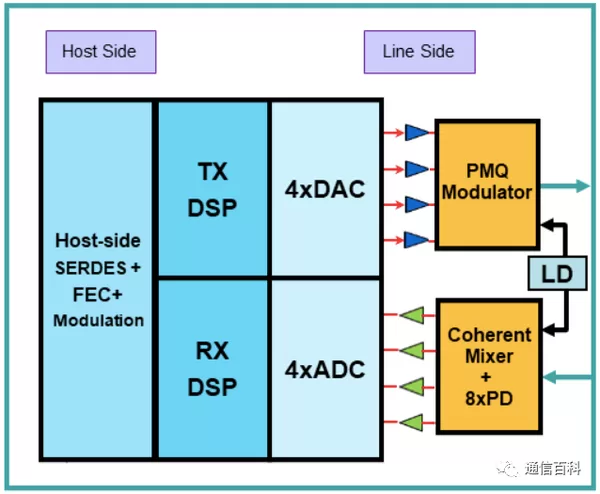
(4) 800Gb/s: Uses 16QAM or 32QAM. At the 800G rate, we will not compare with 600G modules here. 800G modules allow coherent transceivers to run at 96 GBaud with dual-polarization 32QAM or at 120 GBaud with dual-polarization 16QAM. The current mainstream is 96 GBaud, using 4 pairs of DACs and ADCs, one laser, and one pair of optical transmitters and receivers. Current 800G modules support adjustable rates from 200G to 800G. Commonly used 800G modules support only a single channel and are non-pluggable fixed MSA modules; considering integration and other issues, their power consumption should be much higher than 600G. In addition, in the comparison of different rates supported by 800G above, the baud rate remains unchanged. As we understand it, some Western vendors can already reduce the 96G baud rate, with the corresponding spectral width approaching 100 GHz. The following is a structural diagram of a coherent 800G DWDM optical module for reference:
From the Perspective of Spectrum Planning
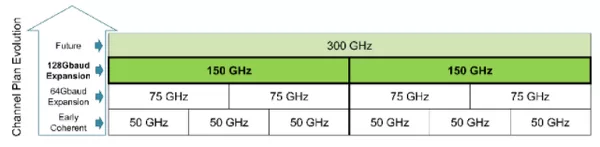
To adapt to future transmission schemes while minimizing residual spectrum, generally speaking, to guarantee the spectrum width requirements of future higher rates and consider compatibility with rates such as 100G, the spectrum of higher rates should be based on integer multiples of 50 GHz or 75 GHz. As shown below:
As mentioned earlier about the shrinking gap to the Shannon limit, industry investment is moving toward increasing the total baud rate to increase capacity while maintaining reach. Without considering other factors, to compare the pros and cons of 112.5 GHz spectrum width and 75 GHz in future network planning, the answer is obvious. As shown in the figure below, 75 GHz multiples give 150 GHz; if 112.5 GHz spectrum is used, a small part of the spectrum resources cannot be effectively utilized.
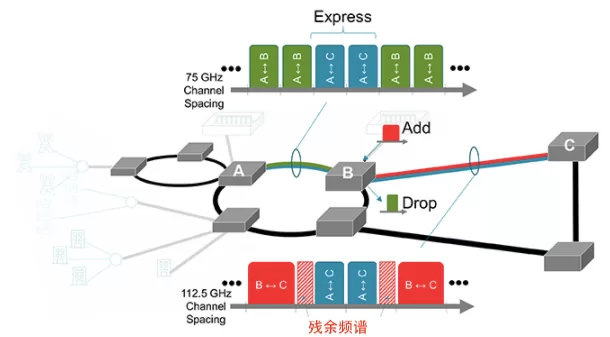
Therefore, based on the channel spacing of current mainstream operator WDM systems, such as 50 GHz for 100G networks, or 37.5/75 GHz for beyond-100G, whether the current 600G uses 75 GHz or future higher rates use 150 GHz, the operator’s network planning and maintenance will be much more favorable. From this point of view, if 800G uses 112.5 GHz channel spacing, it has no advantage. Moreover, considering the launch of 1.2T coherent modules next year or the year after, their performance will be even better than 800G modules.
The above only represents the author’s personal opinion for reference. If there are any inaccuracies, please forgive me. So, in coherent WDM networks, do you think operators should deploy 600G or 800G rate modules now, or wait a bit for 1.2T?

Related Reading
- 800G Optical Module MSA: Technical Analysis of 8x100G in SR Scenarios
- Is the Single-Wavelength 800G Solution Commercially Viable?
- Data Center 800G: PAM4 or Coherent Technology?
Enjoy this article?
Subscribe to get new optical communication insights delivered to your inbox. Free, unsubscribe anytime.