In the field of communications, the direct detection (DD) system is a very practical technology. It realizes information transmission by detecting the modulated optical power (also commonly referred to as the optical field intensity or light intensity).
In a traditional DD system, the receiving end mainly consists of a photodiode (PD), while the transmitting end is responsible for modulating the optical power. Such a system is therefore also called an intensity modulation direct detection (IM-DD) system.
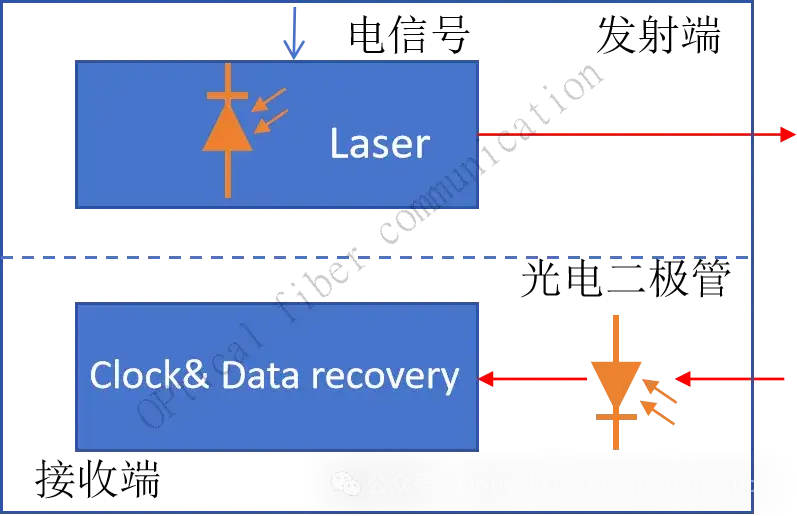
The figure below shows a typical IM-DD transceiver architecture.
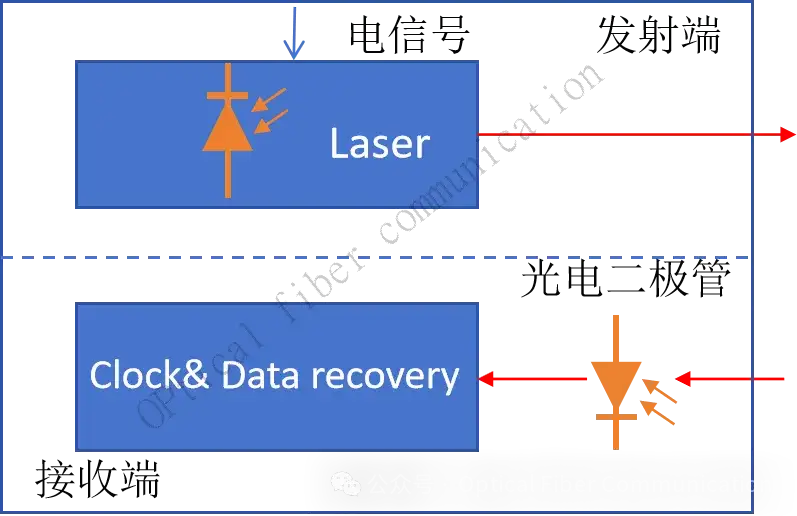
The transmitting end uses a laser as the light source. The optical signal can be modulated directly inside the laser, or it can be modulated through an external modulator. The receiving end includes a photodiode, a clock recovery module, and a symbol decision module; the entire electronic circuit is usually called the clock and data recovery unit.
Compared with complex coherent systems, the electronic and optical parts of the DD system are much simpler. Coherent systems require a digital-to-analog converter (DAC) and a dual-polarization I/Q modulator at the transmitting end, and an optical hybrid, four pairs of balanced photodetectors, and four analog-to-digital converters (ADC) at the receiving end, whereas the DD system avoids these complex components.
In the early stage of communication technology development, when the rate requirement of each transceiver interface was only 10 Gb/s and 40 Gb/s, the DD system was widely used in various optical fiber communication scenarios because of its simplicity and efficiency, from short-distance metropolitan area network connections to long-distance links in core networks. However, as communication demands continued to rise, core networks gradually shifted to coherent systems. This is because coherent systems are more advantageous in receiver sensitivity and spectral efficiency, and are more suitable for long-distance transmission at rates of 100 Gb/s and above. As a result, the application range of the DD system gradually focused on cost-sensitive short-distance scenarios, such as metropolitan transmission, interconnections within and between data centers, and passive optical networks. Today, the typical transmission distance of the DD system generally ranges from a few meters to 100 kilometers.
In the subsequent articles of this topic, we will delve into the working principles and limitations of traditional DD systems; you are welcome to follow us. At the same time, we will also introduce some advanced DD systems that can achieve ultra-high interface rates in short-distance applications by adopting new transmitting-end and receiving-end designs. Finally, we will share our views on the future development of short-distance transmission systems.
Related Reading
- What is the Principle of Direct Detection?
- Probabilistic Constellation Shaping (PCS) (2)
- Does 800G in Data Centers Use PAM4 or Coherent Technology?
Enjoy this article?
Subscribe to get new optical communication insights delivered to your inbox. Free, unsubscribe anytime.