The detection of optical signals is divided into direct detection and heterodyne detection. Direct detection is a detection method that directly demodulates the information-bearing optical signal by using the photoelectric conversion function of the photodetector. It responds only to the time-varying information of the optical wave power and not to the phase information of the optical wave, so it is only suitable for the detection of intensity-modulated information.
Heterodyne detection, also known as coherent detection, originally originated in the field of radio wave and microwave technology. Optical heterodyne detection is an optical-frequency coherent detection, realized based on the principle of mixing a coherent reference light with the incident signal light on the photosensitive surface.
The frequency of the signal produced after mixing is the sum or difference of the signal frequency and the local oscillator frequency; this characteristic constitutes the physical basis of heterodyne detection.

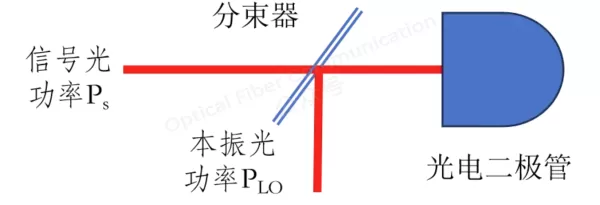
The figure above shows a typical optical heterodyne detection setup. Two light beams are spatially coupled through a beam combiner (or beam splitter). The key implementation conditions include:
1. Using a beam combiner (or beam splitter) to achieve precise spatial coupling of the two beams;
2. Strictly ensuring mode matching.
It must be emphasized that a laser with good coherence must be used as the light source, adding the local oscillator light while receiving the signal light. The frequency of the local oscillator light is extremely close to the signal light frequency, so that the local oscillator light and the signal light form a beat-frequency signal on the photosensitive surface of the photodetector.
In optical fiber systems, the beam splitter is replaced by a fiber coupler, and single-mode fiber (usually polarization-maintaining) must be used. At this point the waveguide characteristics of the fiber naturally satisfy the mode-matching requirement, requiring no additional optical alignment operation.
Unlike in the RF field, in optical heterodyne detection the mixing signal produced by the interaction of the optical signal and the local oscillator wave manifests in the form of an electrical signal. At the same time, the photocurrent output by the photodetector follows a square-law response characteristic, that is, it is proportional to the total light intensity (the square of the electric field amplitude).
When the power and frequency of the signal light and the local oscillator light are stable, the photocurrent contains two characteristic components:
1. DC component: its amplitude is proportional to the sum of the local oscillator power (PLO) and the signal power (PS);
2. AC component: it oscillates at the difference frequency (fbeat = fLO – fS), with its amplitude proportional to the product of the electric field amplitudes of the two optical fields.
It is worth noting that the electrical power of this oscillation component remains proportional to the product of the optical powers of the signal light and the local oscillator light. When a high-intensity local oscillator light is used, even if the input signal light is extremely weak, the generated heterodyne signal can still be significantly stronger than the direct detection signal. This characteristic allows heterodyne detection to achieve effective signal gain without introducing optical amplification, which constitutes the core technical advantage of this method.
Related Reading
- Probabilistic Constellation Shaping (PCS) (2)
- Does 800G in Data Centers Use PAM4 or Coherent Technology?
- Light and Technology: What is the Story Behind Nonlinear Effects in Optical Fiber?
Enjoy this article?
Subscribe to get new optical communication insights delivered to your inbox. Free, unsubscribe anytime.