In optical access networks, we often encounter QinQ applications. So what is QinQ? Why do we need QinQ? Let us summarize today.
What is QinQ?
QinQ is actually an extension technology of VLAN.
As for what VLAN technology is, I believe many people are already very familiar with it, so we will skip it here. But it is important to know that VLAN is defined in the IEEE 802.1Q standard.
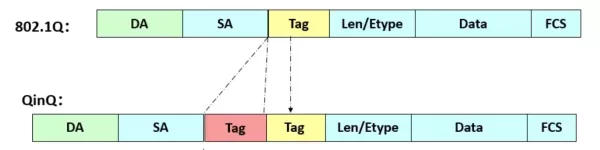
QinQ expands the VLAN space by adding another 802.1Q Tag (double-layer VLAN) on top of the 802.1Q tagged frame (single-layer VLAN). So it is 802.1Q-in-802.1Q, which is where the name QinQ comes from.

QinQ technology is also known as VLAN Stacking or Double VLAN, defined by the IEEE 802.1ad standard.
In fact, according to the above rules, we could theoretically implement three-layer or even four-layer VLAN technology, but the live network does not need that yet, so we only use two-layer VLAN technology for now.
Why do we need QinQ?
Why do we introduce QinQ? On one hand, single-layer VLAN technology has some limitations; on the other hand, QinQ technology itself has some advantages. Summarized as follows:
1. Solving the shortage of VLAN ID resources
In the traditional IEEE 802.1Q standard, a single-layer VLAN ID has only 12 bits and can represent at most 4096 VLANs.
As network scale expands, 4096 VLANs can no longer meet the demand. For example, in an access network, we need VLANs to distinguish services and also to distinguish users, and the number of users exceeds 4K, so single-layer VLAN is clearly insufficient.
QinQ adds a layer of 802.1Q tag on top of the original 802.1Q frame, increasing the number of VLANs to 4096×4096, effectively solving the problem of insufficient single-layer VLAN resources.
2. Meeting the need for fine-grained service management
With the development of Ethernet technology and the requirements of refined operator operations, QinQ’s double-layer tags have gained broader application scenarios.

For example, in operator PON networks, QinQ technology is often used, where the inner and outer tags can represent different information. The inner tag represents the user, called CVLAN (Customer VLAN), and the outer tag represents the service, called SVLAN (Service VLAN).
3. Achieving user isolation and identification
In operator networks, QinQ technology can encapsulate the user’s private-network VLAN Tag inside the public-network VLAN Tag, allowing frames to traverse the backbone network carrying two layers of VLAN tags.
In the public network, devices forward frames only based on the outer VLAN Tag, while the user’s private-network VLAN Tag is transmitted as the data portion of the frame, thereby achieving user isolation and identification.
4. Providing a simple VPN technology
QinQ traverses the operator network carrying two layers of VLAN tags, with the inner VLAN Tag transmitted transparently, making it a simple and practical VPN technology.

QinQ can serve as an extension of core MPLS VPN in metro Ethernet VPN, forming an end-to-end VPN technology.
In summary, QinQ technology meets the needs of network scale expansion and refined operator operations by expanding VLAN space, achieving fine-grained service management, providing user isolation and identification, and offering simple VPN functionality.
Enjoy this article?
Subscribe to get new optical communication insights delivered to your inbox. Free, unsubscribe anytime.