The urgent demand for scalable interconnect in AI data centers is driving a key breakthrough in optical circuit switching (OCS) technology based on micro-electromechanical systems (MEMS).
How does OCS optical circuit switching work?
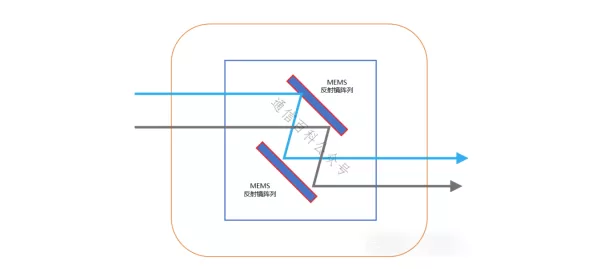
In an OCS system, an optical signal enters from one port and encounters a “matrix” covered with micro-mirrors. These mirrors are extremely flexible and can quickly adjust their angles to precisely “bounce” the incoming optical signal to a designated output port.

This establishes a point-to-point optical path channel. The greatest benefit is that data runs on the optical path the entire way, with no need to convert to electrical signals. This directly opens up an end-to-end connection and minimizes transmission latency.
Taking Lumentum’s R300 switch as an example, compared with traditional Ethernet switch performance:

Why do AI data centers need OCS so much? Mainly because traditional architectures can no longer hold up.
Common architectures like Clos or Fat-Tree rely on several layers of electrical switches (usually 2-3 layers) to connect computing units such as GPUs or TPUs. The problem is that the larger the scale, the more alarming the power consumption and cost, almost doubling. OCS offers a new approach: use it to directly replace the topmost, most core, and most power-hungry part of the “spine” electrical switches. In this way, the entire interconnect architecture is simplified into a single layer of optical connections.

Electrical switch layers arranged in a Clos architecture
Google’s actual application has already seen clear benefits: the interconnect power consumption of their TPU clusters dropped by 40%! Moreover, the optical paths can be flexibly adjusted; if a rack fails, data can automatically bypass it and take another optical path, improving reliability.
There is also a major future-oriented advantage: OCS is “protocol-transparent.” Simply put, it is not picky. Current 400G and 800G links work, and future upgrades to 1.6T will not require changing the hardware itself—directly compatible.
However, to achieve this breakthrough, many problems still need to be solved!
In a switch like Lumentum’s R300, there are tens of thousands of small mirrors, each of which must be precisely controlled to the micron level, with no alignment error. Every time an optical signal passes through an input or output port, there is loss (about 1.5 dB initially, 3 dB nominal), which amounts to 6 dB loss for a round trip—this greatly affects how far the signal can travel. In addition, the stray light (back-reflection) generated by mirror reflection must be suppressed to a very, very low level (on the order of 60 dB) to avoid interfering with other signals, which places almost harsh requirements on the mirror surface precision.

At the same time, to fit more connections in limited space (increasing port density), people thought of using bidirectional optical modules (one port used as two). This indeed doubles the number of ports, but it also requires customized, non-standard optical transceivers. Even more troublesome, the software complexity of controlling the entire system suddenly surges, because it must constantly monitor to prevent two light beams traveling in opposite directions from “colliding” on the same path (conflict detection).
The movable joints (hinges) of those small mirrors must be extremely durable, able to withstand astronomical numbers of switching cycles (such as 10¹⁵ times, equivalent to 20 years of continuous operation). Temperature changes cause mirror positions to drift, leading to inaccurate optical paths, so a real-time monitoring and compensation closed-loop system is also needed. Currently, few manufacturers can make MEMS with telecom-grade high reliability; some manufacturers have deployment experience of over a hundred thousand devices in wavelength-selective switches. But migrating the same reliability and precision to OCS products for data centers, while ensuring large-scale mass production and yield, is still a challenge.
Next, how will optical circuit switching technology develop?
First, hybrid architecture becomes an inevitable choice; it is unrealistic to expect OCS to handle everything alone. A more feasible approach is to let it handle the sustained, large-block data flows in AI training (such as AllReduce communication), while handing fragmented small data packets to traditional Ethernet electrical switches. This requires the control system behind it to be very intelligent, able to dynamically perceive traffic types and schedule flexibly.

Optical circuit switches in a data center (blue box)
Currently, one port usually handles only one path of light. Future technology will enable scheduling multiple optical signals of different wavelengths separately within one port (like dividing a large road into multiple lanes), greatly improving spectrum utilization efficiency.
Finally, combining OCS with “co-packaged optics” (CPO) technology can eliminate pluggable optical modules and further reduce signal loss. In addition, using AI to analyze the data controlling mirror deflection can predict possible failures in advance, making the entire system run more stably.
Thank you for reading!
Related Reading
- Why Does Google Want to Develop OCS Optical Switches?
- What Is Optical Circuit Switching (OCS) Technology?
- Lumentum: OCS Technology Roadmap and Industry Evolution Views
Enjoy this article?
Subscribe to get new optical communication insights delivered to your inbox. Free, unsubscribe anytime.