Preface: Regarding road building, as far back as the Shang Dynasty, people already knew to build roads with rammed earth so that oxen and horses could carry goods faster. The First Emperor even built a network of expressways leading to the whole country to mobilize troops faster, and I believe everyone has heard of the famous “Qinzhidao.” Today, the concept of “to get rich, first build roads” still prevails.
Similarly, in the wired-transmission-technology field of communications, there was also a long “road-building” process. With the surge in services and traffic, we were forced to think about how to build the road of optical transmission “faster, better, and cheaper.” The once-tremendously-popular SDH technology met this requirement for a period of time; it used TDM synchronous multiplexing to build rigid one-way lanes, but ultimately still could not keep up with the pace of bandwidth demand growth.

To this end, wavelength-division multiplexing technology appeared, which creatively divided the optical fiber into multiple lanes, and it has been applied to this day with an unquenchable momentum.

It can be said that before the emergence of wavelength-division multiplexing technology, all transmission technologies could only transmit one wave of services in the optical fiber. Below, let us talk about wavelength-division multiplexing technology.
Wavelength Division Multiplexing, literally meaning the Division and Multiplexing of wavelengths. Therefore, it is not hard to imagine that wavelength-division multiplexing should be able to carry specific wavelengths of multiple services and transmit them in the same optical fiber. So how can multiple wavelengths be transmitted in the same optical fiber?
In the scenario of a highway, dedicated checkpoints (toll stations) are set up at both the entrance and exit. The checkpoint at the entrance serves to converge vehicles from various places onto a single highway, while the checkpoint at the exit allows vehicles with different destinations to leave the highway. In addition, can all vehicles go on the highway? At least my little electric scooter cannot.

Therefore, in wavelength-division multiplexing technology, we also need to solve several key problems.
- How are the channels of optical fiber transmission divided, and how many is appropriate?
- How to converge different wavelength signals into one optical fiber, and how to separate them?
- What kind of wavelength signals can be multiplexed and demultiplexed on an optical fiber without affecting each other?
- How to achieve long-distance transmission?
- ……
Let us first discuss the first problem: how to divide the channels of wavelength-division multiplexing technology.
First, we need to figure out where to divide the channels, that is, how to choose the terrain when building a highway: try to choose places with low resistance. I wonder if you still remember the fiber attenuation diagram from the previous article, as follows:

It is obvious that wavelength-division multiplexing technology makes full use of the wavelength range where light has relatively low attenuation in the optical fiber, basically covering all wavelengths from the O-band to the L-band. Within this range, according to the different sizes of channel spacing, traditional WDM can be divided into coarse wavelength-division multiplexing (CWDM) and dense wavelength-division multiplexing (DWDM). Of course, after the emergence of 5G fronthaul scenarios, there are also MWDM, LWDM, and so on.
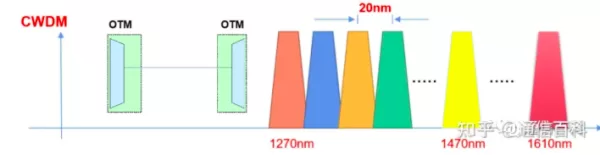
Among them, CWDM covers the entire O~L range, with a channel spacing of 20 nm; DWDM mainly uses the C-band, with various wavelength spacings, generally 0.8/0.4 nm. Various vendors have also developed the CE-band and C++-band. Now, to pave the way for 400G, the L-band and even the C+++L++ band have been developed. We will discuss these later.
The following is a more official statement about CWDM and DWDM:
CWDM: Coarse Wavelength Division Multiplexing, with a relatively large channel spacing of 20 nm and a relatively large range of optical signal wavelengths used, from 1270 nm to 1610 nm. The range is large, but the number of divided lanes is still relatively small, only 18 lanes. No temperature control and no EDFA are needed, so the cost is low, making it suitable for short-distance, high-bandwidth, and access-point-dense communication scenarios, such as network communication within or between buildings.

DWDM: Dense Wavelength Division Multiplexing, with a relatively small channel spacing, generally 0.8 nm or 0.4 nm, and can be even smaller, dividing more lanes. The wavelength range is generally 1525 nm ~ 1572 nm. It later expanded to the L-band, with a wavelength range of 1570 nm ~ 1610 nm. It is suitable for long-distance, large-capacity long-haul backbone networks or ultra-large-capacity metro core nodes.

At this point, I found that one article cannot finish it, so we will continue discussing the other questions next time. At the same time, let me leave a question here: why is the wavelength spacing of CWDM 20 nm?
A friend asked today why there seem to be more original updates recently? I can only say “prepare for a rainy day”!
A large number of WDM documents can be downloaded by joining our Knowledge Planet, and you can also obtain more than 10,000+ other premium documents.
Related Reading
- What Is the Transmission Path of Light in Optical Fiber?
- Optical Fiber Communication: The Structure of Optical Fiber
- Optical Fiber Communication: Mode Field Diameter and Cutoff Wavelength
Enjoy this article?
Subscribe to get new optical communication insights delivered to your inbox. Free, unsubscribe anytime.