

Let me start by borrowing a joke shared by an insider at a certain company: “As a ‘friendly competitor’ of Huawei… friendly competitor? Is our company even qualified?”
Below, let us chat about Huawei’s just-released 2023 annual report, which was within expectations. The two most eye-catching core indicators are:
Full-year revenue of 704.2 billion yuan and R&D investment of 164.7 billion yuan, accounting for 23.4% of annual revenue
Some friends may not have much sense of these two figures. Let us look at the data of ZTE, the No.1 listed communications company in China:
Full-year revenue of 124.3 billion yuan and R&D investment of 25.3 billion yuan
The comparison is not meant to belittle ZTE – ZTE is already quite remarkable, so learn from the gap and forge ahead. It is just that recently, when talking with a friend at a carrier, he was surprised to hear that on the same day several colleagues came to ask me how the compensation for the layoffs at ZTE was calculated – and there is also one of my own friends in the same boat. <Personal opinion: the perspective is still a bit narrow>.
Back to the topic. Huawei’s R&D investment in 2023 was so high that it is truly rare. At least as far as I know, it ranks first among all companies nationwide – whether in the past, the present, or possibly even the future.
Next, let us look at the data trend of Huawei’s revenue and R&D investment over the past five years (in units of 100 million yuan), which will give you a more intuitive feeling:
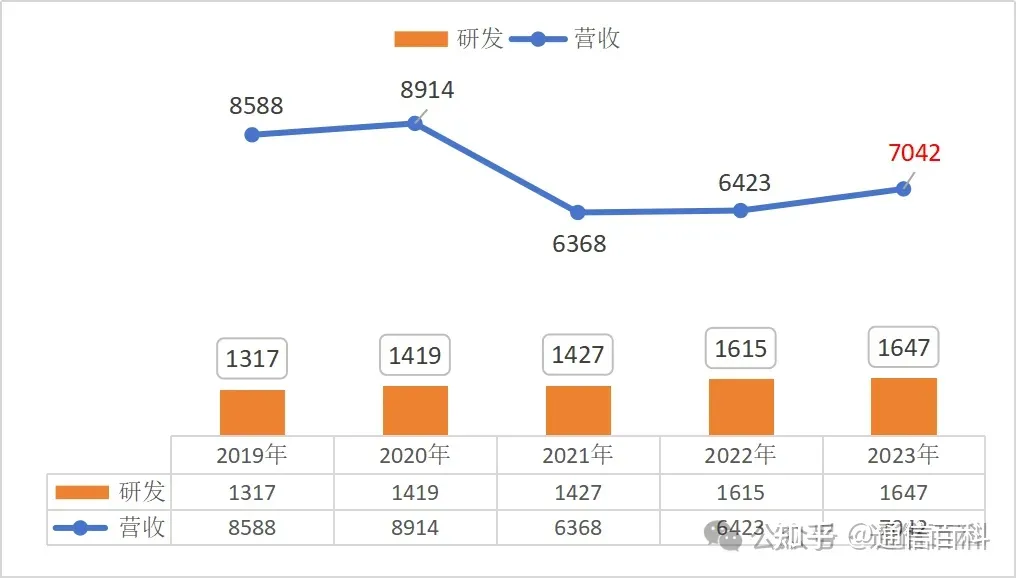
From the trend chart above, 2020 and 2021 were exceptionally difficult years for Huawei. With no chips available for 5G phones, it even sold off Honor and Super Fusion (xFusion). Throughout 2021, revenue declined in all four quarters, dropping from nearly 900 billion yuan to just over 600 billion yuan. Only one word can describe it: brutal! Yet R&D investment did not decrease but increased!
As a practitioner who has spent many years in the communications industry, I know well how tough the past five years have been for Huawei. Fortunately, in 2023, revenue finally rose noticeably, with Huawei returning to the 700 billion yuan mark, a net profit of 87 billion yuan, and profit up 144.50% year-over-year.
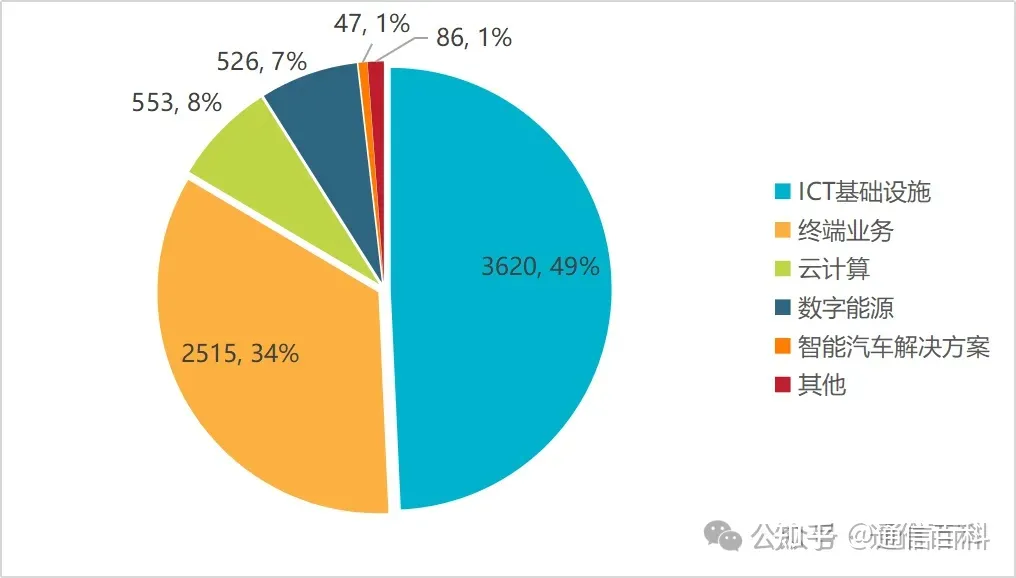
Let us look at several of Huawei’s operating figures:
ICT infrastructure business revenue: 362 billion yuan, up 2.3% YoY
Terminal business revenue: 251.5 billion yuan, up 17.3% YoY
Cloud computing business revenue: 55.3 billion yuan, up 21.9% YoY
Digital power business revenue: 52.6 billion yuan, up 3.5% YoY
Intelligent automotive solution business revenue: 4.7 billion yuan, up 128.1% YoY
Other businesses revenue: 8.62 billion yuan, up 116.8% YoY
It is worth noting that, according to the annual report, 67% of Huawei’s 2023 sales revenue came from the domestic market (471.3 billion yuan), Europe and the Middle East accounted for 21% (145.3 billion yuan), Asia-Pacific 6% (41 billion yuan), and the Americas (mainly South America) 5% (35.3 billion yuan).
Finally, let us look at employee income, since as workers that is what we care about most. As of 2023, Huawei’s global headcount was 207,000. Checking further, the headcount in 2022 was also 207,000, 195,000 in 2021, and 194,000 in 2020. There is not much fluctuation from the data, though it is said that Huawei has fairly high annual employee turnover. In 2023, Huawei’s total spending on salaries, bonuses and allowances reached 156.45 billion yuan, with an average annual salary of 755,000 yuan (though the average is surely pulled up quite a bit), among the top levels in the industry.
Moreover, according to friends who have left Huawei, Huawei is genuinely generous – even after leaving, their bank accounts still receive bonuses from Huawei. On this point, a certain “friendly competitor” should learn well.
Also, the covers of Huawei’s annual reports are quite interesting. Let us take a look – I have organized them below.
2021 cover: Breaking the Ice!

2022 annual report cover: Standing Proud Through the Cold!

2023 annual report cover: Spring Blossoms!

Finally, congratulations to Huawei!
Attached are the 2023 annual reports of major ICT companies, which have been compiled in our community – welcome to download!
China Mobile / Telecom / Unicom / Tower 2023 Annual Reports
Huawei / ZTE / Ericsson / Nokia 2023 Annual Reports
Enjoy this article?
Subscribe to get new optical communication insights delivered to your inbox. Free, unsubscribe anytime.