A broad-area laser diode (also called a broad-stripe laser diode, multimode single-emitter laser diode, broad-emitter laser diode, single-emitter laser diode, or high-brightness diode laser) is an edge-emitting laser diode whose front-end emission region is shaped as a broad stripe, typically 1um (height) x 100um (width).
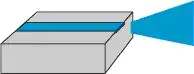
Due to the asymmetry of the emission region, the beam characteristics in the two directions are also completely different:
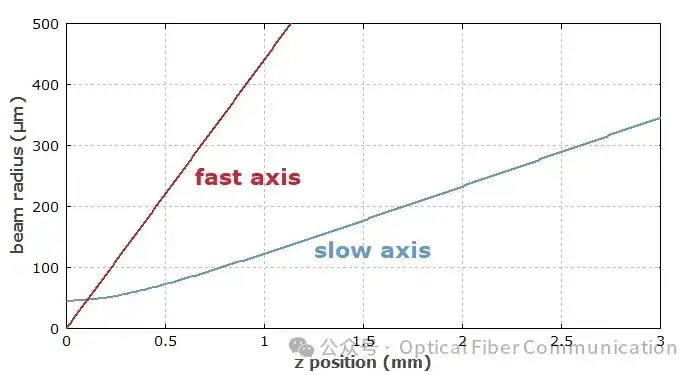
- Vertical direction (fast-axis direction): Because the height of the emission region (e.g., 1um) is small, the beam can achieve single-mode propagation in the vertical direction, thereby obtaining near-diffraction-limited beam quality, with an M2 factor slightly greater than 1. However, due to the small aperture, the beam has a larger divergence angle in this direction, with a half-angle divergence of up to 370 milliradians (equivalent to 25 degrees full-width at half-maximum). Because of this rapid divergence, this direction is called the “fast-axis direction”.
- Horizontal direction (slow-axis direction): The stripe width may be 50um, 100um, 200um or even larger, so the beam is distributed across multiple spatial modes in this direction. Although the divergence angle is larger than that of a diffraction-limited beam, it is still significantly smaller than that of the fast-axis direction (typically 5 degrees to 10 degrees full-width at half-maximum). The focusing quality of the beam is reduced; for example, the M2 factor of a 100um-wide stripe may be about 20. In addition, the intensity distribution of the beam in the horizontal direction may exhibit a multi-peak structure, and its shape may depend on the injection current.
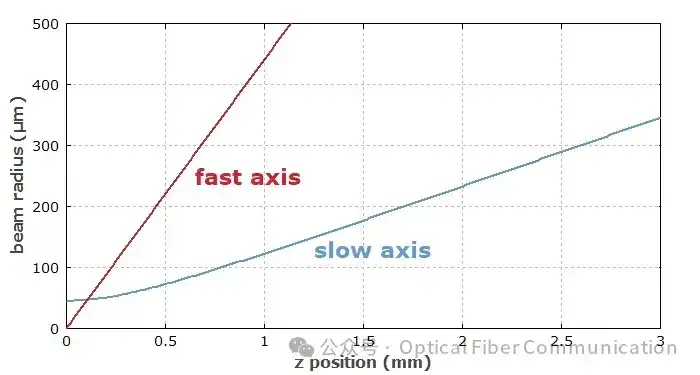
The figure below shows the change in beam radius of the broad-area laser diode output in the “fast axis” and “slow axis” directions. The beam radius in the fast-axis direction starts small but increases rapidly.
Wavefront Characteristics and Beam Quality
At the output facet, the wavefront is approximately planar in the horizontal and vertical directions, but there may be some astigmatism, meaning the focal positions in the two directions differ slightly.
The wider the stripe, the higher the achievable optical power, but the worse the beam quality in the slow-axis direction. The technical trend is to achieve higher power through narrower stripes, but this is limited by the optical intensity at the front facet (which may cause catastrophic failure) and thermal issues. Higher power can be achieved through special facet passivation techniques. For example, commercial devices with a 100um-wide aperture (such as in the 0.8um wavelength region) typically output a few watts, up to 10W. Similar devices are also available in other wavelength regions (such as 480nm blue light or 1550nm), but with generally lower performance.
Laser Resonator Structure
In most cases, the laser resonator is monolithically integrated, formed by reflection from dielectric coatings on the facets of the semiconductor chip. In a few cases, a gain chip with an antireflection coating on one side is used and placed in an external laser resonator (i.e., an external-cavity diode laser).
Handling of Asymmetric Beam Characteristics
Because of the strong asymmetry of the beam profile and the large divergence angle in the fast-axis direction, special attention must be paid to beam collimation. A common approach is to use a high-numerical-aperture cylindrical “fast-axis collimator” lens placed close to the diode facet. This lens can collimate the beam in the fast-axis direction before the beam radius becomes too large. Subsequently, a second cylindrical lens can be used at a farther distance to collimate the beam in the slow-axis direction. By choosing lenses with appropriate focal lengths, a circular beam can be obtained, but because the beam quality differs in the two directions, the divergence angles will still differ somewhat.
High-Power Output and Multimode Fiber Coupling
By combining the outputs of multiple (such as 10 to 20) broad-area emitters with suitable optical elements, higher power (hundreds of watts or even kilowatts) can be coupled into multimode fiber.
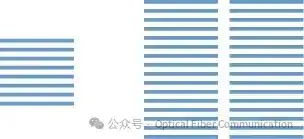
The specific method is to stack the elongated emission patterns of these diodes so that the radiation fills a nearly square region, thereby better matching the circular cross-section of the multimode fiber core. When there are many emitters, they can be arranged in two columns.
Special Features
Some diode bars have special features:
- Integrated fast-axis collimating lens: A fast-axis collimating lens may be integrated in the laser package. Because externally mounted alignment tolerance requirements are high, this integrated design is very practical. There are also laser diode modules with built-in beam collimation in both directions.
- Built-in Bragg grating: A built-in Bragg grating can stabilize the emission wavelength and significantly narrow the emission spectrum. A similar effect can also be achieved through an external volume Bragg grating.
- Tapered laser diode: This diode has a region in the propagation direction where the width and effective area increase significantly. Because of the presence of a narrow straight region, its beam quality and radiance (brightness) are better than those of laser diodes with the largest effective area width. Therefore, this diode is often called a high-brightness laser diode.
Tapered Amplifier Devices
As an alternative to broad-area laser diodes, tapered amplifiers can be used, either as part of a MOPA (master oscillator power amplifier) device or as an external-cavity diode laser. Through this technique, beam quality can be significantly improved while obtaining similar output power.
Comparison with Diode Bars
Combining multiple broad-area emitters in one device can form a diode bar, whose optical power output can reach tens of watts or even exceed 100W. However, despite higher output power, the brightness of a diode bar is lower than that of a single-emitter laser because its beam quality in the horizontal direction is lower. Therefore, when designing diode-pumped lasers, it is generally simpler to pump with broad-area laser diodes. Even for high-power lasers (including high-power fiber lasers and amplifiers), pumping with a large number of broad-area laser diodes rather than a few diode bars has some advantages. For example, unlike diode bars, broad-area laser diodes can typically be switched on and off frequently without significantly shortening their lifetime.
Application Fields
Broad-area laser diodes are commonly used to pump solid-state lasers. For example, devices with 100um or 200um-wide emitters can easily output several watts of power. Laser diodes are usually mounted on thermoelectric coolers, which allows the emission wavelength to be tuned within a range of a few nanometers to match the absorption peak of the laser crystal.
Related Reading
- Why Do Semiconductor Lasers Need Narrow Linewidth?
- Animation: What Is the Difference Between FP Lasers and DFB Lasers?
- Optical Modulation of Semiconductor Lasers!
Enjoy this article?
Subscribe to get new optical communication insights delivered to your inbox. Free, unsubscribe anytime.