Let us first draw an analogy to understand what “hybrid optical-electrical networking” is all about.
A traditional data center network is like a busy intersection, where cars (data) are increasing and the traffic lights (electrical switches) can barely keep directing them. So engineers came up with a clever idea: build a few direct “light-speed express lanes” (optical switching) next to the intersection, so that some large trucks (large batches of data) can fly straight through and relieve pressure on the main road.
This is the core idea of “hybrid optical-electrical networking”: combining the large bandwidth and low energy consumption of optical switching with the flexible responsiveness of electrical switching.

However, the optical switching “express lane” has a small drawback: it is not as “agile” as electrical switching. Once traffic suddenly surges or the route needs to be temporarily changed (that is, “burst traffic” as often mentioned in networks), optical path switching is somewhat slow and can easily cause congestion at the intersection. Therefore, how to design a more congestion-resistant road network structure (robust topology) and how to quickly find the optimal route when traffic changes suddenly (routing optimization) have become the difficult problems currently being studied with emphasis.
At present there are mainly several schools of thought, simply stated:
- The mature school: Architectures such as Helios, C-Through, Proteus, and OSA have been commercialized. They usually have moderate or low scalability, but win with stability and usability.
The Helios architecture adopts a two-level multi-root tree topology, composed of PoD switches and a core layer (electrical switches + MEMS optical circuit switch). Servers access PoD switches through copper cables, but there are problems such as limited port scale, low optical bandwidth utilization, and MEMS insertion loss.

Helios network architecture
The C-Through architecture is a hybrid architecture integrating optical circuits and packet switching, realizing optical path scheduling through centralized MEMS.

C-Through network architecture
The following is the OSA optical switching architecture, whose core innovation lies in building a dynamically reconfigurable all-optical interconnect data center network through software-defined wavelength scheduling. This architecture integrates a wavelength selective switch (WSS) and a micro-electromechanical mirror array (MEMS) to realize on-demand allocation of optical path resources.

- The innovative school: Mordia, RotorNet, Sirius, ReSAW, Sparke, ProjectOR, and FireFly are still in the experimental stage, each with its own tricks. For example, ProjectOR and FireFly do not even use optical fiber, but directly connect using “light flying in the air” (free-space optics), which is a very avant-garde idea.
The Mordia architecture is a centralized optical circuit switching prototype jointly developed by the University of California, San Diego and Google, using WSS technology.

Mordia network architecture
The FireFly architecture is a free-space optical communication scheme proposed by Stony Brook University and Carnegie Mellon University, building wireless optical links between ToR switches through rack-top mirrors, which requires precise avoidance of physical obstruction.

FireFly optical interconnect architecture
The ReSAW architecture pioneered the optical burst switching mechanism. The electrical switch identifies long packets with the same destination and schedules them to AWGR optical paths to achieve picosecond-level grooming of cross-rack traffic, avoiding the central node bottleneck.

It mainly solves the problem of how to efficiently transfer data between servers on different racks in the same data center. Its cleverness lies in letting the traditional electrical switch (equivalent to a traffic police officer at the intersection) first look at where the data packets are going, and if it finds a large batch of long packets heading to the same destination (like a convoy of large trucks), it immediately directs them to take the light-speed express lane (AWGR). This way, there is no need to spend a lot of money building a complex central scheduling hub, while allowing the existing electrical switching equipment to play a greater role.
- The software school: Lotus is quite special, mainly realizing hybrid optical-electrical control through software, with moderate scalability.
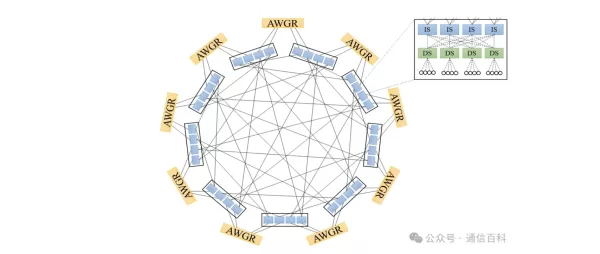
The Lotus architecture is based on a software-controlled AWGR optical backplane architecture, optimized specifically for machine learning clusters. Measured performance is significantly better than traditional topologies:

Lotus network architecture
Compared with Dragonfly and 3D-Torus, communication latency is reduced by 50%, and average throughput is improved by 5 times and 2 times respectively.
To make the differences between these schemes clearer, a large comparison table is listed below.

Finally, it must be mentioned that all these hybrid optical-electrical schemes cannot do without those precise optical components (such as MEMS, AWGR, WSS) working silently in the background. But as mentioned at the beginning, the “insufficient flexibility” of optical switching is still a hard nut to crack. When network traffic surges suddenly like morning and evening rush hours, the speed of optical path switching cannot keep up, and congestion easily occurs.
How to make these “light-speed express lanes” as flexible as ordinary roads and quickly respond to sudden traffic is exactly the hurdle that engineers will strive to overcome next. This requires smarter road design (topology) and a more intelligent traffic command system (traffic control algorithms).
Enjoy this article?
Subscribe to get new optical communication insights delivered to your inbox. Free, unsubscribe anytime.