
Polarization is a characteristic of the vibration direction of light waves. In traditional single-mode fiber, due to factors such as mechanical stress and temperature changes, the polarization state of light may change randomly during transmission, which may degrade signal quality, especially in polarization-sensitive systems.
Why does this happen, and how to solve it? Let us first briefly recall some theoretical concepts.
We know that light is an electromagnetic wave. It consists of an oscillating electric field E and a magnetic field B. The polarization direction is actually the polarization direction of the light wave, determining the vibration characteristics of the light wave in a specific plane.

Light waves can vibrate in multiple directions. Light that vibrates in only one direction is called polarized light, such as vibrating up and down. Light that vibrates in multiple directions is called unpolarized light, such as light vibrating up-down and left-right.

For ordinary single-mode fiber, the fundamental mode TEM00 that propagates is actually two orthogonal polarization modes. These two components have the same propagation constant.
Ideally, as long as the single-mode fiber is short and straight enough, it can maintain its polarization. But with even the slightest perturbation, such as external force causing uneven fiber thickness, bending, or even temperature, birefringence will be produced.
Light waves in a birefringent medium propagate at different phase velocities, causing the polarization state of the light wave to change.
This involves the principle of birefringence, which is essentially caused by the non-cubic lattice structure of optical crystals, that is, inherent anisotropy.

You may have rarely heard of birefringence, but it is essentially the same process that produces polarization mode dispersion (PMD), because fundamentally they are two aspects of the same physical phenomenon. So birefringence leads to differential group delay (DGD).
In fiber, besides external stress, birefringence can also be caused by slight asymmetry of the fiber core cross-section along the length, because the fiber core is not absolutely circular.

Therefore, normally we want the fiber to withstand the birefringent polarization perturbation caused by these external stresses or internal reasons. So what to do?
Polarization-maintaining fiber was invented for this purpose. Perhaps our first reaction is that polarization-maintaining fiber must avoid birefringence through some means.
Quite the opposite. Polarization-maintaining fiber actually makes use of birefringence, making this birefringence effect stronger. Therefore, this fiber is also called Highly Birefringent Fiber, abbreviated as HiBi fiber, which is polarization-maintaining fiber.
Some people may wonder: doesn’t birefringence cause linear polarization perturbation?
In the design of polarization-maintaining fiber, a structure with two principal axes is deliberately constructed, and the refractive indices of these two axes are different. In the direction where stress is applied, the effective refractive index of the core is higher, causing the propagation speed of light to slow down, forming the so-called slow axis, which is also the principal axis of the polarization-maintaining fiber.
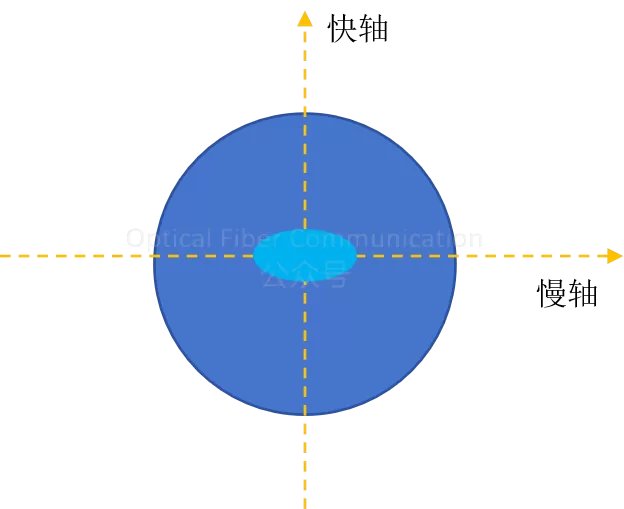
Shape-birefringence polarization-maintaining fiber
Correspondingly, on the axis perpendicular to the stress direction, light propagates faster, and this direction is called the fast axis. Only when the polarization direction of light is aligned with the fast axis can light propagate efficiently in the fiber.
Through design, there is a significant refractive index difference between the two orthogonal polarization modes inside the polarization-maintaining fiber. The fast axis and the slow axis have significantly different propagation constants. The figure above is a shape-birefringence polarization-maintaining fiber.
This difference can be geometric, such as the shape-birefringence polarization-maintaining fiber with an elliptical core design mentioned above, or more commonly realized by applying controllable uniaxial stress, which is called stress-birefringence polarization-maintaining fiber. Stress-birefringence fiber is divided into several typical geometric structures. The vast majority of polarization-maintaining fibers currently in use are based on these three designs: bow-tie, panda, and elliptical jacket structures. The bow-tie polarization-maintaining fiber is named for its unique double-loop structure, which produces different refractive indices in two directions, thereby forming the desired birefringence effect.

Bow-tie polarization-maintaining fiber
The panda polarization-maintaining fiber uses a different stress application method, with internal stress elements distributed like the eyes of a panda. This structure can also produce significant birefringence.

Panda polarization-maintaining fiber
The elliptical jacket polarization-maintaining fiber introduces stress by adding an elliptical jacket outside the fiber. This jacket has a different thermal expansion coefficient from the fiber material, and the resulting stress creates birefringence inside the fiber.

Elliptical jacket polarization-maintaining fiber
Polarization-maintaining fiber plays an irreplaceable role in fiber sensors for temperature monitoring, in precise interferometry, and in optoelectronic integrated circuits that require precise polarization. At the same time, it is becoming increasingly important in coherent optical transmission and long-distance communication. In the past, because polarization-maintaining fiber was too useful in manufacturing high-tech military equipment such as navigation systems and sonar, some Western countries were unwilling to sell it to us. However, now some domestic fiber production companies have already acquired production capability. Thanks for reading. If there are any inaccurate expressions, please forgive me, and let us improve together!
Related Reading
- Sumitomo: A Multi-Core Fiber with Low Polarization Mode Dispersion
- What Is the Propagation Path of Light in Optical Fiber?
- Optical Fiber Communication: The Structure of Optical Fiber
Enjoy this article?
Subscribe to get new optical communication insights delivered to your inbox. Free, unsubscribe anytime.