In the 400G era of data centers, there are mainly two modulation methods: PAM4 for intra-DC connections and coherent for DCI or edge interconnect.
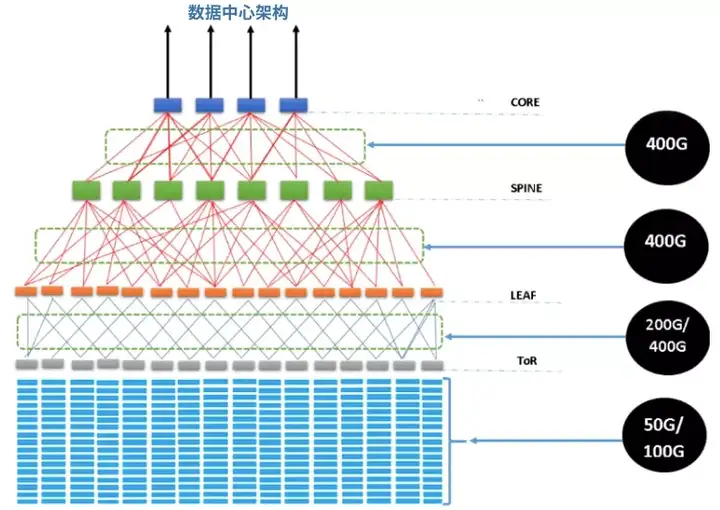
PAM4 is an intensity modulation method in which the turning on and off of the laser represents the bit rate. Different from the 2-level amplitude modulation NRZ, PAM4 is 4-level pulse amplitude modulation, where the 4 represents four different amplitude states, corresponding respectively to the four states 00, 01, 11, and 10, with each symbol representing 2 bits of information. Therefore, PAM4 running at a 53G baud rate can carry 100Gbps of data.
However, for a module using PAM4 modulation, if 400Gbps is to be achieved, four independent wavelengths as well as independent lasers, modulators, and receivers are required. Because direct modulators are used, the transmission distance is mostly relatively short. But in this scenario, fiber resources are abundant, with each fiber carrying one channel, so even multiple wavelengths are not a problem. This is also why PAM4 is mostly used for intra-DC connections at 400G.
In DCI long-distance interconnect scenarios, PAM4 seems somewhat inadequate. How to solve this? Coherent modulation based on the 400ZR protocol can operate with dual-polarization 16QAM (DP-16QAM) modulation at a baud rate of about 60Gbaud (both the phase and amplitude of the optical signal are encoded), supporting a single wavelength carrying 400Gbps or higher.
Of course, this also places higher performance requirements on the optical module laser, requiring an ultra-narrow linewidth laser, I/Q modulator, and coherent receiver. Compared with the direct modulation used by PAM4, it can transmit farther.
So, in the 800G and even 1.2T/1.6T era, which of these technologies is most competitive in data center application scenarios?
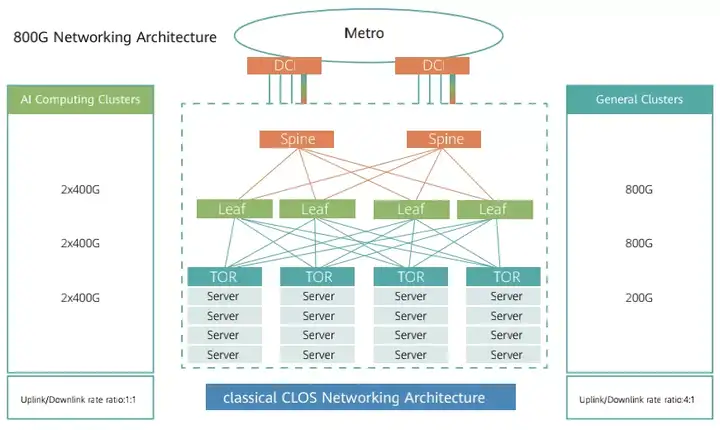
With the development of technology, PAM4’s 100G transceivers can also reach farther distances (Inphi’s ColorZ 100G transceiver). In the 800G era, the technical gap between PAM4 and coherent will become smaller. And what determines whether a technology is competitive is nothing more than cost and power consumption. Let us look at these two aspects below.
While keeping the baud rate unchanged, the simplest way to double the data rate is to replicate hardware. For example, PAM4 can use 4 or 8 wavelengths of 100G/200G, while coherent modulation can use 2 wavelengths of 400G.
Another way is to increase the baud rate. For example, doubling the baud rate to about 110Gbaud, PAM4 still needs multiple wavelengths, while for coherent modules the modulation method remains unchanged. But doubling the baud rate will bring an increase in cost. For coherent technology, it depends on whether the IQ modulator and receiver are implemented using InP or silicon photonics.
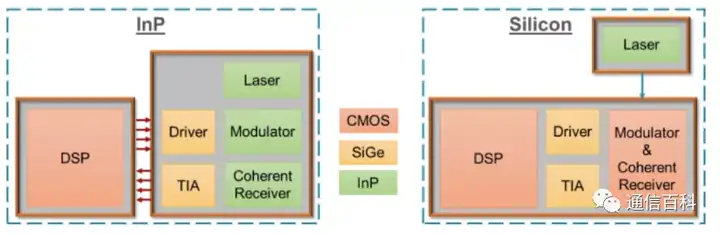
For PAM4, indirect modulation EML with a built-in indium phosphide (InP) laser can be used, or an integrated array of silicon photonics modulators and an InP laser array. But whether it is PAM4 or coherent technology, InP modules are more expensive, while silicon photonics is cheaper.
In addition, in terms of power consumption, as chip technology evolves from 7nm to 5nm, and even 3nm, it is not only the DSP processing rate that improves, but also the performance in reducing power consumption is increasingly excellent, as shown in the figure below. The relationship between DSP power consumption and CMOS for coherent modules and PAM4 transceivers.
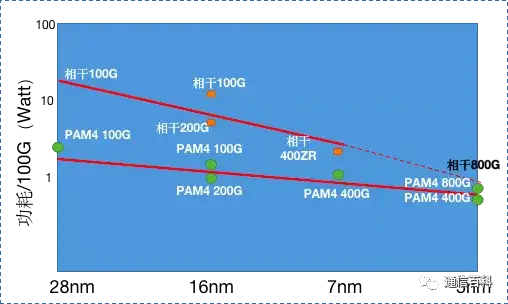
It can be seen that at the 100G rate, the power consumption of PAM4 is nearly 10 times lower than that of coherent modules, but this difference has become less obvious at the 800G rate using 5nm CMOS.
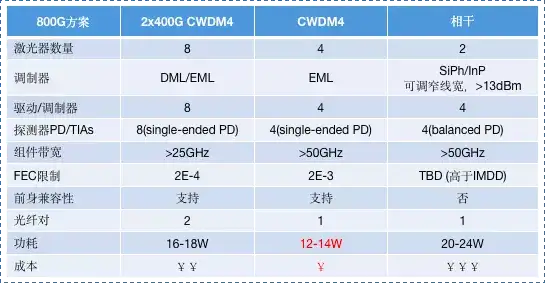
However, in the 800G PLUGGABLE MSA white paper on single-channel 200G 800G/1.6T, it is believed that modules based on 200G-per-channel direct modulation detection have lower cost, lowest power consumption, and highest cost-performance, as shown in the figure below.

Related Reading
- Ciena: 800G and Higher-Rate Coherent Pluggable Optical Modules
- MSA’s 800G Optical Module – Technical Analysis of 8x100G in SR Scenarios
- 600G or 800G?
Enjoy this article?
Subscribe to get new optical communication insights delivered to your inbox. Free, unsubscribe anytime.