We always hear about white-light modules, gray-light modules, and colored-light modules. What exactly are they and what are the differences? Today let us talk about them. Before discussing gray light and colored light, let us first look at what white light is.
White light is defined as mixed light of different colors, containing all colors (wavelengths) in the spectrum, such as ultraviolet light, visible light, and infrared light, so it has the highest luminance and is called “white light.” Gray light and colored light are also discussed within this range, except that the range is in the near-infrared region. So what are gray light and colored light respectively?
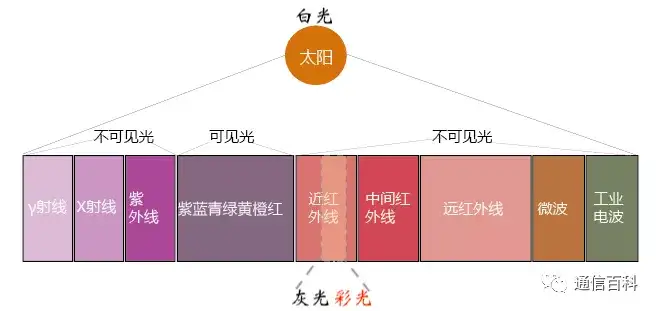
As we all know, the earliest technologies used in optical transmission systems are PDH/SDH. In the optical path of PDH/SDH, one fiber transmits only one signal at one wavelength, like one large lane running only one car. The wavelength of this signal has no strict requirement on the center wavelength, only whether it fluctuates within the low-loss window. The fluctuation range of the wavelength is generally around +/-40nm, for example, as long as it is within the 850nm window, 1310nm window, or 1490nm, 1550nm window. This kind of light is called gray light.

It can be said that, similar to white light, gray light also has an undefined wavelength within a certain range, except that it does not have as wide a range as white light. Therefore, gray light is sometimes also called white light, or black-and-white light.
Gray light is mainly defined by ITU-T G.957, ITU-T G.691, ITU-T G.959.1, and IEEE 802.3.
- G.957 defines gray light interfaces for rates such as STM-1, STM-4, STM-16;
- G.691 defines the STM-64 gray light interface, where G.691 is an extension of G.957;
- G.959.1 defines the specifications for client-side signals 2.5G, 10G, 25G, 40G, as well as PAM4 50G and other inter-domain gray light interfaces;
- IEEE 802.3 defines interfaces for various Ethernet rates.
What characteristics does gray light have? Let us use an analogy: gray light is like the sight of a shotgun. As long as it is within this range, it can hit (transmit), but it cannot shoot far, which is the same as gray light being suitable for short-distance scenarios.

In application scenarios, the light emitted by the client-side optical modules of switches, routers, SDH networks, and the WDM/OTN discussed below is all gray light. At the same time, gray light generally has a certain correlation with the optical transmission window. For example, 850nm is generally short-distance, 1310nm is short/medium-distance transmission, while the 1550nm window is generally used for long-distance and ultra-long-distance transmission.
Gray light also has an important scenario: it is generally also used for inter-vendor interconnection. This is much easier than the colored light interconnection discussed below.
Next, let us look at what colored light is.
Is colored light the same concept as the seven single colors of red, orange, yellow, green, cyan, blue, and violet separated after natural light passes through a prism? These truly colored lights in a rainbow are essentially mixed light and visible light, which is not the same thing as colored light in communication. Colored light in communication refers to light of a single wavelength/frequency.
To meet the horizontal compatibility with the original transmission system interface, I think the concept of colored light has already appeared in ITU-T G.692, which specifies the frequencies and wavelengths of the C/L band with 80 channels (50GHz spacing) at the nominal center frequency, except that the rates are relatively small.
In WDM systems, the optical module on each line side emits light that conforms to the wavelength frequency specified in the standard protocol. The light here is what we call colored light, and different wavelengths of light are transmitted in the same fiber through a multiplexer/demultiplexer. It is like dividing a large lane into many small lanes, as shown in the figure below.
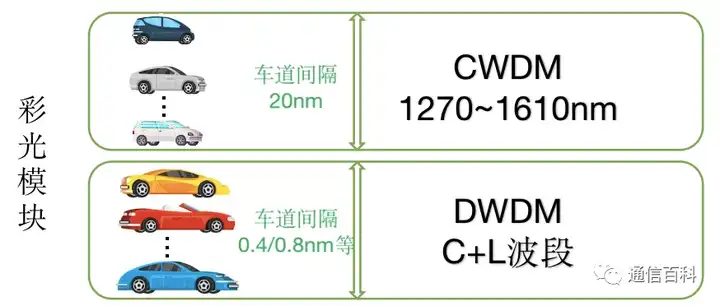
In the G.694x protocol, colored light modules can be divided into CWDM (coarse wavelength division multiplexing) colored light modules and DWDM (dense wavelength division multiplexing) colored light modules according to the wavelength spacing. Among them, CWDM has a wavelength spacing of 20nm, and DWDM has a wavelength spacing of 0.8nm/100GHz (with other spacings such as 0.4nm).
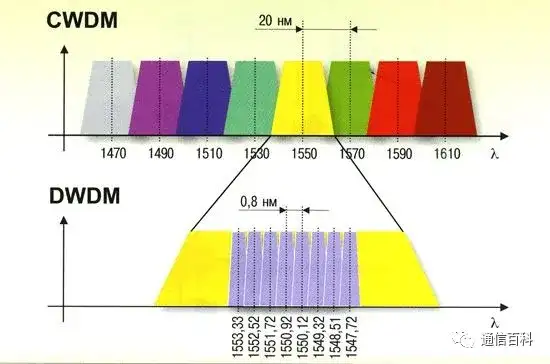
DWDM colored light modules are defined in the ITU-T G.694.1 standard, while CWDM colored light modules are defined by the ITU-T G.694.2 and G.695 standards. G.694.2 defines the center wavelengths of CWDM, and G.695 defines its optical parameter values and describes the optical physical layer, as well as how to convert non-standard wavelengths to colored light wavelengths (for example, converting 1310nm gray light into a single-wavelength colored light signal in CWDM through optoelectronic-optical conversion).
The above standard protocols fix the center frequency point of colored light at a single point, and the deviation of the center wavelength is relatively small. For example, the maximum center frequency deviation of DWDM at 100GHz spacing is +/-20GHz. This is like installing a sight on an AK (CWDM is equivalent to not installing a sight).

So how do gray light and colored light convert and interconnect?
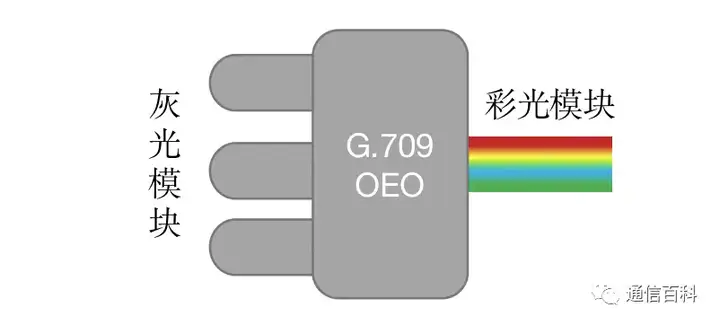
Strictly speaking, directly connecting a gray light module to a colored light module through optical fiber cannot achieve interconnection. Because one emits point light and the other emits scattered light, the center frequencies are different, and of course there are also limitations such as modulation and packaging. Therefore, in the G.709 protocol, the encapsulation and mapping scheme for converting client-side gray light to line-side colored light in OTN networks is defined.
In terms of cost, colored light modules are generally more expensive than gray light modules, because gray light only requires the laser to emit light within the low-loss window. Colored light modules need to constrain the center frequency of the laser emission within a certain accuracy (maximum center frequency deviation), and also control the temperature (TEC) to ensure the stability of its wavelength. DWDM colored light modules are stricter than CWDM colored light modules.
Of course, this also involves specific laser devices. For example, direct modulation DML lasers such as VCSEL/FP/DFB are cheaper (lower rate, shorter distance), while indirect modulation EML lasers are more expensive (higher rate, longer distance). Therefore, for how to choose gray light and colored light modules, it mainly depends on the specific application.
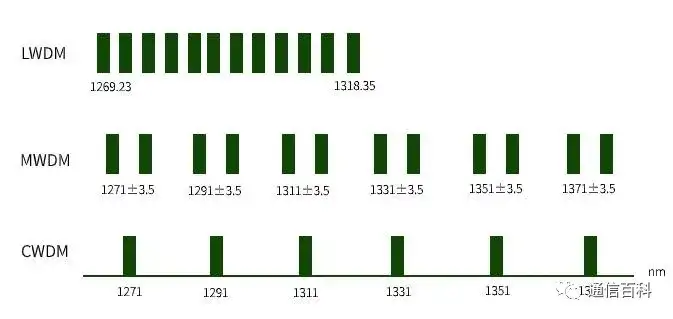
For example, in 5G fronthaul, we also have gray light solutions and colored light solutions. Among them, CWDM6 (6 wavelengths), LWDM (12 wavelengths), and MWDM12 (12 wavelengths) can all transmit multiple wavelength signals in one fiber, which are colored light solutions. So the colored light solution in 5G fronthaul can effectively save fiber resources, which is especially suitable for scenarios with scarce fiber resources.
Therefore, we usually choose gray light modules in scenarios with short distances and abundant fiber resources, and colored light modules in places with long fiber distances and insufficient fiber.
Enjoy this article?
Subscribe to get new optical communication insights delivered to your inbox. Free, unsubscribe anytime.