Data center expansion is shifting from “pushing single-lane rates as high as possible” to “splitting the bandwidth for parallel use” — for example, using eight 50 Gb/s wavelengths in parallel. This creates market demand for large-volume, precisely wavelength-aligned multi-wavelength light sources, giving rise to the CW-WDM MSA. This 4-minute video explains several multi-wavelength light source schemes. Watch the video first, then review the key points below.
Two Main Categories
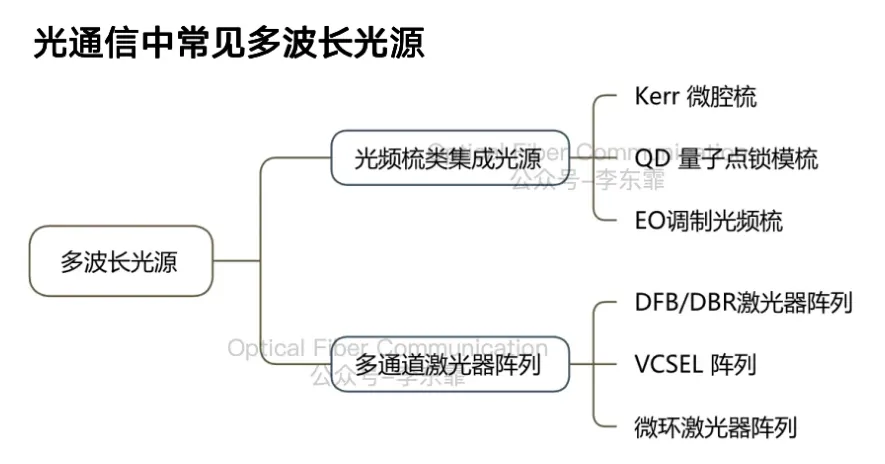
Multi-wavelength light sources currently fall into two categories. One is optical-frequency-comb integrated sources, which use a single source to generate multiple wavelengths, including Kerr microcavity combs, QD quantum-dot mode-locked combs, and EO-modulated optical frequency combs. The other is multi-channel laser arrays, where each wavelength has its own independent gain laser, including DFB/DBR laser arrays, VCSEL arrays, and microring laser arrays.
Kerr Frequency Combs and Soliton Mode Locking
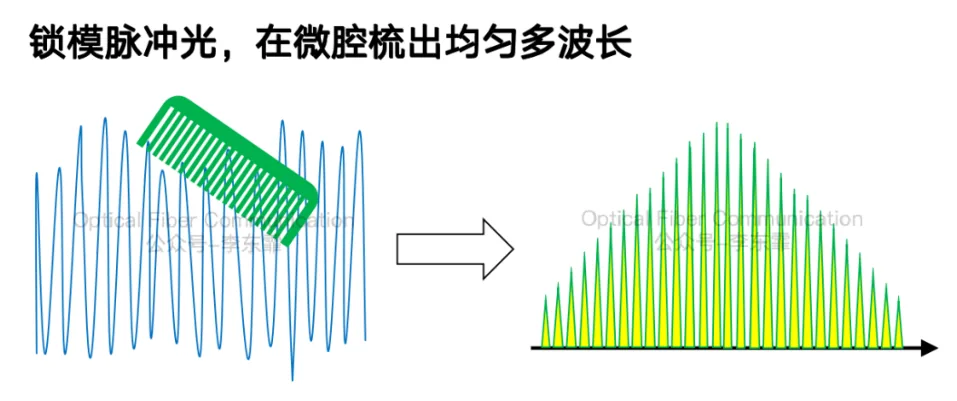
Kerr frequency combs exploit the Kerr nonlinearity in a microcavity to generate equally spaced new wavelengths step by step through four-wave mixing and cross-phase modulation under strong pump light, broadening a single pump laser into a broadband optical frequency comb. However, the initially generated comb has chaotic phase relations and high noise, requiring soliton mode locking — once mode-locked, the frequency components maintain a stable phase relation, forming a train of stable ultrashort optical pulses (dissipative temporal optical solitons) in the time domain, like straightening tangled hair into evenly spaced strands.
How to Choose Among the Three Comb Types
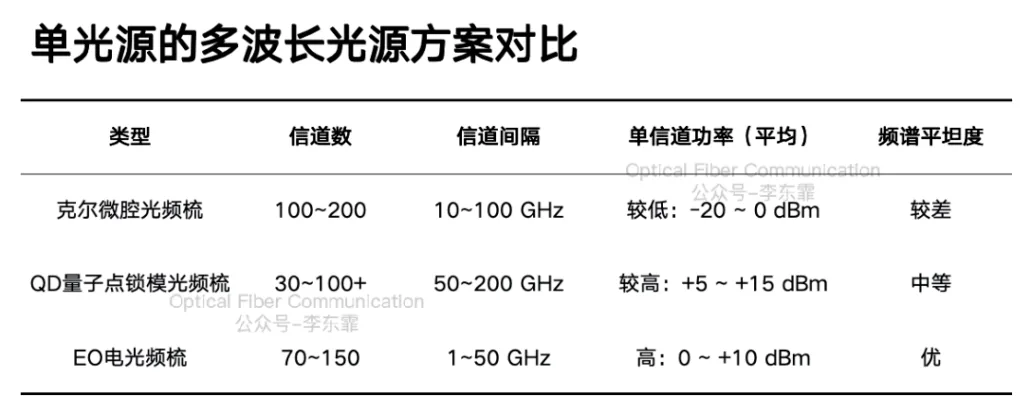
Among single-source schemes, the Kerr microcavity comb has the most channels (100-200), but lower per-channel power and poorer flatness; the quantum-dot mode-locked comb is electrically pumped and heat-tolerant, eliminating the TEC and isolator, and is well suited to short-reach data center interconnect; the EO comb has good coherence and flat comb-line power, making it a very clean source for coherent transmission, though it requires RF drive and consumes more power. In addition, DFB laser arrays achieve continuously tunable wavelengths by changing the grating period or waveguide refractive index, combined with TEC temperature control or injection-current tuning.
Video produced by this site, narration by Li Dongfei. Drag the progress bar to see a specific section.
Related Reading
- Optical interconnect toward 3.2T: some issues and ideas at 425G/lane
- Fudan University: latest progress in MicroLED optical interconnect
- ZTE: reliable installation and heat dissipation for CPO external light sources
Enjoy this article?
Subscribe to get new optical communication insights delivered to your inbox. Free, unsubscribe anytime.