There are two approaches to increasing optical network transmission rates: one is power-density cost optimization, and the other is performance optimization.
Power-density cost-optimized solutions use standard pluggable technology. They have excellent performance and are the industry workhorse for most applications. Performance-optimized solutions use proprietary technology, aiming to maximize bit throughput under given fiber conditions. They are mainly used in application scenarios requiring “longer distance” transmission, such as DCI (data center interconnect) and submarine transmission.
The latest achievement in performance optimization is single-wavelength 800G technology and its commercial viability. For this, we have two ways to achieve 800G, both using a single optical channel. We call them Method A and Method B here, and their main difference lies in the relationship between the carrier and the optimal channel bandwidth.
Method A: Uses two high-speed carriers, each capable of achieving up to 600G bandwidth, and a flexible channel width of up to 150 GHz.
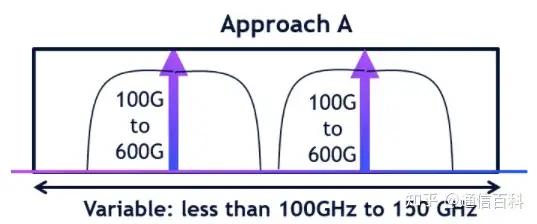
Method B: Uses a single ultra-powerful carrier capable of achieving up to 800G bandwidth, with a constant channel width just over 100 GHz.
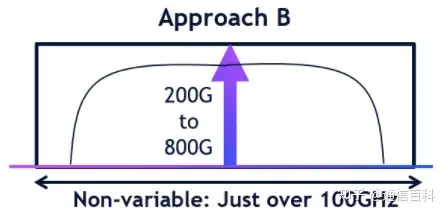
Using a speedboat design as an analogy, Method B is equivalent to a speedboat where all power comes from a single engine, while Method A splits the power into two engines.
Both methods can achieve 800G transmission in a single channel. To compare them, we look at two practical criteria:
1) Do they have the ability to carry the latest generation of high-speed 400GbE client traffic?
2) How well do they handle fixed-grid and flexible-grid network applications.
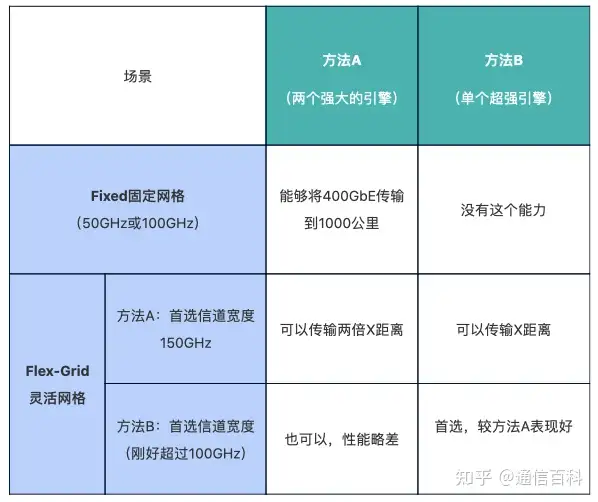
Here we mainly discuss the second point. Whether the new technology is compatible with existing fixed networks is very important, that is, whether it can be applied to the current 50 GHz and 100 GHz fixed-spacing WDM optical fiber systems. The reason Method A above can be applied to these networks is that it uses two carriers, each of which can fit into a 50 GHz channel. Two 400G carriers can carry two 400GbE clients for about 200 km, or two 200G carriers can carry one 400GbE client for more than 1000 km. However, Method B completely does not support this deployment because it is based on a fixed-carrier scheme with a channel width greater than 100 GHz.
Let’s look at flexible-grid networks again; both Method A and Method B can be used. Here it depends on the channel spectrum width used. If the preferred channel width is 150 GHz, Method A has an advantage over Method B, carrying two 400GbE client services at 2.5 times the distance of Method B. This is because the OSNR of two 400G carriers within 150 GHz is far smaller than the OSNR of a single 800G carrier above 100 GHz.
But on the optimal channel just over 100 GHz, such as 112.5 GHz, Method B performs somewhat better, with distance further increasing by about 20%. That is, with a narrower channel width, Method B is more spectrally efficient.
As we approach the Shannon limit infinitely, increasing the rate becomes very difficult, so we must deeply study different application scenarios to understand the relative pros and cons of different methods. Finally, to summarize, the comparison of Method A and B above in different 800G transmission scenarios.
Related Reading
- 800G Optical Module MSA: Technical Analysis of 8x100G in SR Scenarios
- 600G or 800G?
- Data Center 800G: PAM4 or Coherent Technology?
Enjoy this article?
Subscribe to get new optical communication insights delivered to your inbox. Free, unsubscribe anytime.