Since the invention of optical fiber decades ago, we have been trying every means to increase the capacity transmitted by optical fiber links. In the early days of optical communication, although single-wavelength on-off keying (OOK) modulation (turning the laser on and off to represent “1” and “0”) significantly improved the performance of previous electrical signal transmission, it only improved a small portion of the performance of optical fiber transmission.
Why do we say this? Because at this time, single-wavelength single-mode optical transmission only operated in the low-rate Gbps range, and the transmission capacity was defined by that single-wavelength data rate. They did not require light of a specific wavelength or frequency, and optical transceivers with this characteristic were also called “gray light.” If longer transmission distance was needed, it had to be achieved through optical-electrical-optical regeneration.

So how can large-capacity transmission be achieved?
The following two major technological advances played an important role in meeting large-capacity transmission needs.
- Multiplexing optical signals of different wavelengths into the same fiber for transmission, i.e., Wavelength Division Multiplexing (WDM) technology;
- Coherent transmission uses digital signal processors (DSP) to more effectively modulate and detect multiple levels of the phase and amplitude of the laser on both polarizations, thereby improving spectral efficiency.
Let’s first look at WDM technology.
In the 1980s, with the invention of the erbium-doped fiber amplifier (EDFA), a major breakthrough accelerated optical network deployment. The EDFA could amplify all wavelengths within the 1550 nm low-loss window in the optical domain, meaning a single amplifier could amplify multiple wavelengths within the window. Thus, for long-distance transmission of optical signals, so many expensive regeneration boards were no longer needed for electrical regeneration.

Around the same time, the design of lasers and wavelength stabilization technology also matured, allowing multiple wavelengths to be densely packed in the same 1550 nm window. Through EDFA and stable lasers, WDM entered the era of Dense Wavelength Division Multiplexing (DWDM) and remains the mainstream technology of optical transmission to this day.

It can be said that the invention of the EDFA greatly promoted the application of DWDM in optical networks, especially in submarine and long-distance backbone and metro networks. In 1995, DWDM commercially deployed an 8-wave x 2.5 Gbps WDM network, and by 1999, a 40-wave x 10 Gbps WDM system had been successfully deployed.
To achieve long-distance transmission, various new technologies were adopted in the above fiber links to overcome various dispersion effects produced by the interaction between the laser and the fiber medium. For example, in terms of dispersion compensation, dispersion-shifted fiber or passive dispersion compensator modules were mainly used. Of course, this dispersion limitation was already solved in the 100G/B100G era.
In addition, affected by fiber nonlinearity and the limitations of directly modulated lasers and direct detection detectors, the OOK modulation method used at this time could only support WDM networks at a maximum rate of 10 Gbps per wavelength, and as the rate increased, the spectral width of the OOK channel also increased. At the same time, due to the frequency change between ‘1’ and ‘0’, chirp was inevitable. The existence of chirp broadened the spectral bandwidth of the laser’s emitted spectrum, degrading the spectral characteristics of the light source, limiting the system’s transmission rate and distance; it was suitable for short-distance transmission.

Around 2000, phase modulation was introduced, enabling Differential Phase Shift Keying (DPSK) and Differential Quadrature Phase Shift Keying (DQPSK) to transmit at 40 Gbps per wavelength. These schemes could also utilize existing direct detection receiver technology. However, under the same physical conditions, 40G systems were limited by PMD, dispersion, and nonlinearity; to achieve the same performance as existing DWDM 10G, they had to have:
- Improved error correction capability against white noise, reducing the system OSNR requirement by 6 dB;
- Advanced coding and modulation technology to comprehensively improve transmission performance;
- Reduced limitations in OSNR, PMD, nonlinearity, dispersion, and other aspects;
- New dispersion management technology (such as ADC) to improve dispersion tolerance and reduce nonlinearity.

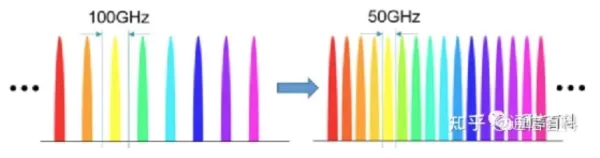
In addition, ITU played a very important role in the standardization and commercialization of DWDM. For example, in 2002, ITU released the frequency grid plan for DWDM transmission, which is the familiar ITU-T G.694.1 recommendation. The standard defined grid intervals of 100 GHz, 50 GHz, and 25 GHz, with a granularity of 12.5 GHz. As shown below.

In the initial stage of DWDM, a frequency spacing of 100 GHz was used, with a wavelength interval of about 0.8 nm. This interval was relatively wide, allowing lasers and passive filters to be mass-produced with sufficient margin. Through standardized DWDM design, operators’ networks could freely add and drop wavelengths and services at required nodes.
Of course, at this time these nodes relied on FOADM, that is, fixed optical add-drop multiplexers, for add/drop multiplexing. These operations also needed to be done manually. For example, when the wavelength changed, it was necessary to manually connect the service board to the M board and connect the pass-through wavelength fibers. Later, with the invention of tunable lasers or filters, we could remotely change the transmit wavelength of the service board through commands on the network management system, without having to go on-site to change the pigtail.
With technological development, that is, more stable lasers and optical filtering technology, DWDM technology could reduce the interval between adjacent wavelength channels, shrinking the frequency interval from the original 100 GHz to 50 GHz (50 GHz is about 0.4 nm). Compared with networks using 100 GHz intervals, the transmission capacity of DWDM systems doubled.

Next, let’s talk about the role of coherent technology in the capacity of optical transmission systems.
As mentioned earlier, 10G and 40G non-coherent WDM networks were severely affected by fiber dispersion and needed dispersion compensation to transmit longer distances. Around 2010, the CMOS integration of high-speed data converters and DSPs made coherent optical transmission systems feasible, and coherent optical transmission technology emerged.


Coherent technology can compensate for signal dispersion in the electrical domain through algorithms, achieving 100G and B100G long-distance transmission capability, but its modulation scheme is much more complex than OOK, DPSK, and DQPSK.
Early coherent schemes used fixed modulation order and fixed baud rate for transmission. With the advancement of DSP technology, software-programmable modulation order and baud rate became achievable, which is what we now call the SDO function, providing the ability to handle multiple applications with common hardware. For example, higher-order modulation such as QPSK (2 bits per symbol), 16QAM (4 bits per symbol), and 64QAM (6 bits per symbol) provides methods for greater data transmission capability.

At the same time, the system transmission capability can also be improved by increasing the rate at which these symbols are transmitted, that is, the baud rate. Of course, modulation and baud rate have a dialectical relationship in terms of transmission capacity and transmission distance. Overall, higher modulation orders provide increased capacity at the cost of reach, while lower modulation orders can transmit farther but with reduced capacity. To improve the performance of coherent transmission, technologies such as probabilistic shaping have also been developed to adjust the probability and position of coherent constellation points to optimize reach and capacity.
At this point, although coherent technology can be applied to traditional 100 GHz/50 GHz channel fiber line systems, as our title says, optical transmission has always been seeking greater capacity. Besides higher-order modulation and baud rate, increasing the number of DWDM channels in a single fiber is also one of our efforts. This also places higher requirements on coherent modulation to achieve higher capacity and transmission distance. That is, we need more flexible frequency and wavelength spacing to support the transmission of various coherent modulations, no longer limited to 50 GHz/100 GHz spacing. At the same time, the transmission window is no longer limited to the current C band.
Let’s first talk about flexible spacing. To meet flexible frequency spacing, Wavelength Selective Switch (WSS) technology came into being. Compared with traditional FOADM fixed add-drop systems, WSS forms a Reconfigurable Optical Add-Drop Multiplexer (ROADM).

Such ROADM systems can specify the addition and deletion of wavelengths through software control, with one-time fiber connection that lasts. At the same time, WSS technology can also make the frequency spacing of our transmission network tunable, supporting the flexible-grid DWDM grid rather than fixed 50 GHz or 100 GHz networks, thereby allowing different coherent modulations with different spectral widths to be transmitted on the same fiber.

To address this need, ITU-T revised G.694.1 to meet the planning and design of flexible-grid networks. At the same time, in 2017, the Optical Internetworking Forum (OIF) also proposed a framework to help develop flexible coherent DWDM transmission, including 37.5 GHz, 50 GHz, 62.5 GHz, and 75 GHz channels.
Solving the flexibility of frequency spacing is to meet the high spectral width requirements of high-rate coherent modulation. But to increase the capacity of the entire system, expanding the optical transmission window is also one of the directions we must consider. Especially because high baud rates bring wide spacing, spectrum expansion is particularly important. Therefore, the L band, one of the transmission windows with the smallest attenuation, has become the first choice for spectrum expansion.

Let’s do a simple analysis. For example, with PM-16QAM and 75 GHz spacing. If the C band is used, the spectrum resource is 4 THz, which can only transmit 53 waves, with little significance. After expanding to the CE band, the spectrum resource increases by 20% to 4.8 THz. If the C++ band is used, it is 6 THz. If the C+L band is used, it is 8/12 THz, improving the spectrum resource by 2-3 times compared to the C band. However, limited by the optical amplification spectrum width, using the C+L band requires two sets of fiber line systems.

Thanks to the above technological advances, since the 1980s, the capacity of optical fiber transmission has multiplied many times. The latest transmission solutions have approached the practical limit of fiber capacity. But operators need to plan and design their networks in the most cost-effective way, balancing factors such as transmission distance and system capacity, rather than blindly expanding system capacity.

Enjoy this article?
Subscribe to get new optical communication insights delivered to your inbox. Free, unsubscribe anytime.