
In the early 1980s, the rate of telephone modems was always 9.6 kbps; if this speed were increased, serious problems would appear on the line. To address this problem, a new error-correcting code was developed that could increase the modem rate by 1/4. This raises three questions: is there a better error-correcting code to further increase the rate, to what level can the speed be increased, and what is this error-correcting code.
In fact, Shannon answered the first two questions back in 1948: a communication system has a highest system capacity, now generally called the Shannon limit, and there also exists an ideal error-correcting code that allows the system capacity to approach the Shannon limit. Of course, Shannon’s groundbreaking work in 1948 did not answer the third question, or his answer to the third question was not very realistic.
Before this, Nyquist solved the noiseless system-capacity problem. On the basis of Nyquist and Hartley, Shannon proposed the system capacity of an additive-Gaussian-noise system from a probabilistic perspective. Because real communication systems always have noise, the capacity of a communication channel is mainly determined by two factors: the channel bandwidth and the channel’s signal-to-noise ratio.
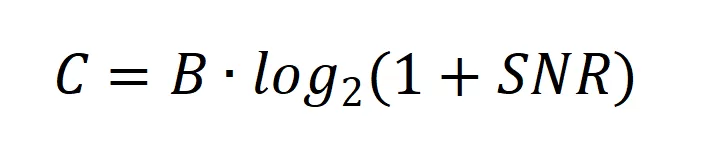
For an optical fiber communication channel, B is the optical bandwidth in Hz occupied by the channel, and C is the theoretical upper limit of the system information rate in bit/s. The communication channel here corresponds to one polarization state in one mode of one operating wavelength in one fiber core. Based on this brilliant work, for optical communication, the theoretical upper limits of the information rates for the commonly used communication bands C, L, and S are determined. Some of the work in the past and over the next period of time has been to improve the system communication capacity and continuously approach the Shannon limit. For a system, spectral efficiency may be more important, and its theoretical upper limit is as follows.
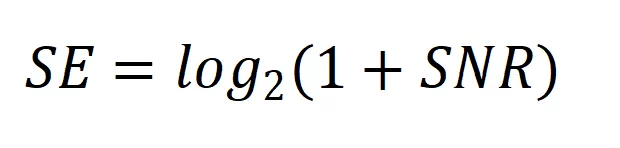
The improvement of spectral efficiency drives the improvement of the overall system. System capacity and spectral efficiency are two relatively important indicators for measuring a system. For a single communication channel, due to the extremely concise expression of the Shannon limit, it is easy to know how the theoretical upper limit of its information rate changes with the signal-to-noise ratio. This work has not only guided the direction of efforts over the past half century but is likely also an area of innovation for a long time to come.
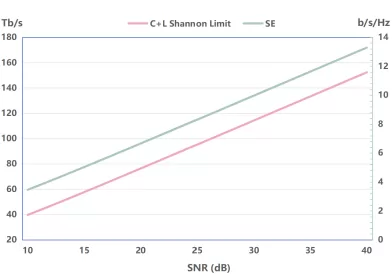
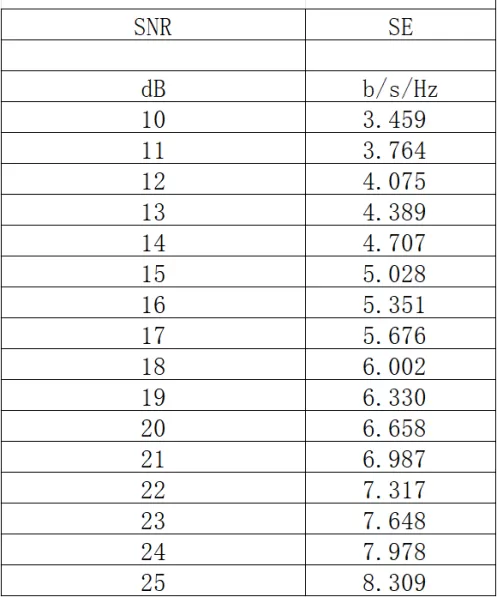
It can be seen that when the system signal-to-noise ratio doubles, the spectral efficiency increases by about 1 bps/Hz; of course, it does not double.
As of now, the overall system capacity improvement is still roughly carried out from five aspects: baud rate, modulation format, dual polarization, wavelength-division multiplexing, and space-division multiplexing.
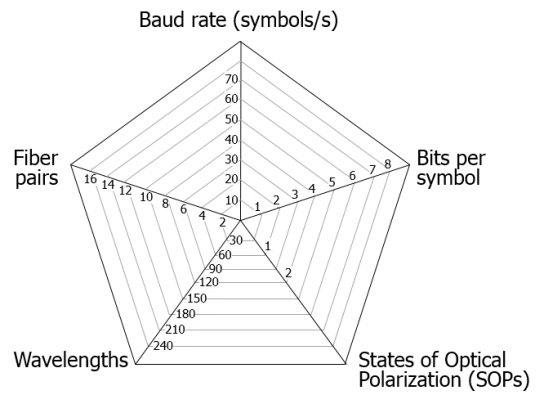
1. Increase the baud rate, which naturally involves work on both the optoelectronic system and the optical fiber. 2. Not only adopt higher multi-level modulation formats to increase the number of bits per symbol, but also further approach the Shannon limit through technologies such as probabilistic constellation shaping, geometric shaping, and hybrid shaping. 3. Wavelength-division multiplexing, expanding the operating wavelength range and increasing the number of information channels. – Expanding the operating wavelength range from the C-band to the C+L band, and the current new capacity records have all expanded from the C+L band to the C+L+S band. This involves hybrid amplification schemes; basically, for the C+L band, distributed Raman and erbium-doped fiber hybrid amplification is used, and for the S-band, distributed Raman and thulium-doped fiber hybrid amplification is used. – This also involves the balance between single-wavelength baud rate and carrier spacing. 4. Polarization multiplexing; dual polarization doubles the capacity. For the Shannon limit, it mainly limits a single polarization, so dual polarization doubles the theoretical upper limit of the system capacity. 5. Space-division multiplexing – increasing the number of fibers. – Multi-core fiber: each core is treated as an independent communication channel, so the fiber capacity is multiplied by the number of cores per fiber. – Few-mode fiber or multimode fiber: each fiber mode is treated as an independent communication channel, and the fiber capacity increases linearly with the number of spatial modes. From the 1990s to around 2017, it can be seen from submarine cable systems that the system capacity showed an exponential rapid increase under the efforts of these five aspects.
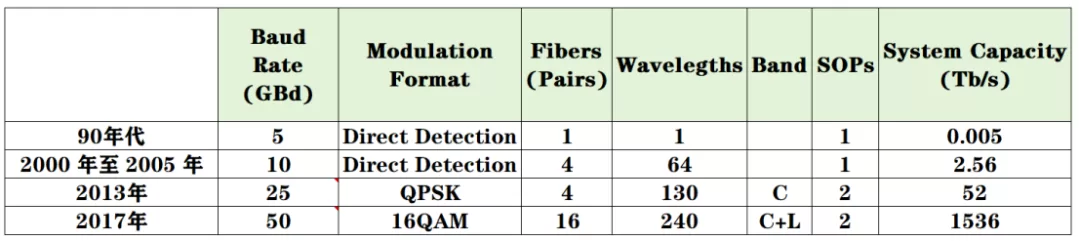
Of course, it can be seen that there is still considerable room before reaching the Shannon limit. The records of the last three years have also been continuously improving, and the system capacity, under different optimization angles, especially the optimization of modulation formats, has further approached the Shannon limit. In particular, frequency efficiency and single-channel capacity are improving significantly.
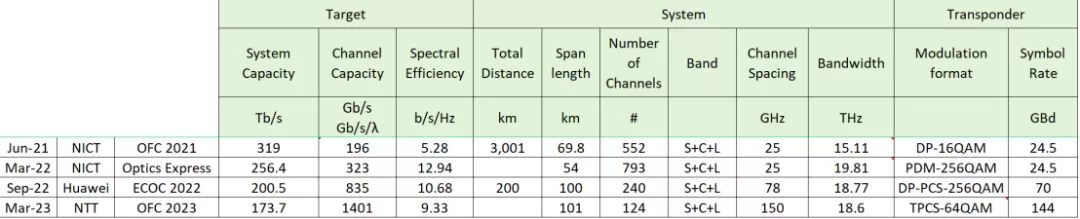
First, the optical channels have all expanded from C+L to S+C+L, but in the S-band, hybrid amplification still has some challenges, or semiconductor amplification may achieve a breakthrough here, at least reaching flat amplification efficiency equivalent to C+L. It can be seen that in each record, the modulation format, baud rate, and channel spacing all have some differences. Since the literature does not record in detail the type and parameters of the fiber, input power, and optical signal-to-noise ratio, it is difficult to judge whether the channel capacity can be further improved through fiber optimization and system nonlinearity optimization. Of course, since the literature is probably all completed in the laboratory, the actual fiber loss should be somewhat higher, which will sacrifice part of the system capacity or bring a certain power penalty.
Related Reading
- What Is the Transmission Path of Light in Optical Fiber?
- Optical Fiber Communication: The Structure of Optical Fiber
- Optical Fiber Communication: Mode Field Diameter and Cutoff Wavelength
Enjoy this article?
Subscribe to get new optical communication insights delivered to your inbox. Free, unsubscribe anytime.