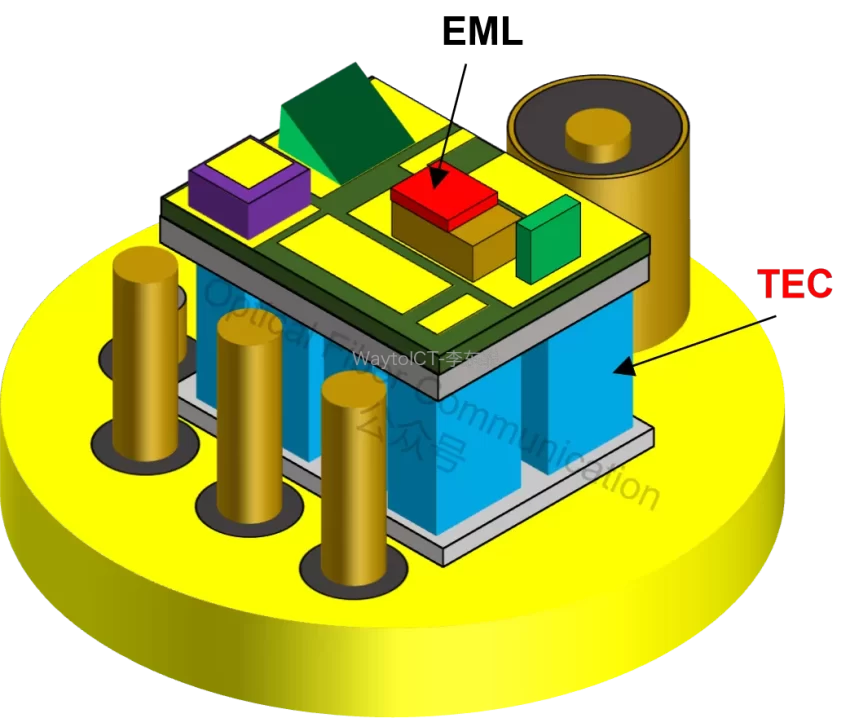
The EML lasers we usually see all have a TEC in their structure.
For example, in this kind of TO package, the side of the TEC is closely attached to the thermally conductive substrate, and the EML chip is then attached through the substrate.
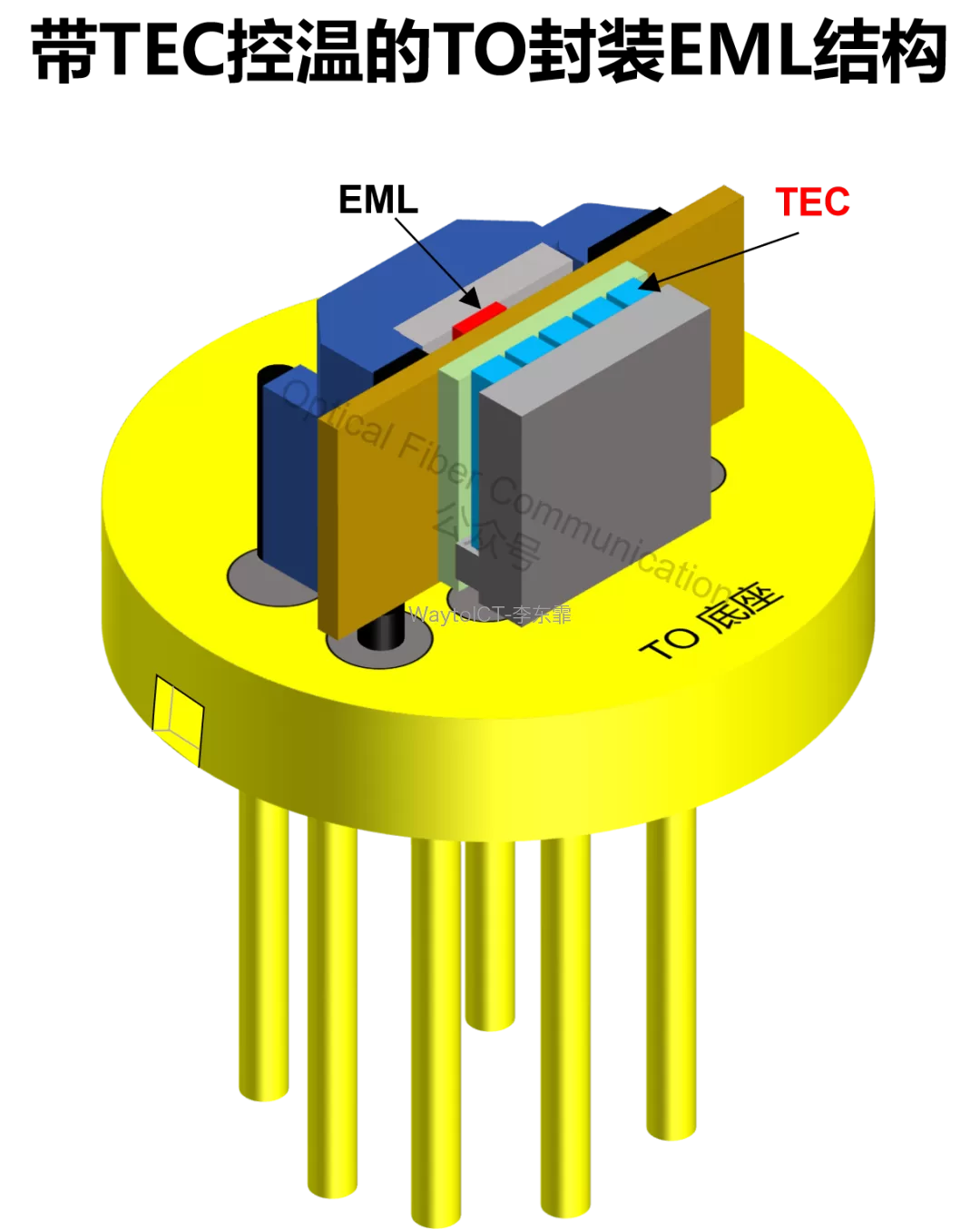
There is also a structure like this:
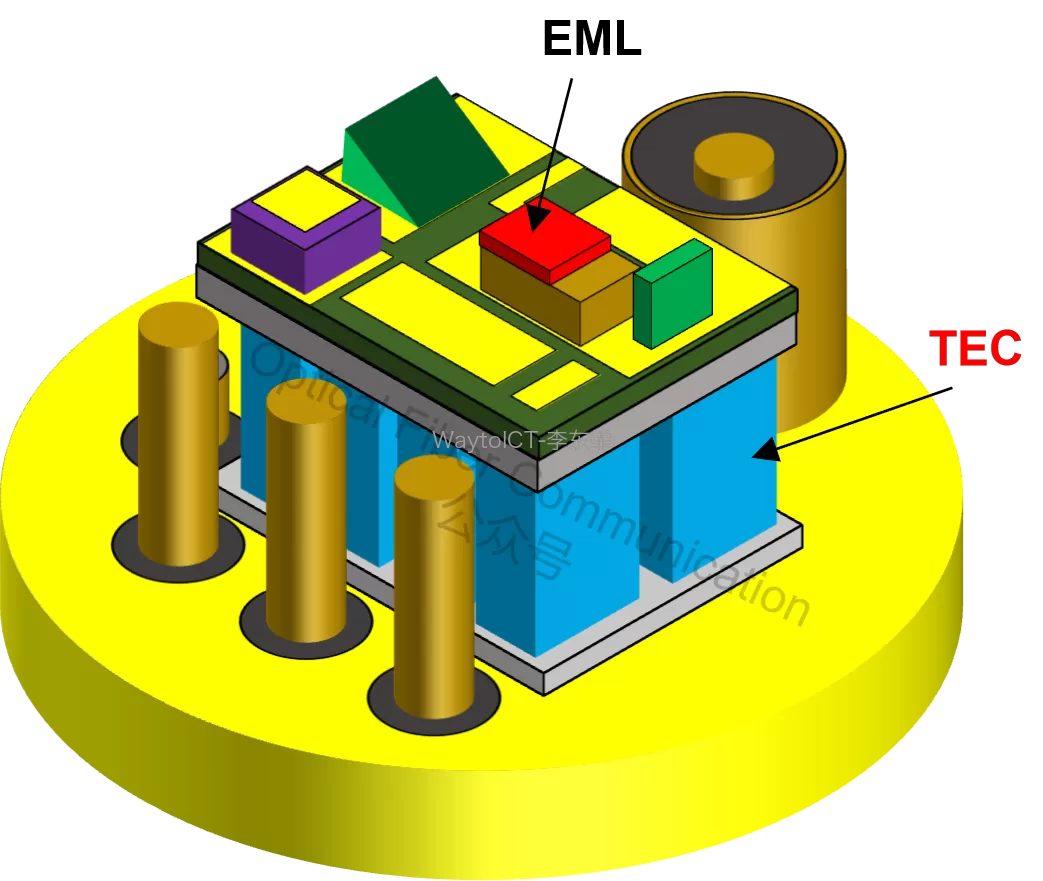
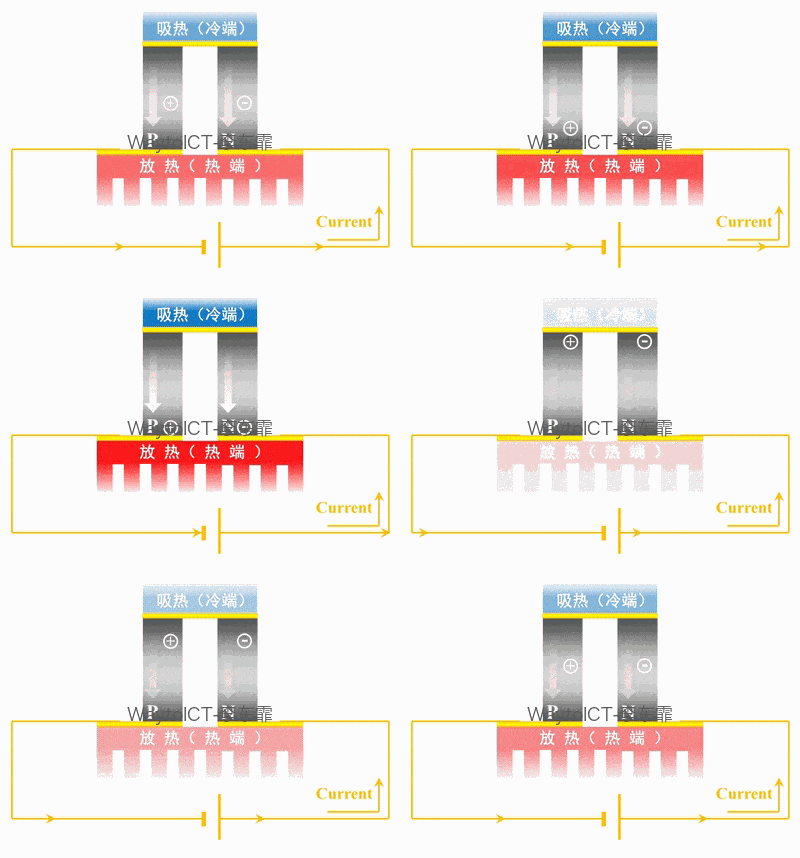
The principle of TEC is the thermoelectric cooling effect, that is, the Peltier effect: two different semiconductors form an electrical junction, and after power is applied, one side absorbs heat and the other releases heat, realizing active temperature control.
Extended reading: UESTC: CPO Co-Packaging Scheme Based on Micro-Channel Liquid Cooling
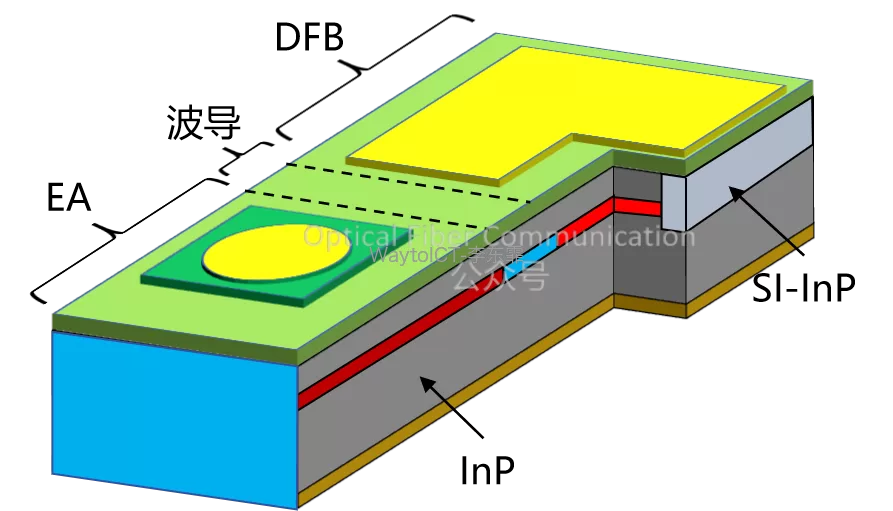
The EML itself integrates a DFB laser emission region and an EAM electro-absorption modulation region on the same chip. The front DFB section is responsible for emitting light, and the rear EAM section is responsible for controlling the light.
Recommended reading:
Lumentum: Progress of 4x200G Differential-Drive EML
Broadcom: 400G EML Evolution Roadmap and Differential-Drive Scheme
Source Photonics: 400G/lane EML Scheme and 3.2T Optical Module Roadmap and Viewpoints
The EAM controls the on/off of light through voltage. In normal mode, when no voltage is applied, it is “transparent” to light of a specific wavelength; when a reverse voltage is applied, it becomes “opaque” and absorbs the light.
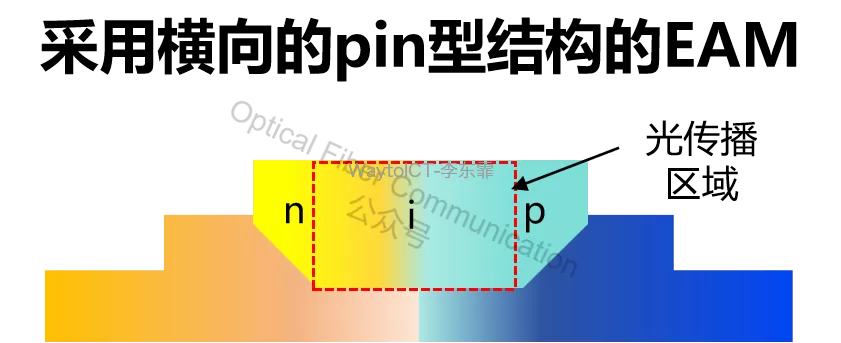
The schematic of the absorption characteristics of the I region in the optical transmission area is as follows.
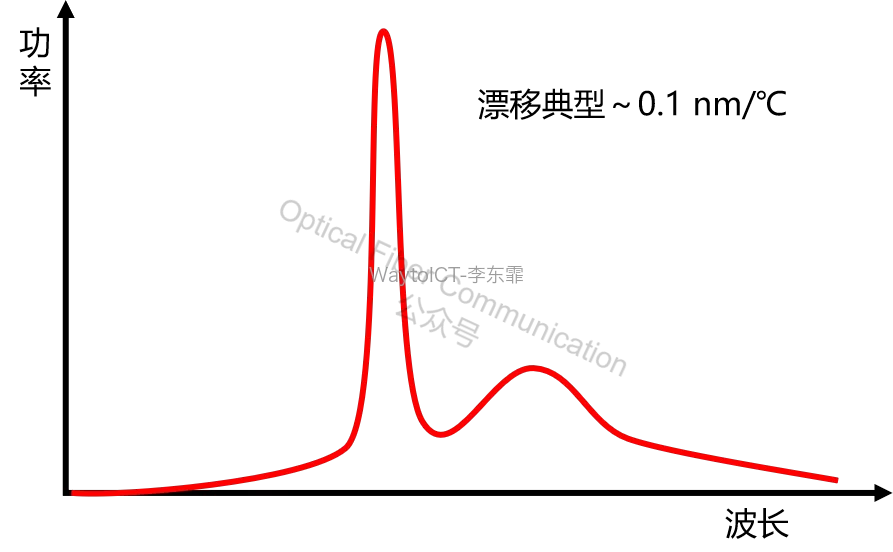
The DFB laser emits light continuously during operation, and its emission wavelength and power characteristics are shown in the figure below.
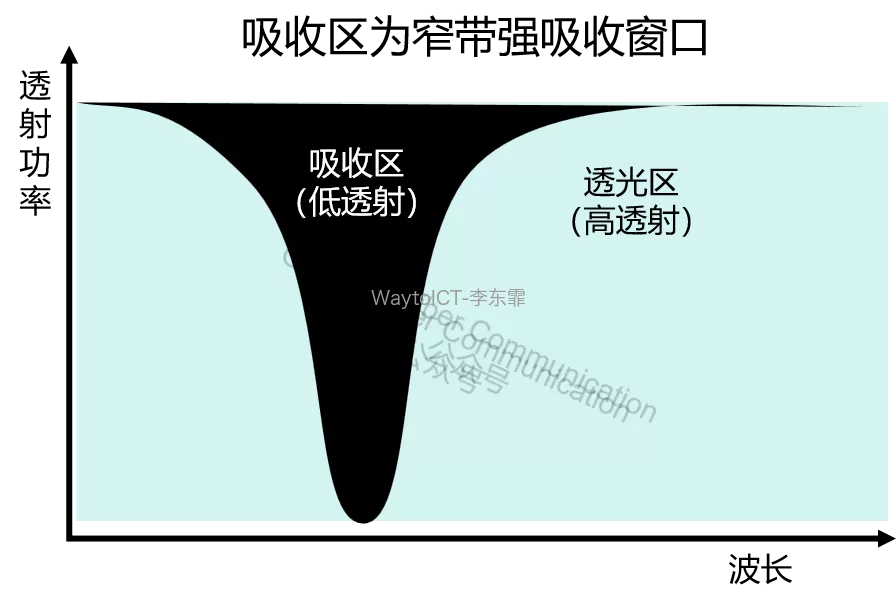
When a reverse voltage is applied, the DFB wavelength exactly falls at the center of the absorption valley, the light is strongly absorbed, the transmitted power is very low, and the output is logic “0”.
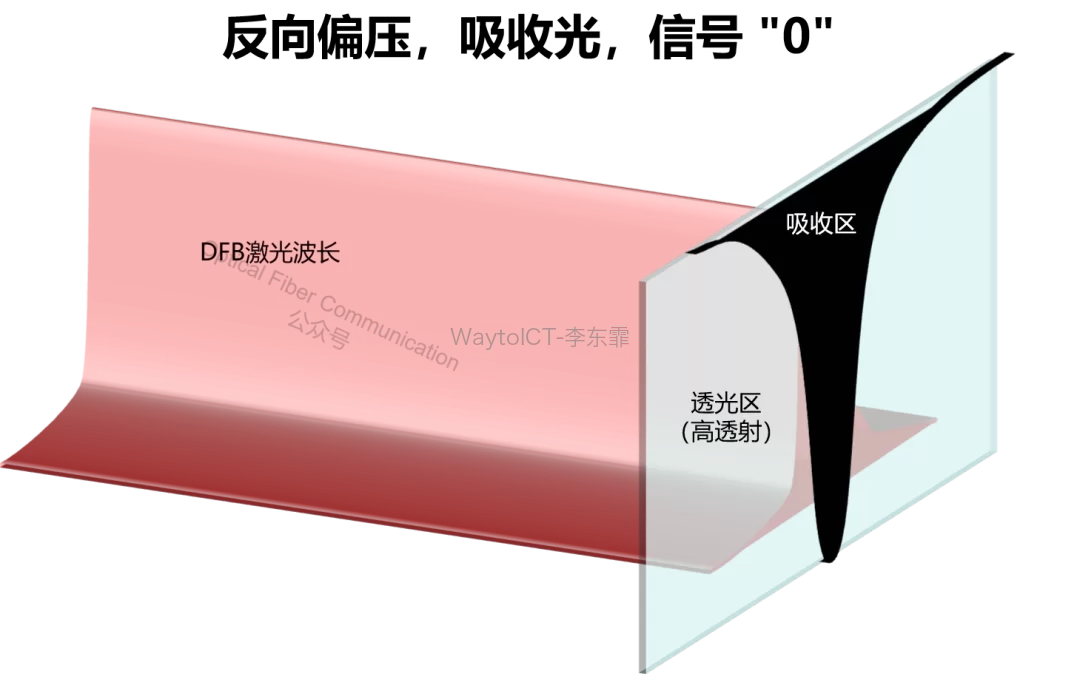
When no voltage or only low voltage is applied, the absorption valley shifts, the DFB wavelength moves out of the absorption valley into the transmission region, the transmitted power is very high, and the output is logic “1”.
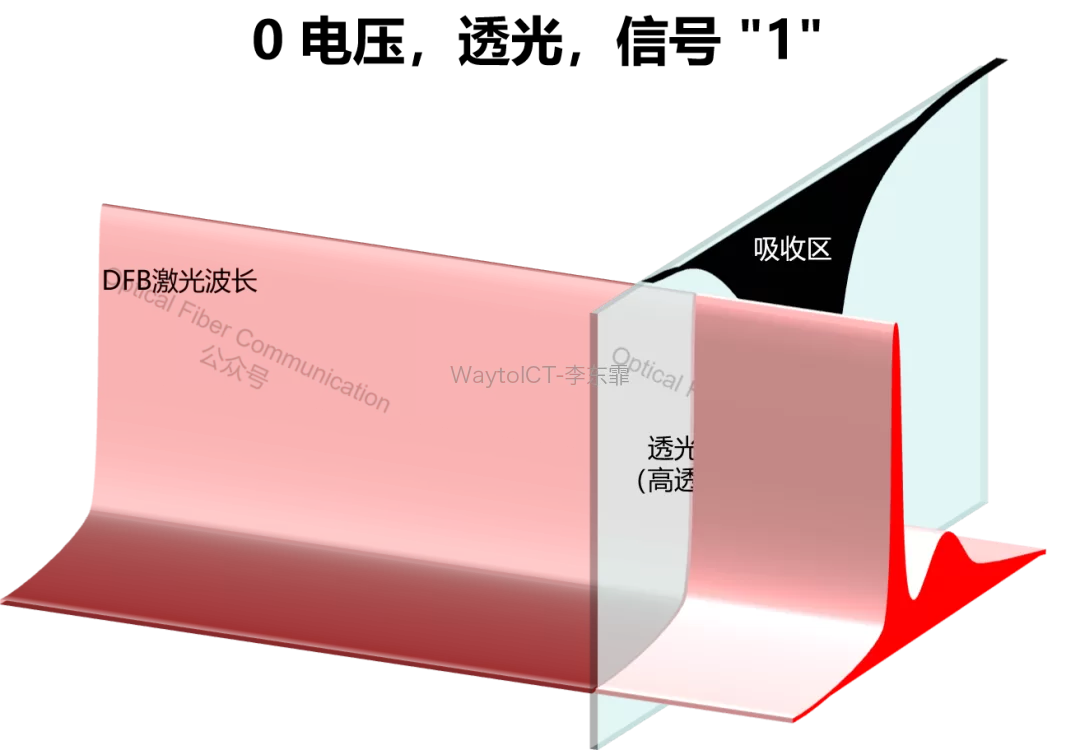
Expressed with the absorption curve, when the voltage is 0V, the edge of the absorption spectrum is far from the laser wavelength, and the modulator hardly absorbs light.
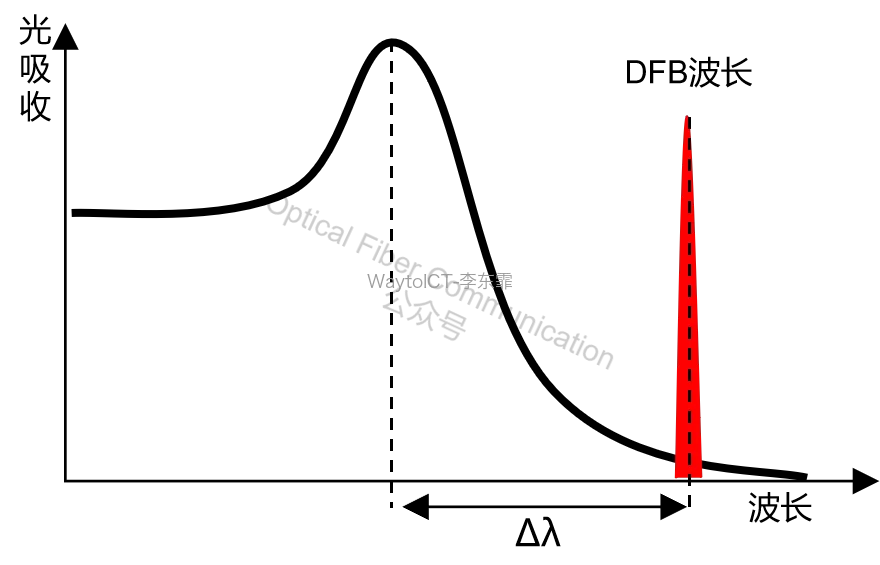
If Δλ is too small, the laser wavelength is close to the EAM absorption edge, and even at 0V the absorption is extremely strong and the output is extremely low. Although this can improve the extinction ratio, it causes insufficient logic “1” power, affecting performance.
Returning to our original question, it is easy to explain why TEC temperature control is needed for the EML.
In the TO package mentioned earlier, the EML chip generates heat during operation. As the temperature rises, the DFB wavelength red-shifts toward longer wavelengths at a rate of about 0.1nm/degC.
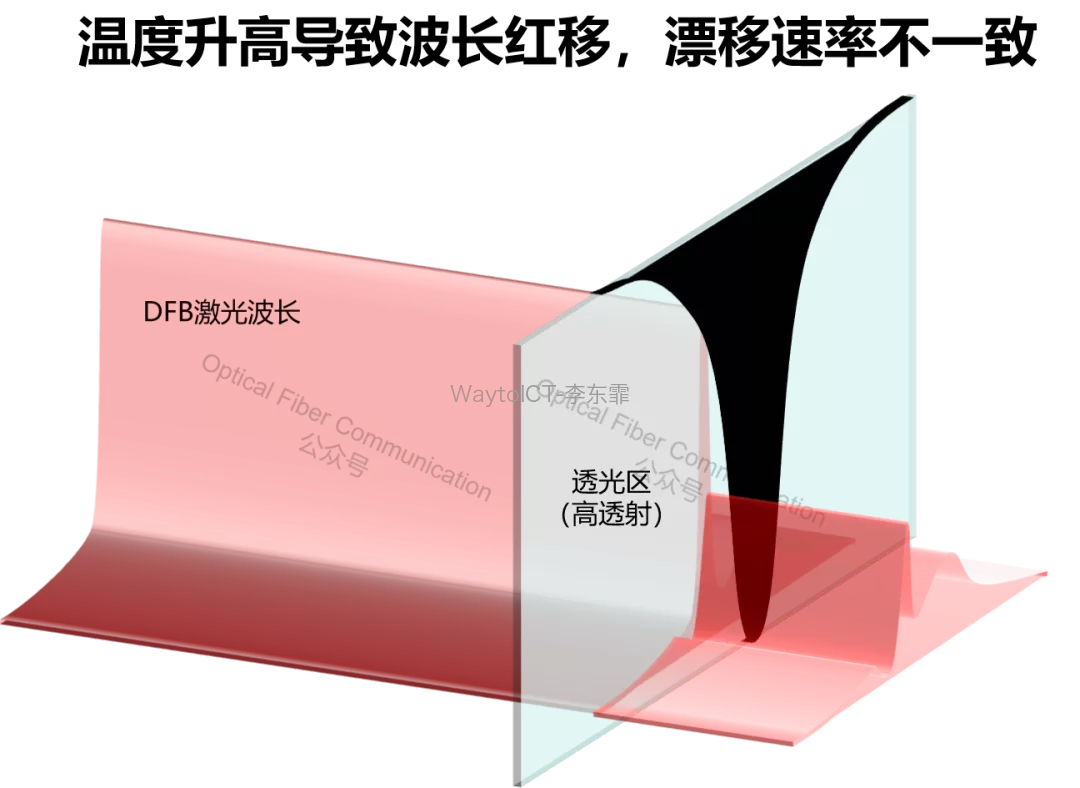
The EAM absorption valley also red-shifts, but the two drift at different rates.
The EAM absorption valley is a narrow window, and modulation relies entirely on the precise matching between the DFB wavelength and the edge of the absorption valley. Once the temperature changes, the positions of the two deviate, causing the problem that the off-state cannot absorb completely and the on-state cannot transmit through.
Therefore, TEC precise temperature control is needed to stabilize the matching between the wavelength and the absorption valley, allowing the EML to work stably in various environments.
Related reading:
Alibaba: Failure Analysis of 400G Optical Modules in AI Networking Scenarios
Broadcom: 400G EML Evolution Roadmap and Differential-Drive Scheme
You can add WeChat WaytoICT to be invited to join the Semiconductor & Optical Components Industry Chain Group 2.
Welcome to join our community to obtain high-value technical documents, trend research reports, and various supply-demand business opportunities in the fields of semiconductor chips / optical components / optical modules.
If you are interested in semiconductors / optical components / optical modules / optical fiber communication, welcome to follow us!
Enjoy this article?
Subscribe to get new optical communication insights delivered to your inbox. Free, unsubscribe anytime.