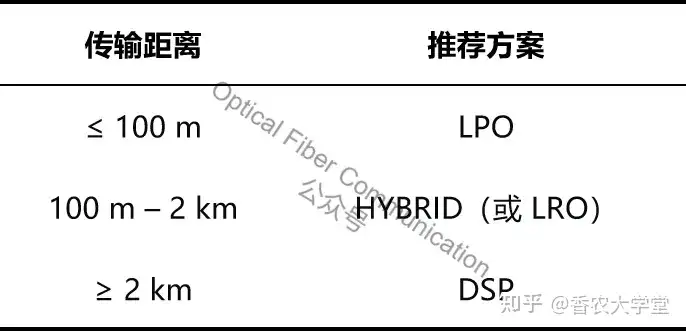
In the current field of optical transceiver technology, the four schemes of DSP, LPO, LRO, and HYBRID will coexist for a long time, each serving different transmission needs and application scenarios.
Full DSP refers to equipping complete DSP at both the transmit and receive ends, with the strongest signal processing capability, supporting medium- and long-distance transmission, with a mature industrial chain and plug-and-play capability.
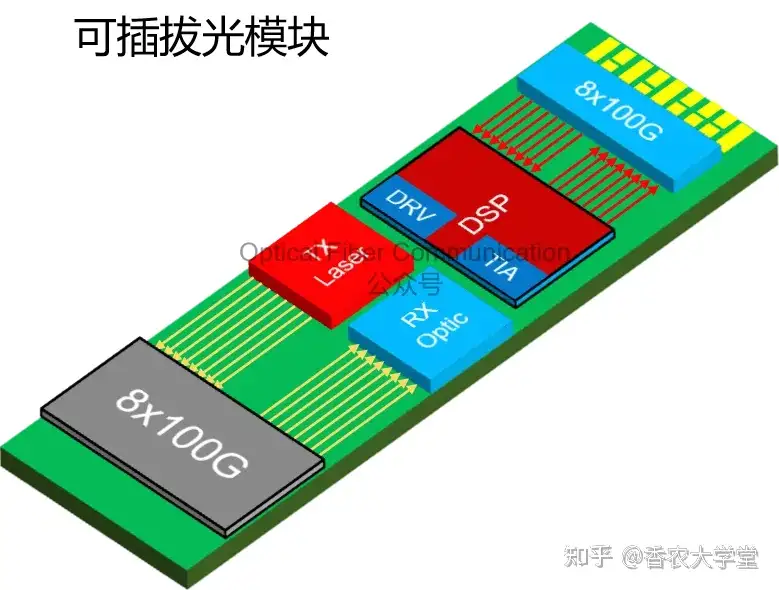
But its power consumption is relatively high (800G modules usually exceed 14-16 W), the latency is larger, and the cost is also the highest, mainly used in metro networks, backbone networks, and core links with extremely high reliability requirements.
The LPO scheme completely removes the DSP inside the module, moving the signal processing function to the host-side SerDes.
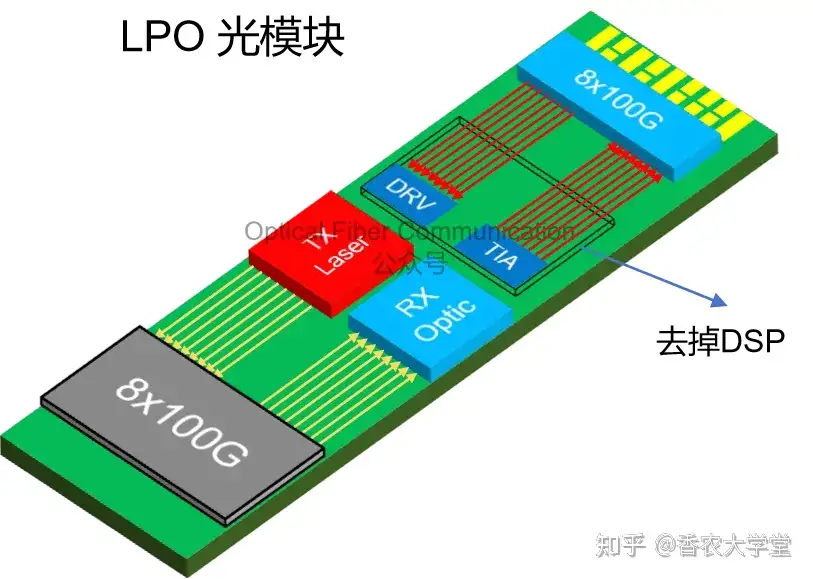
Its advantage lies in the lowest power consumption (30-50% lower than DSP), extremely low latency, and the lowest module BOM cost.
The disadvantage is that it places extremely high requirements on the host SerDes and channel consistency, with a transmission distance usually limited to within 100 meters, complex system debugging, and an ecosystem still under development. It is mainly suitable for ultra-short-distance interconnection within or between AI cluster racks.
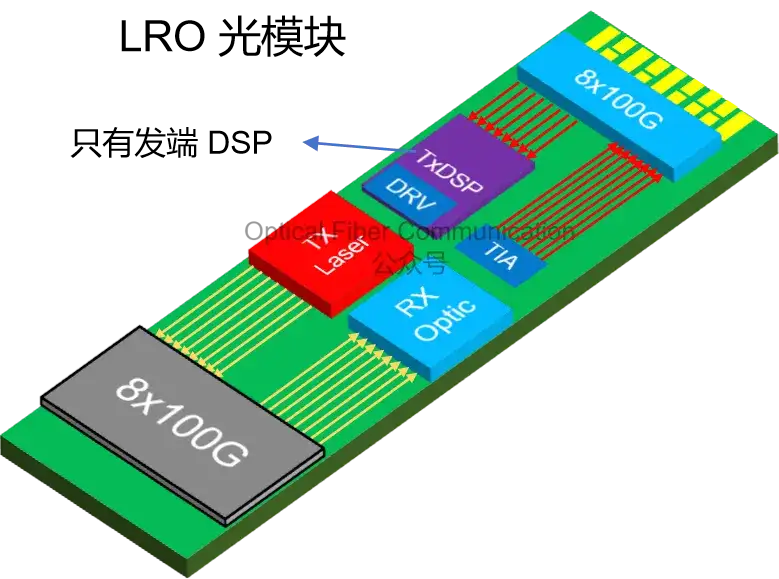
The LRO scheme retains the DSP only at the transmit end, with linear reception at the receive end.
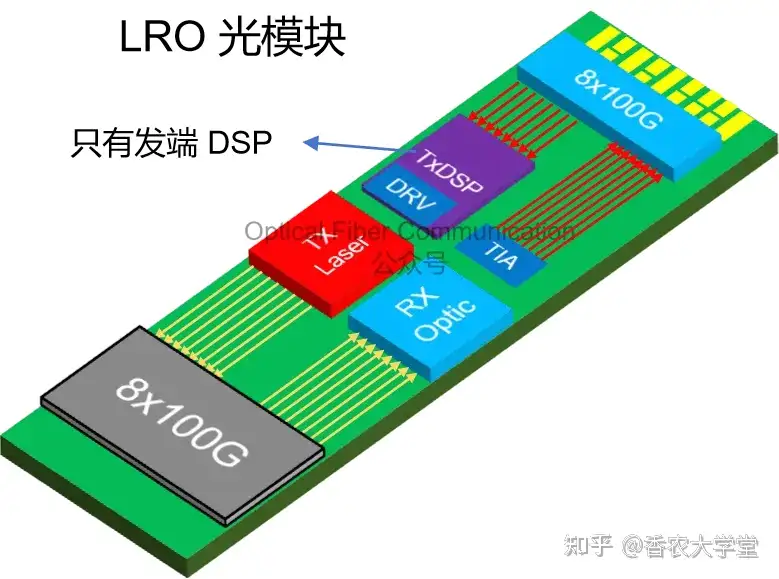
Its power consumption and transmission distance are between those of DSP and LPO. However, because it uses a highly customized transmit-side simplex DSP, it has the fundamental problem of poor chip generality and difficulty in scaling, so it has not become a mainstream scheme.
The HYBRID scheme is different from the above, and can be said to be a comprehensively optimized architecture. Inside the module, it lets only half of the transmit/receive channels go through DSP processing, while the other half uses a linear architecture.
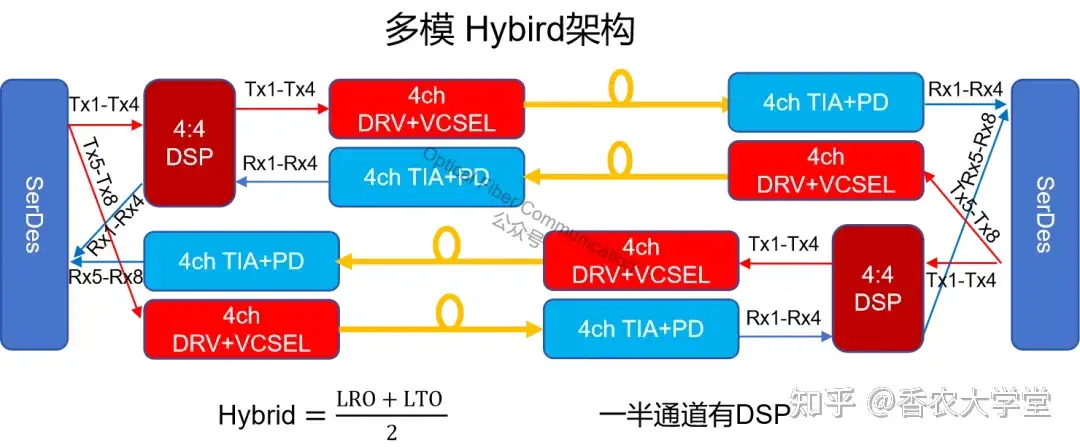
For specific technical interpretation and form factor, please refer to:
1.6T/3.2T Optical Transceivers: Half-DSP, Half-LPO Hybrid Architecture
The key difference from LRO is that HYBRID can reuse the mature duplex DSP chips on the market, rather than relying on customized simplex DSP, only reducing the number of channels used.
Therefore, HYBRID has more advantages in chip generality, supply chain stability, and scalability. Actual measurements show that the performance of some of its links is even better than LRO.
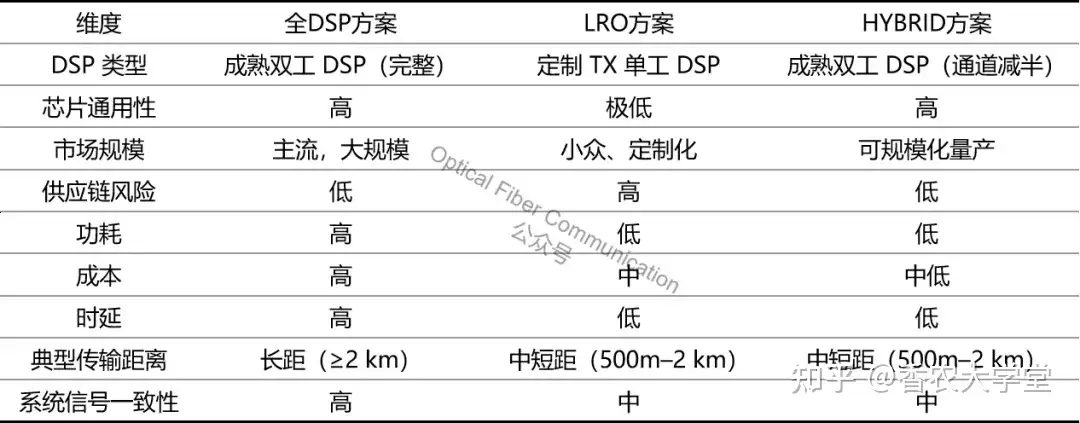
Compared with the full DSP scheme, HYBRID can reduce power consumption by about 20%-30%, significantly reduce latency, and reduce overall cost by about 20%.
In terms of signal quality, for example, a pre-forward-error-correction bit error rate of E-7 to E-8 can be achieved at a multimode distance of 50 meters, and an E-10 level can be reached at a single-mode distance of 500 meters.
Of course, HYBRID requires the host side to cooperate in signal tuning, depends on system-level collaborative optimization, and is still in the early stage of large-scale application.
Recommended reading:
1.6T/3.2T Optical Transceivers: Half-DSP, Half-LPO Hybrid Architecture
HiSilicon / Intel: SiN-SOI Microring Modulator for CPO
Cisco’s Pluggable-Supporting CPO Optical Interface Scheme
Accelink: Some Views on CPO and Its 3.2T Silicon Photonics CPO Scheme
Google’s TPUv7 and Optical Transceivers, OCS Switches
Enjoy this article?
Subscribe to get new optical communication insights delivered to your inbox. Free, unsubscribe anytime.