In DWDM wavelength-division networks, we often use different modulation formats. So why do we use these modulation formats? As we know, as the per-wavelength rate increases, traditional modulation coding such as NRZ is no longer applicable. Moreover, as the signal rate increases, according to the Fourier transform (the relationship between pulse width and spectral width is a time-domain and frequency-domain relationship, and they form a Fourier transform pair), the pulse period decreases, and the spectral width increases. Considering that the spectral width available for optical signals is limited, we need to seek better modulation formats to improve spectral efficiency.
Therefore, here we consider another question: by increasing the modulation order, how much bandwidth gain can we achieve? Is it true that the higher the modulation order, the greater the bandwidth gain? Let’s look directly at the following table:
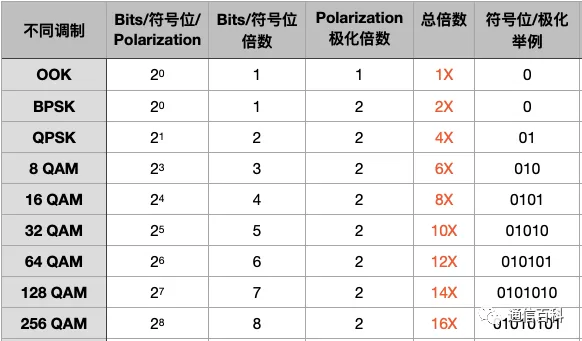
From the “total multiplier” column in the table above, upgrading from QPSK to 16QAM can double the bandwidth capacity, but upgrading from 64QAM to 128QAM only increases the bandwidth by 17%. PS: The figure below shows a schematic of the Bits/Symbol principle for different modulation formats in the X-Y polarization directions.

In short, as the modulation order gets higher and higher, the bandwidth capacity gain from increasing the modulation order becomes less and less significant. In addition, we should also note that the higher the QAM order, the more sensitive the high-order QAM signal is to noise, and the shorter the transmission distance it can achieve.

Related Reading
- 400G+ Optical Transmission Systems: Baud Rate, Modulation, and Spectral Technology
- 5G NR Modulation and Coding Scheme: Modulation and Code Rate
- Is 5G Modulation Really Difficult?
Enjoy this article?
Subscribe to get new optical communication insights delivered to your inbox. Free, unsubscribe anytime.