First, let’s discuss whether all incident light can be transmitted in an optical fiber. We know that when a light wave enters a lower-refractive-index medium from a higher-refractive-index medium, reflection and refraction occur at the boundary, and total reflection occurs when the incident angle exceeds the critical angle.
Based on the above theory, at the end of the optical fiber, not all light entering the fiber core from air at different angles can be transmitted in the fiber. Only light injected into the fiber within a certain angular range can be transmitted in the fiber.
If the incident angle at the fiber end face is α, then the angle between the light in the waveguide and the axis perpendicular to the fiber is θ. At this point, light with θ>θC (the critical angle) will be totally reflected, while light with θ<θC will enter the cladding and leak out. As shown below.
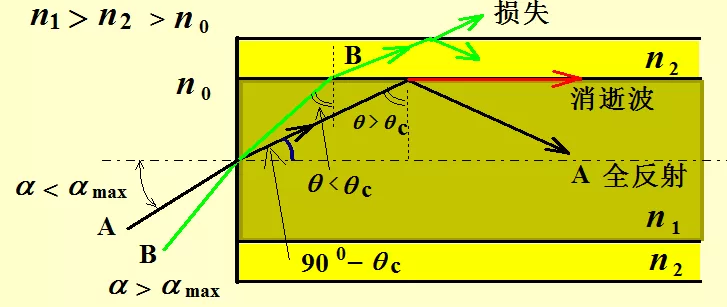
Therefore, to transmit light in the fiber, the incident angle must enable the light entering the fiber to undergo total reflection and return to the core, propagating forward in a zigzag pattern.
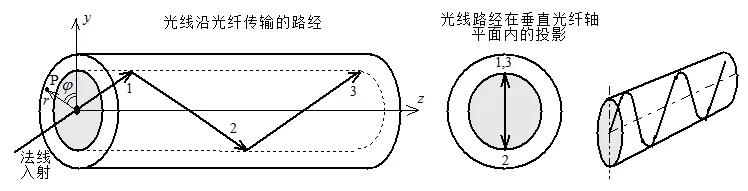
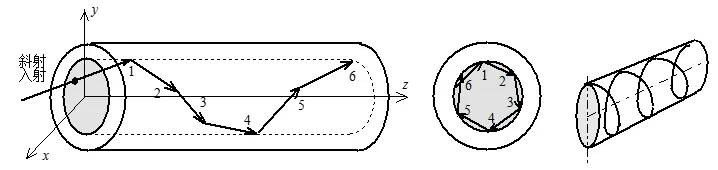
So are their transmission paths all the same? Depending on whether the incident light intersects the fiber axis, the transmission path of light in the fiber has the following two forms.
Normal incidence: the light always intersects the fiber axis, as shown below.
Oblique incidence: the light does not intersect the fiber axis, as shown below.
Question: In the widely used G.652 fiber, in which path form does light propagate?

Related Reading
- Optical Fiber Communication: The Structure of Optical Fiber
- Optical Fiber Communication: Mode Field Diameter and Cutoff Wavelength
- Understanding the Principles Behind Optical Fiber Communication Through Animations!
Enjoy this article?
Subscribe to get new optical communication insights delivered to your inbox. Free, unsubscribe anytime.