In the field of optical transport, major vendors basically all have 400G, 600G, and 800G coherent solutions. We know that coherent optical transmission technology is a key factor driving the capacity and number of high-speed services carried by optical networks, and also a key factor controlling their cost. Using different baud rates and different modulation formats or DSP implementations, such as 32QAM, 64QAM, and hybrid modulation… 32, 56, 64, 95 GBaud and higher baud rates? What is the difference between them? Fixed grid, flexible grid, what is 75 GHz? More importantly, what are the related network implications? What is the impact on the overall system performance of the network? These are all things we need to understand.
Therefore, we need a vivid and detailed understanding of the relationship between Bit and Symbol, constellation diagrams, and Baud rate. To illustrate these relationships, we will compare the performance of coherent optical transmission to freight transportation, which I believe will give a more intuitive understanding.
The goal of equipment vendors using coherent technology is to carry wavelengths in a single fiber, transmitting greater capacity at the greatest cost-effectiveness. This is similar to wanting to be as efficient as possible in freight transportation, using available trucks and road resources to carry as much payload as possible.
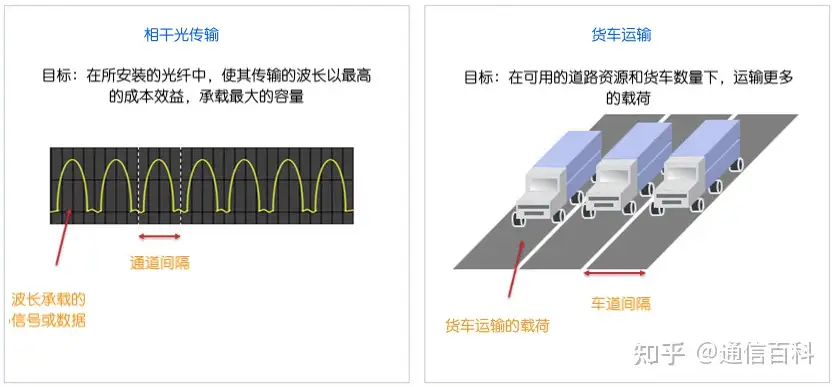
Figure 1 – Coherent transmission compared to truck transportation
Using the figure above as an example, we take 100G Ethernet client-side traffic carried by a coherent modem. Its client-side port receives 100G Ethernet service traffic, and then converts it into an optical signal using a certain modulation technique, and this optical signal is what we call a wavelength. Here, each wavelength carries a certain throughput (e.g., 100 Gb/s), occupying a certain width of spectrum resources at a certain channel spacing. In the current widely commercialized DWDM systems, the main spectrum resources are dominated by the C band, with a total of 4800 GHz available spectrum. Therefore, for example, if an operator deploys 100G wavelengths with 50 GHz fixed channel spacing, their fiber can transmit 96 x 100 Gb/s, or 9.6 Tb/s of capacity.
Analogy: This is similar to trucks with a certain payload on a certain number of lanes, where the total payload they can carry is the maximum payload each truck can carry multiplied by the number of trucks.
To improve the efficiency of network transmission, we want to maximize the capacity of the existing optical fiber network system. The capacity of the system directly depends on the number of bits per modulated symbol, and the number of symbols sent and processed per second. We call the symbol rate per second the baud rate. Generally, we can improve system capacity in the following two ways:
1) Use more complex modulation schemes to increase bits/symbol
2) Increase the baud rate, i.e., process more symbols per second
Let’s still use freight transportation for comparison, as shown below:
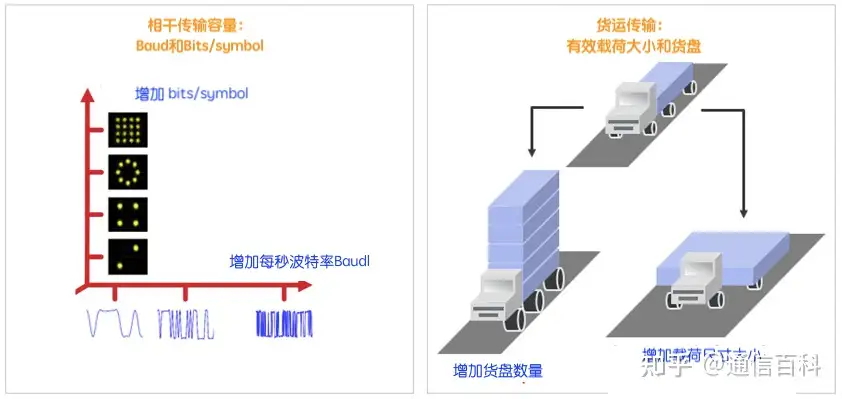
Figure 2 – Two main methods to increase system capacity and payload platform size
Increasing bits/symbol -> adding more pallets:
Increasing bits/symbol means implementing more complex modulation schemes. However, the higher the bits/symbol, the closer the symbols are to each other, the more sensitive they are to noise, and the shorter the transmission distance.
Here, we can use powerful coding and forward error correction (FEC) algorithms in the DSP to correct the linear and nonlinear impairments (mainly nonlinear noise) that the signal encounters during propagation, so that the signal can travel farther under a specific modulation mode. DSP algorithms are usually unique to each vendor, which is why different products use different technologies and cannot directly interconnect with each other.
Increasing bits/symbol is similar to increasing the number of pallets on the truck platform.
The more pallets there are, the less stable the load on the truck, and the shorter the distance the truck can travel. Therefore, for a truck, a more powerful engine and suspension system is needed to carry more pallets, which is similar to the role played by DSP algorithms. As shown below.
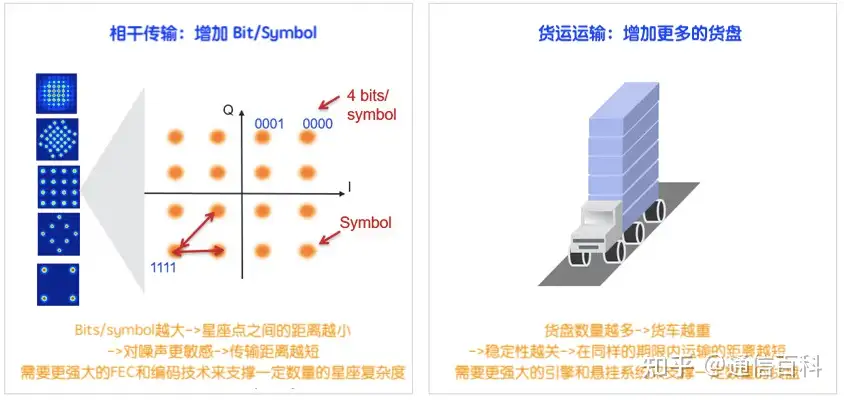
Figure 3 – Increasing Bits/Symbol
Increasing baud rate -> increasing the load size of the truck platform
As we know, the second method to increase capacity is to increase the baud rate, that is, to process more symbols per second. This is similar to increasing the load platform size of the truck, so that we can load more payload for each pallet.
Increasing the baud rate allows us to get better system performance from a single coherent modem, thereby reducing the cost per bit. This means greater capacity per signal within a given range.
When increasing the baud rate, the spectrum width occupied by the signal also increases, just as a truck with a wider load platform needs a wider lane. As shown below.
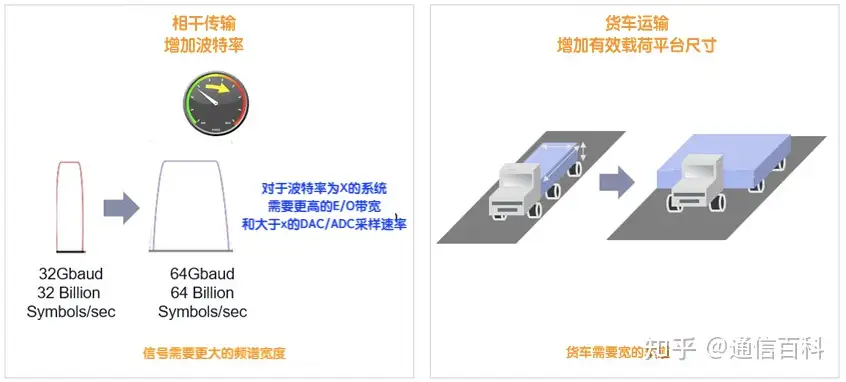
Figure 4 – Increasing the baud rate
The impact of modems with higher baud rates on network performance
What impact does increasing the spectrum of the signal have on the network? We know that current optical networks are based on fixed-grid 50 GHz or 100 GHz multiplexing/demultiplexing units (OMU/ODU), or wavelength selective switches (WSS). Fixed-grid OMU/ODU are similar to fixed lanes on a road with fixed directions, while WSS is similar to a roundabout that allows trucks to travel in different directions while the lane width can still change. Imagine a smarter roundabout where a traffic controller flexibly allocates lane sizes according to the size of the truck, so that the lanes better match each traveling truck.
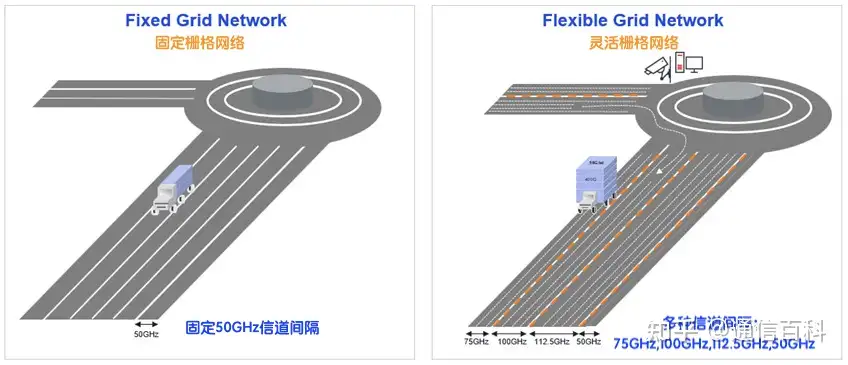
Figure 5 – Fixed Grid and Flexible Grid networks
In addition, when we deploy 400G and above wavelengths and rates, the baud rate will reach 45 GBaud or higher, and the corresponding channel spacing requirement in the spectrum will be greater than 50 GHz. Flexible-grid networks can be set to fixed channel spacing through network management, such as 64 channels with 75 GHz spacing or 48 channels with 100 GHz spacing. However, this method cannot completely and effectively utilize the entire spectrum resources. For example, when we need to carry a 400G rate on 50 GHz channel spacing, by analogy with truck transportation, a 50 GHz lane width is not enough for a 56 GBaud truck to pass. For another example, when we transmit 100G rate wavelengths in a fixed 75 GHz channel spacing, the baud rate of about 35 GBaud will cause waste of spectrum resources. In short, what we need is a system that supports Flex Grid/flexible channel spacing to perfectly solve this problem. As shown below, using truck transportation as an analogy can illustrate this vividly.
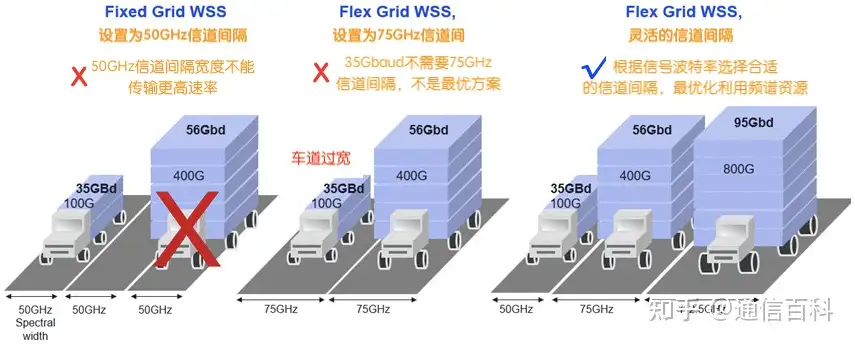
Figure 6 – Different network models
For different baud rates in coherent optical solutions, their selection and design mainly depend on the following two aspects:
- Maximum single-wavelength throughput and maximum transmission distance: depends on the type of client traffic to be transmitted and the customer’s requirements for network capacity;
- High-bandwidth electro-optics with appropriate passbands to process new signals, and digital-to-analog and analog-to-digital converters (DAC/ADC) that can operate at appropriate sampling rates.
In short, total system performance – how much capacity each signal carries and how far the signal can travel – will depend on the DSP algorithm, similar to the performance of the truck engine and the strength of the suspension system.
Next, let’s talk about the current 800G solution. Its baud rate is up to about 95 GBaud, and the nominal values may differ slightly among vendors. The 800G solution can run at programmable capacity rates from 200G to 800G in 25G increments (programmable means it can support different modulation schemes and thus run at different baud rates). The reason the 800G solution chooses 95 GBaud as the symbol rate is that it allows a maximum single-wavelength capacity of 800G over actual short distances (100-200 km), and 800G can effectively carry multiples of 100GE and 400GE services. At the same time, it also allows efficient transmission of 400GE services across arbitrary distances, so 400GE can reach the longest transmission distance in the network as a single wavelength.
The higher the baud rate, the better the DSP performance required, and the corresponding high-bandwidth electro-optics and high-speed converters are also needed, so that a single modem can achieve more throughput and further reduce the cost per bit. The 95 GBaud modem mentioned above can relatively improve the cost per bit, but for different rates it is also necessary to make a comprehensive selection based on service requirements and transmission distance. But overall, the performance of coherent system solutions ultimately depends on suitable and available DSP technology, as well as the availability of high-speed converters and high-bandwidth electro-optics.
Some previous articles:
- 400G Line-Side Transmission Solutions
- Probabilistic Constellation Shaping (PCS)
- 600G or 800G?
- 800G Coherent and PAM4 Optical Module Architecture
- 800G Optical Module MSA: 4x200G Technical Analysis in FR Scenarios
- 800G Optical Module MSA: 8x100G Technical Analysis in SR Scenarios
- Optical Transmission: High-Order Modulation or Higher Baud Rate?
- I/Q Modulation and Constellation Diagrams in Optical Communication

Related Reading
- Data Center 800G: PAM4 or Coherent Technology?
- A Brief History and Introduction of Digital Coherent Systems
- Ciena’s 1.6Tb/s Coherent Optical Solution
Enjoy this article?
Subscribe to get new optical communication insights delivered to your inbox. Free, unsubscribe anytime.