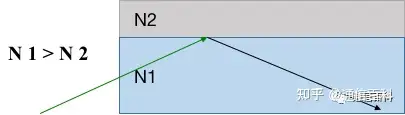
Optical fiber is a transmission medium, drawn from an optical fiber preform with a specific refractive index profile. A pure bare fiber consists of an inner layer and an outer layer. The refractive index N1 of the inner layer is greater than the refractive index N2 of the outer layer, and light is transmitted in the inner layer according to the principle of total internal reflection. N1 greater than N2 is a necessary condition for optical signals to be transmitted in the fiber.
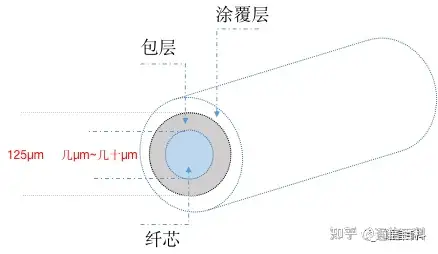
The inner layer is the core, with a diameter generally between a few microns and tens of microns. The core is not pure silica, but is doped with impurities, such as germanium dioxide, to increase the refractive index. The next outer layer is the cladding, generally also silica, with a refractive index of about 1.44. The outer diameter formed by the cladding and the core is 125 microns. An outermost coating layer is added to protect the fiber. A key parameter for distinguishing fiber types is the core diameter.
Commonly used fibers have several different core diameters: 62.5 microns, 50 microns, and smaller cores of 5 to 10 microns.
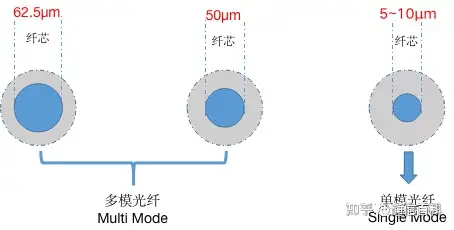
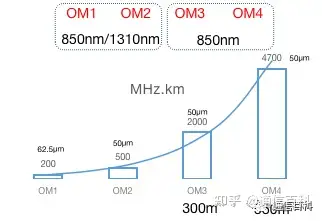
Fibers with core diameters of 62.5 and 50 microns are multimode fibers. Through technological development, from OM1 to OM4, performance has improved. OM1 and OM2 mainly use LED light sources. The bandwidth of OM1 with a 62.5-micron core is 200 MHz.km, and the bandwidth of OM2 with a 50-micron core is 500 MHz.km, with relatively small transmission distance and bandwidth. OM3 and OM4 use VCSEL 850 nm light sources; the bandwidths of 50-micron OM3 and OM4 are 2000 MHz.km and 4700 MHz.km respectively.
For single-mode fiber, the core diameter is generally only a few microns. The G.652 to G.657 fibers we often hear about are all single-mode fibers. Their transmission distance and bandwidth are greater than multimode. Multimode fiber is more commonly used in data center equipment rooms, winning on low cost.
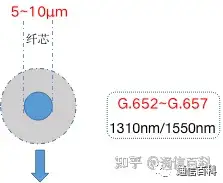
The size of the core diameter is the physical characteristic that distinguishes single-mode and multimode fiber. But to achieve single-mode transmission, in addition to satisfying the core diameter, we also need to pay attention to the cutoff wavelength and numerical aperture.

Related Reading
- What Is the Transmission Path of Light in an Optical Fiber?
- Optical Fiber Communication: Mode Field Diameter and Cutoff Wavelength
- Understanding the Principles Behind Optical Fiber Communication Through Animations!
Enjoy this article?
Subscribe to get new optical communication insights delivered to your inbox. Free, unsubscribe anytime.