When talking about the Raman amplifier, we must talk about the man Raman. For people in optical communication, he is both familiar and hazy. Let’s first put up a handsome photo.

Speaking of familiar, it is because people in optical communication often deal with Raman’s achievements – the Raman amplifier was invented using the stimulated scattering effect discovered by Raman.
Speaking of hazy, it is because it was mentioned in our elementary school textbooks. Do you remember the text “Why is the sea water blue”? Those reading this article are probably all heroes over 20 years old.

“Why is the sea water blue” is about Raman. On the cruise ship from India to Oxford, England, to attend a Commonwealth university conference, he used Rayleigh’s statement that the blue of the sea is the reflection of the blue of the sky to explain this to a little boy. But after saying it, even he himself could not convince himself.
Then, Raman started experiments and brainstormed, and wrote two papers on the ship discussing this phenomenon, believing that it must be caused by the scattering of light by water molecules, and thus won the Nobel Prize. So, parents with young children are the best at thinking and the most likely to win the Nobel Prize.
Let’s look at what the Raman scattering discovered by Raman is all about.
Raman scattering, simply put, is that light shines on the surface of a sample, undergoes inelastic collision, and the photon exchanges energy with the molecules (or other forms) that make up the sample.
(If elastic collision occurs, it is Rayleigh scattering, with no energy exchange, which is why Rayleigh said the blue of the sea is the reflection of the blue of the sky.)
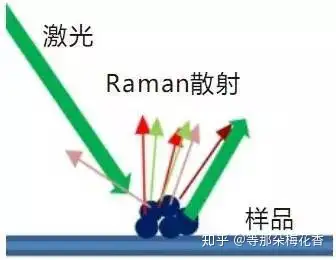
As mentioned above, when energy exchange occurs, there are only two cases: absorbing and being absorbed.
If the incident photon is absorbed of energy by the sample molecule, the frequency will be lower than the incident light frequency; such photons are called Stokes photons;
If the incident photon absorbs energy from the sample molecule, the frequency will be higher than the incident light frequency; these are called anti-Stokes photons.
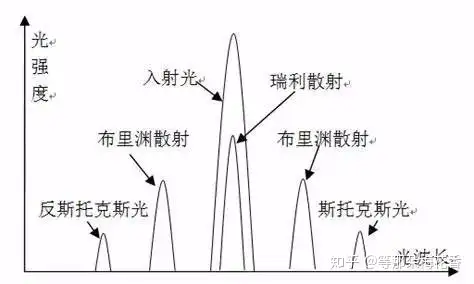
As can be seen from the above, the optical energy of Stokes and anti-Stokes photons is relatively small.
Seeing this, friends working in WDM may have an idea: since the frequency can be shifted, can we use this characteristic to add energy to light of a specific frequency?
Yes, the topic of this article, the Raman amplifier, comes from this.
Unfortunately, Grandpa Raman was not so lucky. He discovered the Raman effect, an advanced skill, but for many years no one could master it, until he was 74 years old… that is, in 1962, this scattering phenomenon was observed by Woodbury and Ng in the laboratory.
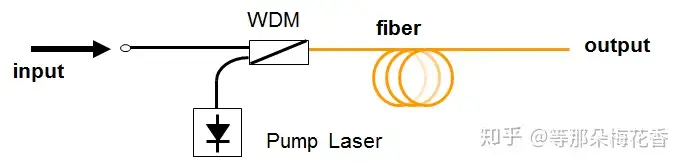
The Raman amplifier uses the Stimulated Raman Scattering effect by transmitting strong pump light and weaker signal light simultaneously in one fiber. The strong pump light undergoes oscillation scattering with the fiber, and is then emitted as light of a longer frequency, which is exactly the frequency of our weak signal light.
Let’s discuss a few questions below.
(1) Can all incident signal light be amplified?
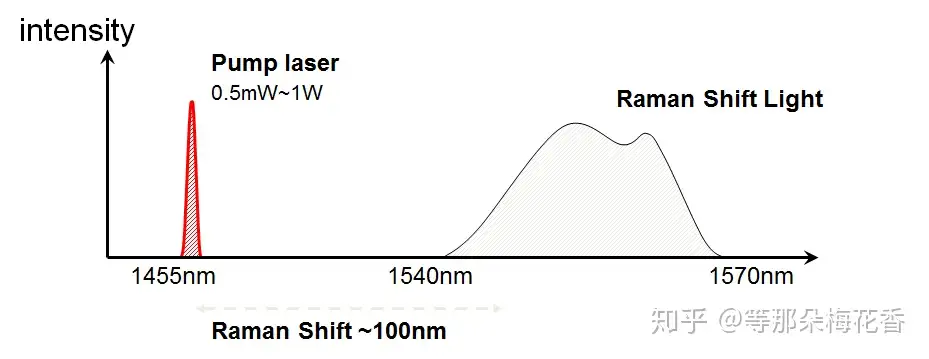
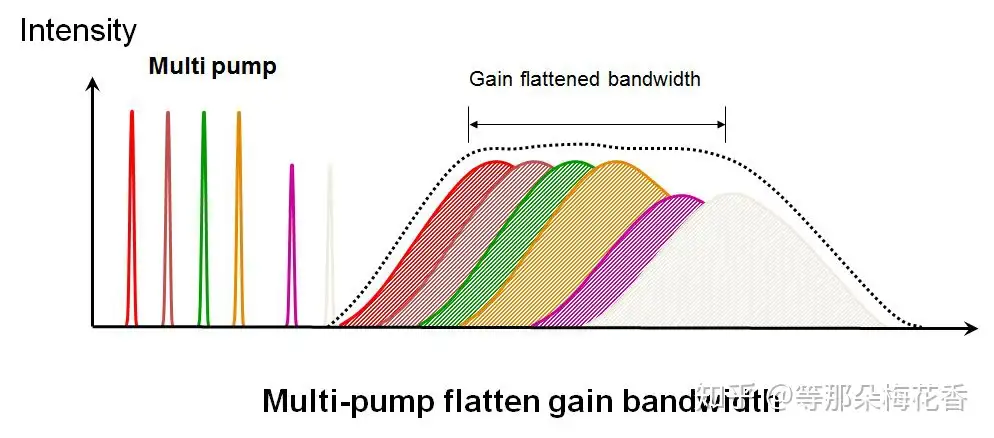
For pump light of a specific frequency, in the fiber medium, the signal light and pump light need to satisfy a peak gain frequency offset of 13.2 THz, which is about 100 nm of spectral offset in the figure above; the signal light only needs to fall within this gain spectrum width.
(2) Can all incident signal light be amplified?
If the range where the gain spectrum width is located is related to the pump light frequency, as long as there are suitable multiple pump light frequencies, we can achieve gain amplification of the required signal light.
(3) The relationship between pump light, gain, and fiber length?
When the pump light power is very small, the Raman gain is very large, but as the fiber distance increases, it attenuates quickly! Therefore, the pump light power of Raman amplifiers is very high. So never look directly at it with your eyes. As for the relationship between gain and fiber length, it is a nonlinear relationship. Let’s just show the figure directly, which is more intuitive.
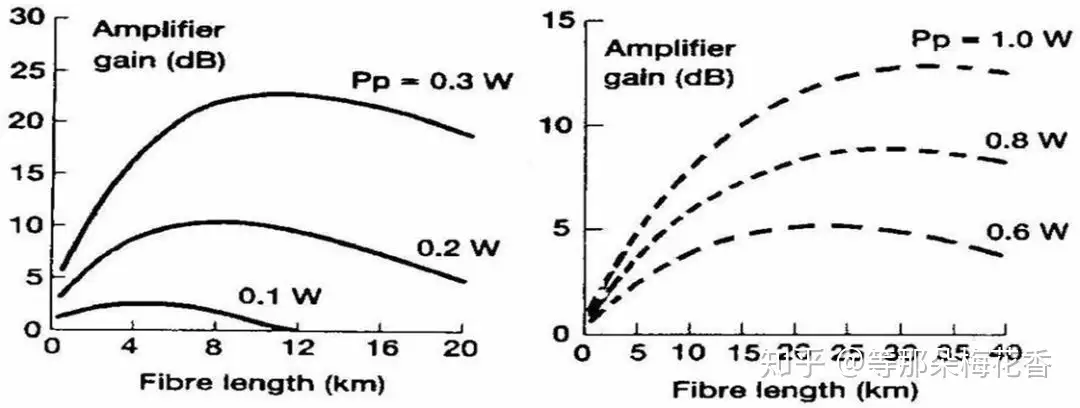
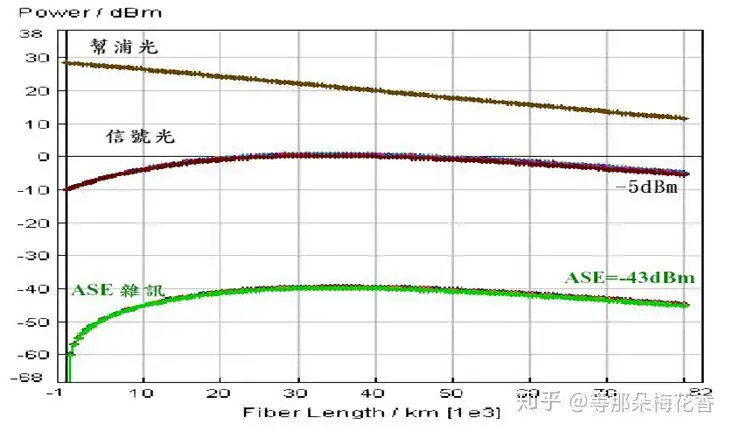
Therefore, the gain of the Raman amplifier is generally small, at most about 15 dB. Although the gain is not high, its ASE spontaneous emission noise is also small! Therefore, we usually use the EDFA erbium-doped fiber amplifier (high gain, high noise) in combination with the Raman amplifier.
Let’s summarize:
The gain range of the Raman amplifier is determined by the frequency of the pump light;
As long as there is suitable pump light, the gain of the required signal light can be achieved, and the gain range is very wide;
The gain amplification capability is relatively weak, but the generated noise is also relatively small.
We will talk about the EDFA erbium-doped fiber amplifier another time!

Related Reading
Enjoy this article?
Subscribe to get new optical communication insights delivered to your inbox. Free, unsubscribe anytime.