What is the essence of sunlight and lamplight, and how do they differ from the light in optical fiber communication? With these questions, we begin this installment of the “Light and Technology” journey.
Ancient China has a relatively long history of studying light. In the “Mojing” compiled by Mozi, the sage of science, it is written: “Light reaching a person shines like an arrow. The lower part of the person appears high, and the higher part appears low. The feet block the lower light, so the image forms above; the head blocks the upper light, so the image forms below. Because there is a small hole at near or far distance for light to enter, the image forms inside the dark box.” The general meaning is that when light shines on a person, the light reflected by the human body travels in a straight line like an arrow. Thus, the lower part of the person forms an image at the top of the screen; the upper part of the person forms an image at the bottom of the screen, meaning the image formed is inverted.
Why? This is because the lower part of the light from the feet is blocked, and the upper part of the light from the head is blocked. But precisely because there is a small hole at near or far distance on the light path for light to enter, the image formed in the dark box is a bright image.
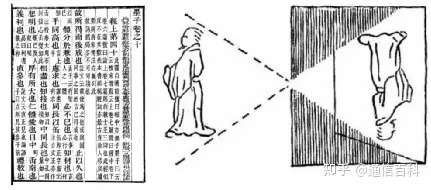
From the above description, it can be seen that the Mojing not only elaborated on the pinhole imaging scenario but also pointed out the straight-line propagation property of light, but only to that extent. Later studies of light more or less repeated and cycled without going deeper.
In the West, the ancient Greek philosopher Empedocles was the earliest to define the phenomenon of light: seeing things because the eyes emit light that hits objects, which is incorrect. Ibn al-Haytham from Mesopotamia, called the “father of optics” and “father of the scientific method”, published the “Book of Optics” around 1015, proving that light enters the human eye and thus produces images.
The in-depth study of the nature of light, however, had to wait until the first Industrial Revolution. This started the debate between the “wave nature” and “particle nature” of light.

The wave nature of light has a famous experiment, “Young’s double-slit interference experiment,” whose strangeness I believe everyone knows. Later, Maxwell predicted that light, like radio, is also a very high-frequency electromagnetic wave, essentially an electromagnetic phenomenon. The confirmation of this phenomenon was completed by Hertz, who experimentally measured the speed of electromagnetic waves, close to the speed of light. The wave nature of light can explain many phenomena, but light sometimes does not behave like a wave. Hence the later study of the particle nature of light.
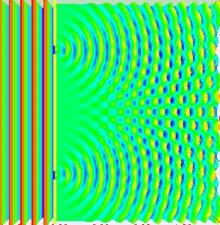
Young’s double-slit interference experiment
The particle nature of light was first endorsed by scientists led by Newton, who believed that the essence of light is particles. The one who truly discovered this phenomenon was Hertz. In proving the wave theory experiment, he discovered that if one of two zinc balls is irradiated with ultraviolet light, electric sparks very easily jump between the two balls. This is regarded as the “photoelectric effect.” The explanation of this phenomenon was proposed by Planck, who believed that light is energy and should be emitted in discrete quanta. Later, Einstein’s photoelectric effect theory also proved the particle nature of light.
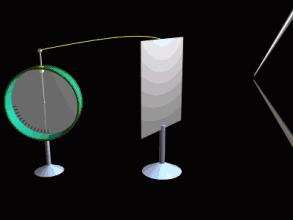
Photoelectric effect
The process of understanding the nature of light has been full of twists and turns, and finally concluded in the 20th century with “light has wave-particle duality.” Here we will not elaborate too much on the historical “struggle” between them.
Through the in-depth understanding of light, scientists successfully demonstrated the laser for the first time in 1960. The light we usually refer to in optical communication is the light in the laser, that is, the laser in the optical module. The laser can be said to be the heart of the optical module, and its cost accounts for about 50% of the total cost of the optical module.
Let’s look at the English word “laser,” which evolved from the abbreviation of LASER (Light Amplification by Stimulated Emission of Radiation). The laser consists of three parts: the gain medium, the pump system, and the resonant cavity. The pump system delivers energy to the gain medium to achieve population inversion, while the resonant cavity continuously amplifies the stimulated radiation light until stable laser output is produced.
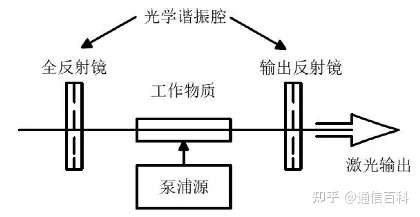
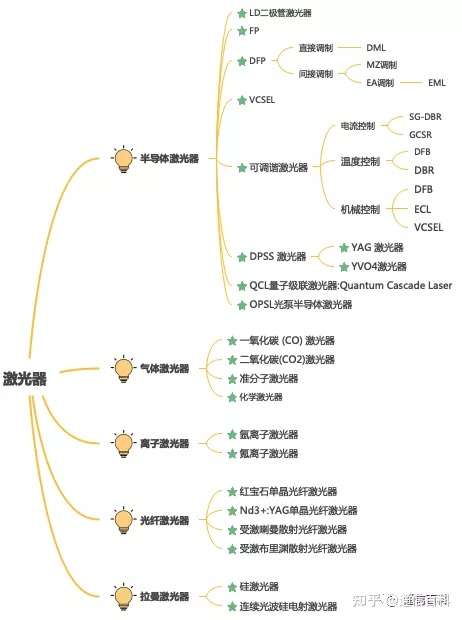
The pump source of the laser can take various forms, the two most common being optical energy and electrical energy. For optical pumping, it can be a lamp. Electrical pumping can be achieved through direct current (such as laser diodes), discharge (inert gas lasers and excimer lasers), or radio frequency discharge. The figure below lists the classification of some lasers.
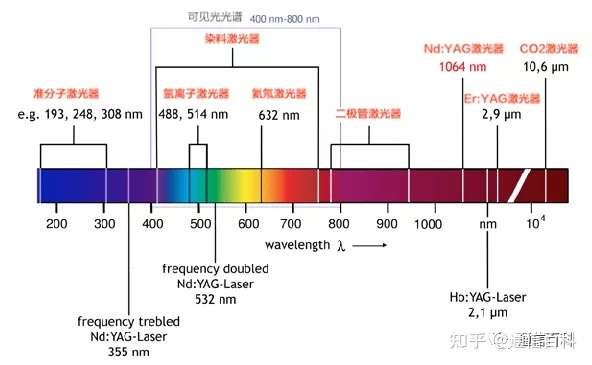
The spectra of some lasers are listed for reference, as follows:
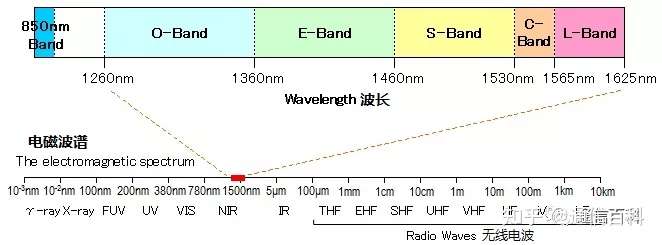
However, when the laser was first invented, there was no semiconductor laser that could work at room temperature, only the LED (Light Emitting Diode, which is different from the LD laser diode in the figure above), with a spectrum around 850 nm, which is the first window of optical fiber communication we know. Light in this window needs multimode fiber to ensure that the light emitted by the LED can be effectively injected into the fiber. As fiber attenuation continues to decrease and fiber types diversify, other windows of optical fiber communication have gradually opened up.
Currently, the lasers used in optical modules in optical fiber communication are mainly VCSEL (Vertical-Cavity Surface-Emitting Laser), FP (Fabry-Perot laser), DFB (Distributed Feedback laser), and tunable lasers.
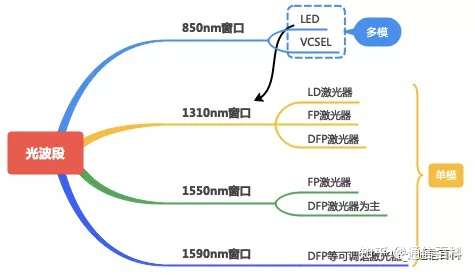
Among them, DFB lasers are more expensive than FP lasers, and FP lasers are more expensive than VCSEL lasers. VCSEL lasers are used for transmission distances of tens of meters; optical modules within 40 km generally use FP lasers; transmission distances greater than 40 km generally use DFB lasers.

Enjoy this article?
Subscribe to get new optical communication insights delivered to your inbox. Free, unsubscribe anytime.