When light is transmitted in an optical fiber, the main losses come from three aspects: absorption by the optical medium, Rayleigh scattering, and loss caused by bending.

Among the above factors, the loss caused by medium absorption of the fiber itself mainly occurs above 1700 nm. Relative to our optical communication windows of 850 nm, 1310 nm, and 1550 nm, it is not our main consideration. As shown in the curve below, in the above windows, fiber loss is mainly caused by Rayleigh scattering due to impurities in the fiber.
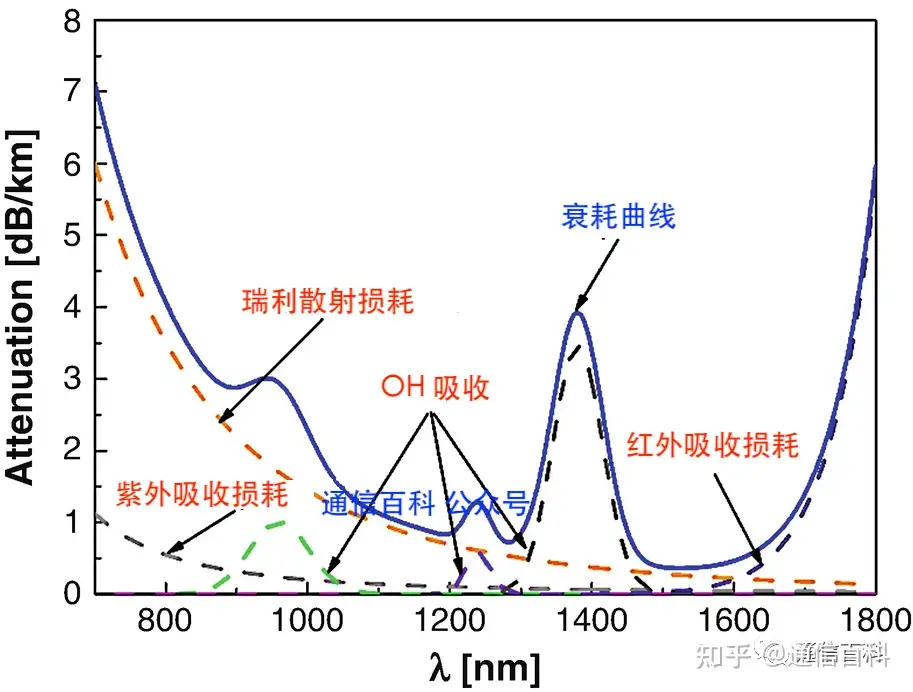
So today let’s talk about what is different between 1310 nm and 1550 nm light wavelengths transmitted in the fiber.
We know that Rayleigh scattering refers to the fact that when the particle size in the medium is much smaller than the incident light wavelength (less than one-tenth of the wavelength), the intensity of scattered light in various directions is not the same, and this intensity is inversely proportional to the fourth power of the incident light wavelength.
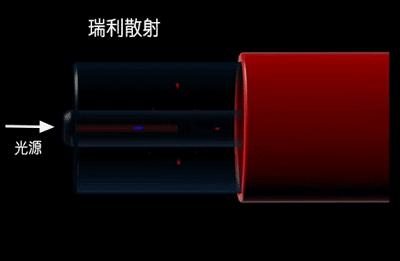
Through the derivation of the Rayleigh scattering formula, the following conclusion is obtained:
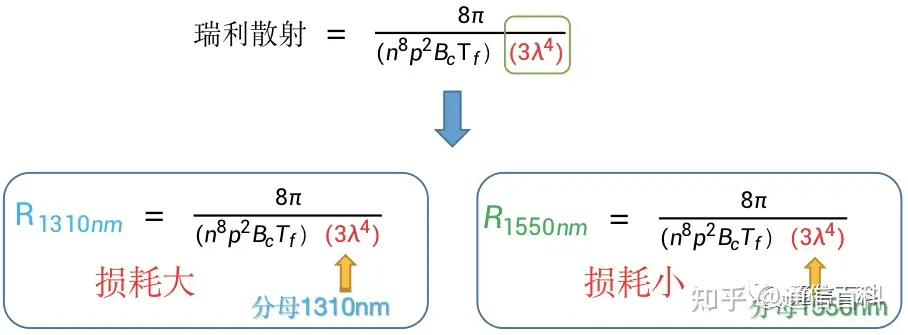
That is, the shorter the wavelength of the light, the more energy is lost to Rayleigh scattering. Therefore, the fiber loss at 1310 nm is greater than that at 1550 nm. So we often say that when measuring fiber loss, as long as the power loss at 1310 nm meets the requirement, then 1550 nm is fine.
For bending loss, when the fiber is bent within its allowable bending radius, the incident angle of the optical signal is still greater than the critical angle, and total internal reflection still occurs in the fiber. When the fiber is excessively bent, the incident angle is less than the critical angle, and total internal reflection does not occur at the bend point, causing light to leak into the cladding, resulting in bending loss.
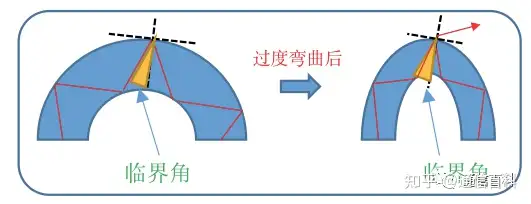
So, is 1310 nm or 1550 nm light better at resisting bending in the fiber? Let’s look at the relationship between the critical curvature radius of fiber bending and the size of the light wavelength, as shown in the following formula:
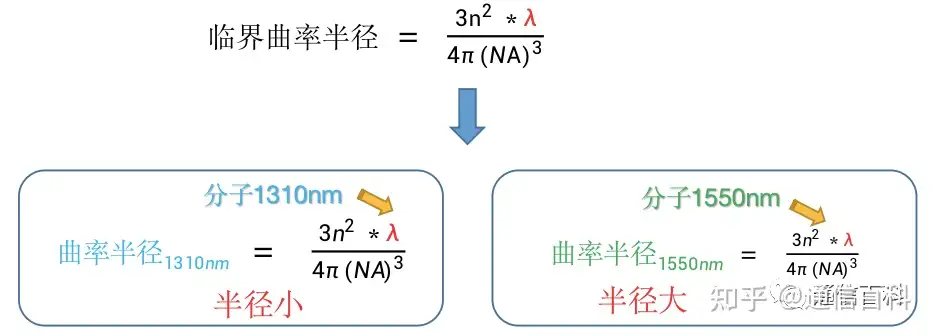
That is, the smaller the critical curvature radius, the stronger the ability to resist bending loss, and the more it can be bent. When the fiber has a certain bend, as long as 1550 nm light can pass, 1310 nm light will certainly be fine. Finally, do you know the minimum bending radius allowed for commonly used fibers on the market?

Enjoy this article?
Subscribe to get new optical communication insights delivered to your inbox. Free, unsubscribe anytime.