When light propagates in a vacuum, individual waves from different light sources do not interact with each other. However, when light propagates in a material, such as in an optical fiber, the light waves interact with the material or other light waves in various ways. The impact of this interaction will lead to changes in the light waves themselves and cause changes between different light waves.
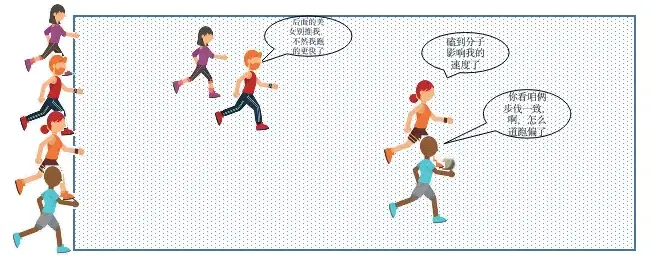
This is like several people running together. As they run, some people slow down because they trip on a stone (the medium) on the track (power reduction). Some people like to push the person in front, causing the front runner to go faster (short-wave energy transfers to long wave). Or a guy in another lane is attracted by the beauty of the girl next door and runs at the same speed as her (same frequency and phase), unconsciously turning four lanes into five lanes (generating a new wavelength).
Returning to the optical fiber medium, the interaction between light and the material in the fiber is generally relatively small, and the interaction between different signals on the same fiber is also very small. However, since signals travel long distances on the fiber, very small effects also have the opportunity to accumulate into large effects. Therefore, the nonlinear effects we refer to are effects that increase significantly as the optical power level in the fiber increases.
Generally, we believe that when the launched power of the fiber is not large, the fiber exhibits linear characteristics. After optical amplifiers and high-power lasers are used in optical fiber communication systems, as the launched power increases, the nonlinear effects of the fiber will become very significant, thus bringing many adverse effects to the optical system.
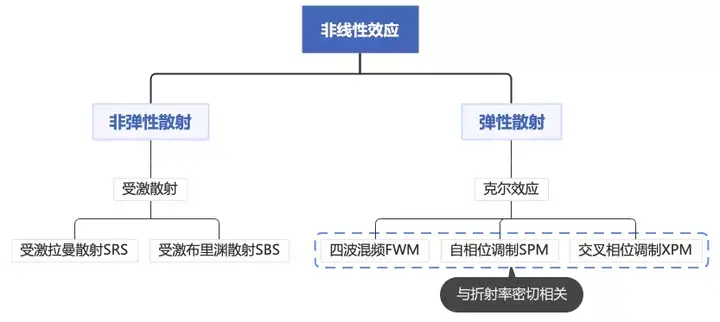
Here, nonlinear effects can be divided into elastic effects and inelastic effects. Elastic effects refer to the interaction between light waves and the medium where they are affected by it, but there is no energy exchange between the two; they are mainly related to wavelength and refractive index, and we also call them Kerr effects. The main example of elastic scattering is four-wave mixing. “Inelastic scattering” is where energy transfer occurs between the involved matter and light waves. Stimulated Brillouin scattering and stimulated Raman scattering are examples of this type.
- Inelastic scattering: stimulated Raman scattering (SRS), stimulated Brillouin scattering (SBS);
- Elastic scattering: Kerr effects (self-phase modulation SPM, cross-phase modulation XPM, four-wave mixing FWM).
For the complete content, please scan the QR code below with WeChat to read it on the “Communication Encyclopedia” official account:

Previous articles in the series:
- Light and Technology: What Is the Difference Between Gray Light and Colored Light?
- Light and Technology: How Do 1310 nm and 1550 nm Light Differ?
- Light and Technology: The Road to Expanding Optical Transmission Capacity

Related Reading
- What Is the Transmission Path of Light in an Optical Fiber?
- Optical Fiber Communication: The Structure of Optical Fiber
- Optical Fiber Communication: Mode Field Diameter and Cutoff Wavelength
Enjoy this article?
Subscribe to get new optical communication insights delivered to your inbox. Free, unsubscribe anytime.