Recently, the 4x400G MSA was established as an industry alliance to promote the development and adoption of high-density 1.6T pluggable optical modules. Its founding members include Arista, Broadcom, Intel, Molex, and AOI.

The 4x400G MSA will meet end-user demands for next-generation network infrastructure based on the existing 100G Lambda optical interface standard, with a single-mode fiber transmission distance of up to 10 km. Using widely available and proven per-channel 100G optical component technology and infrastructure manufacturing, the 4x400G 1.6T solution can be delivered quickly.
In addition, the specification will ensure that high-density 1.6T optical interfaces will interoperate with the standard 400G FR4 and 2x400G FR4 optical modules already deployed in 12.8T and 25.6T switches and other network equipment. The same approach can be used to provide 4x400G LR4 optical modules that are fully interoperable with installed 400G LR4 and 2x400G LR4 optical modules.
Q: Why does the industry need the 4x400G MSA?
A: Promoting the reuse of mature, industry-standard high-capacity optical 400G interface specifications will help build a healthy partner ecosystem and accelerate time-to-market for 1.6T optical interconnects. The 4x400G MSA will specify 1.6T interfaces that are backward compatible with the 800G and 400G standards in use today. Backward compatibility is critical to the industry. Because ASICs are designed to support multiple interface rates, providing optical interconnects that can leverage this advantage gives network architects a path to incrementally upgrade networks to 1.6T.
Q: Does the 4x400G MSA depend on other external standards activities?
A: The 4x400G MSA will promote interface solutions based on 100G per optical channel technology and architecture for 1.6T, some examples of which are already clearly defined or under development in IEEE or other MSAs. If necessary, the 4x400G MSA will also draw on and reference form-factor-specific MSAs, such as the OSFP-XD MSA and the Common Module Interface Specification (CMIS).
Q: What are the expected use cases of the 4x400G MSA?
A: The 4x400G MSA will promote fully interoperable optical links by leveraging existing and proven IEEE standard 802.3cu optical interfaces and end-to-end KP4, meeting end-user demands for next-generation Ethernet network infrastructure based on 51.2 switch ASICs, up to 100 m over multimode fiber or up to 2 km over single-mode fiber, and up to 10 km based on the popular 100G Lambda MSA interface.
The 4x400G MSA can be said to be an alternative path to 1.6T, that is, setting 16 100G channels on the optical and electrical sides of a transceiver in the OSFP-XD form factor. The figure below shows the three dimensions of higher-speed module paths.
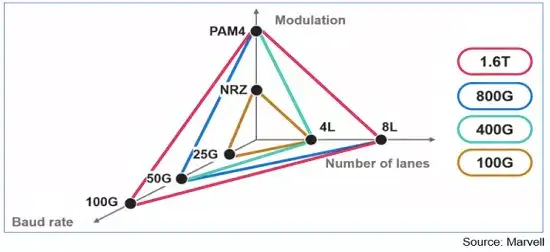
Inphi, now part of Marvell, moves upward along the vertical axis: from NRZ to PAM4. It started with 25G baud rate for 200G and 2x200G transceivers, then 50G baud rate for 400G (4x100G) and 800G (2x400G) transceivers. From the figure, the next logical step is a 100G baud rate DSP to support the 8x200G design of 1.6T modules.
As for per-channel 200G DSP and optical components, they are still under development. At the same time, the market is not very confident about whether suppliers can manufacture 200G optics with the high yield needed to reduce costs, whether they will be as reliable as 100G optics, and how long it will take for these new chips to qualify.
The primary goal of this 4x400G MSA is to reduce the risks associated with 200G optics performance, and the second goal is to launch 16x100G transceivers as soon as possible.
[Communication Encyclopedia * Knowledge Planet]
A massive collection of technical solutions, e-books, and knowledge principles…
PPT, PDF, WORD…
High-value resources are continuously uploaded…
Join now while the price is attractive!!!

Related Reading
- POET: 1.6T (4x400G) 2FR4 Optical Module Based on Interposer Layer
- 400G Line-Side Transmission Solutions
- Introduction to 400G Ethernet Transceivers
Enjoy this article?
Subscribe to get new optical communication insights delivered to your inbox. Free, unsubscribe anytime.