Traffic growth brings bandwidth pressure to long-distance transmission. The growth of network traffic leads to an increase in port bandwidth on the transmission network. For long-distance and high-bandwidth transmission, coherent transmission technology based on wavelength division multiplexing (WDM) provides the best solution. Historical article: 400G+ Optical Transmission System: Baud Rate, Modulation and Spectrum Technology

As the 400G coherent solution matures, the demand for 400G coherent ports will grow rapidly. There are two drivers for the growth of 400G coherent ports:
- Network bandwidth growth;
- Increase in the number of client-side 400GE ports.
Using one 400G wavelength to carry 400GE services has been proven to be the most cost-effective approach. According to LightCounting’s forecast report, 400G coherent ports will be used in more and more networks and will see the fastest growth in the next 5 years. As network traffic, total wavelengths, and the number of wavelengths per network continue to increase, network operators will also raise their requirements for flexibility in network management and scheduling, thereby driving the large-scale deployment of reconfigurable optical add-drop multiplexers (ROADM) and optical cross-connects (OXC). Through wavelength selective switching (WSS) technology, operators can dynamically configure wavelength paths as needed and achieve point-to-point connections through optical paths, reducing latency and power consumption. Because of these benefits, more and more operators are adopting this solution. For example, in 2017, a Chinese T operator built a ROADM network with as many as 364 wavelengths along the middle and lower reaches of the Yangtze River. Flexible-rate modulation and flexible-grid technology make DWDM networks more flexible and resilient, whereas traditional DWDM systems use a fixed 50/100 GHz grid, center frequency, and channel width. If flexible modulation and grid technology are available, the modulation format and channel width of each port can be customized according to capacity and transmission distance, improving spectral efficiency and transmission capacity. The figure below is a schematic of flexible rate and grid for flexible network configuration.
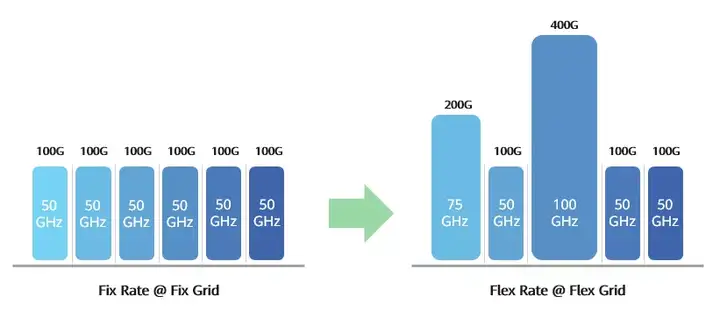
Changes in network architecture require more flexible line-side optical modules supporting Flex Rate and Flex Grid. At present, the trend of optical networks is toward higher spectral efficiency, approaching the Shannon limit. Coherent optical modules are developing in three directions:
- Spectral efficiency: improve spectral efficiency and single-fiber capacity based on advances in oDSP algorithms;
- Baud rate: increase the single-wavelength baud rate to obtain higher single-port bandwidth and reduce cost per bit and power consumption;
- Smaller size and lower power consumption: adopt integrated optoelectronic components, advanced manufacturing processes, and dedicated oDSP algorithms.
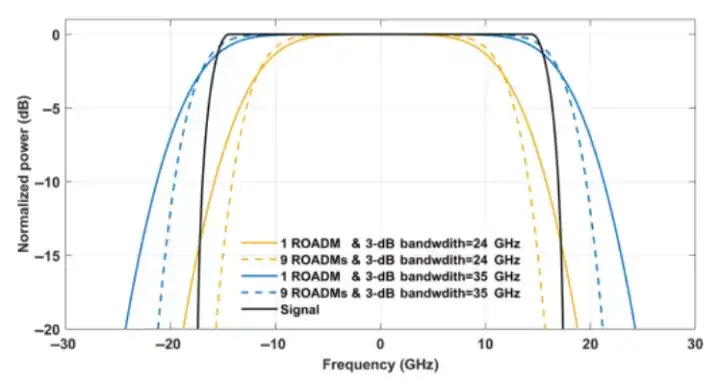
Due to the Shannon limit, the 64 Gbaud 400G wavelength cannot achieve the performance required for long-distance optical transmission. Higher baud rates and more complex and powerful oDSP algorithms are needed to meet the requirements of inter-city (regional) and long-distance backbone networks. For example, for long-distance links (> 1000 km), the baud rate of the 400G wavelength should be above 90 Gbaud, and the ADC and DAC rates in the oDSP need to be increased at the same time. However, as the baud rate increases, the penalty of fiber transmission is higher and harder to compensate. Therefore, stronger compensation algorithms are needed to compensate for physical lane impairments. Given that ROADM is already widely used, an end-to-end wavelength link needs to pass through several or even dozens of ROADMs, which contain wavelength selective switches (WSS). The filtering cascade effect of WSS narrows the effective bandwidth of the link, placing higher requirements on the compensation algorithms in the oDSP. The figure below shows the impact of multi-stage ROADM on optical channel bandwidth.
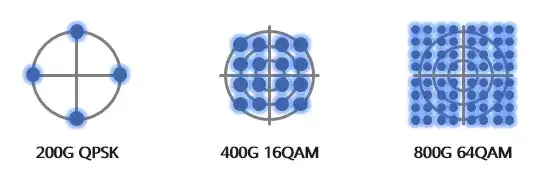
In addition, many operators hope to flexibly configure the modulation format and baud rate according to port rate and transmission distance. For example, deploying 400G 16QAM for 400G long-distance transmission and 800G 64QAM for metro data center interconnect of tens of kilometers, to improve spectral efficiency and reduce cost per bit. With this flexible modulation technology and the flexible grid of the optical layer, fiber capacity can be maximized, thereby saving investment in optical cable. 400G optical modules for long-distance large-capacity transmission networks. HiSilicon Optoelectronics’ long-distance large-capacity 400G coherent optical module solution meets the needs of different customers. Each module supports flexible-rate modulation (100G/200G/400G), using CFP2 and micro packages. To meet the large-capacity needs of customers, it supports both 40 nm C-band spectral width and 48 nm Super C-band, with a maximum of 120 wavelengths. Small-size silicon photonics components or high-performance high-bandwidth InP components are used to meet a range of different application scenarios. The principle of 400G coherent optical modules of different packages is the same. The Tx end of the 400G coherent optical module consists of oDSP, data driver, wavelength-tunable laser, and PDM-I/Q modulator. First, the data from the main board is mapped and encoded. Then, the Tx-oDSP performs spectral shaping and compensation on the data link bandwidth. After that, the data driver amplifies the amplitude and inputs the amplified data into the modulator. The modulator then converts the data into an optical signal for output. On the Rx side, the optical signal enters the ICR and interferes with the local oscillator wavelength to achieve photoelectric conversion. After the high-speed ADC samples the electrical signal, it compensates for dispersion (CD) and polarization state (SOP). The figure below is a block diagram of the coherent optical module.
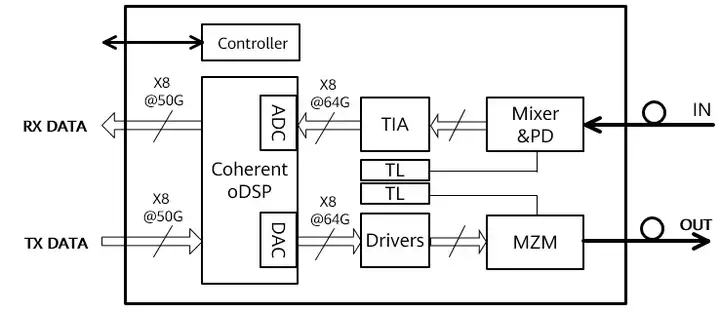
For the 400G CFP2 module used for 400G large-capacity long-distance transmission, the following recommendations are given:
- Comply with the CFP2 protocol (MSA);
- Use the CFP2 package;
- Compiled to comply with the 400G CAUI-8 and FlexO interface specifications;
- Support multiple modulation formats, including QPSK and 16QAM;
- Support 400G 16QAM 500 km @ 75 GHz and 200G QPSK 2000 km @ 75 GHz.
The 400G CFP2 is a pluggable optical module that provides optimal performance, integrating multiple innovative technologies to improve 400G transmission performance. The figure below is a block diagram of the 400G CFP2.
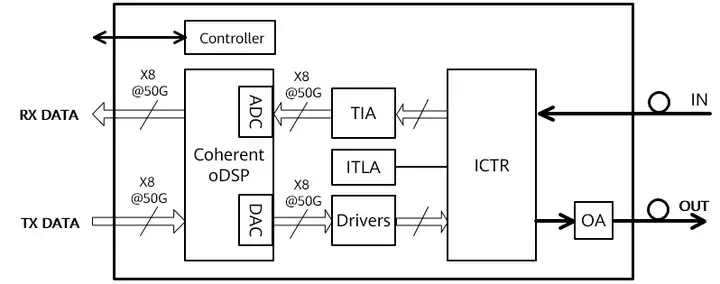
● High-performance low-power oDSP. To increase the transmission distance, Turbo Product Codes (TPC) FEC technology is adopted – high performance and low power – continuously approaching the Shannon limit. It also supports elastic rates from 200G to 400G. In addition, a low-power IP/DSP architecture is adopted to achieve pluggable and low-power characteristics. For 400G CFP2, multiple modulation formats are supported, including 400G 16QAM, 200G QPSK, and DQPSK. For large-capacity transmission, 16QAM is recommended to achieve single-wavelength 400G@75GHz transmission. For new networks, QPSK is recommended for 200G@75 GHz transmission, with a transmission distance of 2000 kilometers. Conversely, DQPSK is suitable for existing networks in hybrid scenarios to reduce the impact on linearity. ● Super C-band capability. In wavelength division multiplexing systems, the capacity of a single-fiber system is directly affected by the number of transmission wavelengths. This CFP2 module is the industry’s first Super C-band optical module, supporting 80 wavelengths of 400G@75G, achieving a single-fiber optical transmission capacity of 32T. The realization of the Super C-band depends on other capabilities, including the underlying laser, ICTR, and built-in optical amplifier (OA). To achieve the low-power compact design of the CFP2 package, Tx and Rx share one laser, and fewer lasers are used in this process. In addition, HiSilicon’s unique laser design adopts a compact nano-laser with high output optical power. The figure below shows the ultra-wideband spectrum (120 wavelengths).

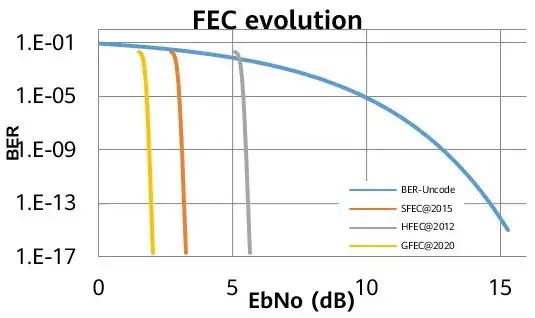
● Large output optical power adjustment range. In long-distance transmission, fine adjustment of the output optical power is needed for better performance. The output optical power of the 400G CFP2 can be precisely adjusted in the range of +1 dBm to +4 dBm to meet the input power requirements of different optical layers. ● Silicon photonics integrated ICTR. Silicon photonics ICTR technology is adopted in the 400G CFP2 optical module to minimize physical size. Due to its unique optical characteristics, silicon photonics has greater optical field confinement, resulting in a more compact waveguide structure. In addition, silicon photonics supports polarization handling, enabling modulation and coherent detection of dual-polarization 16QAM signals while minimizing the size of the ICTR chip. ● Optoelectronic multi-chip packaging. The RF link performance from oDSP to optical modulator is optimized to reduce the requirements on the driver, thereby reducing power consumption. In addition, the optical chip and electronic chip are packaged together to reduce physical size. ● High-performance compact OA. Silicon photonics ICTR technology is used to achieve compact size, but it leads to relatively large insertion loss. To meet the requirements of high-performance optical transmission, a small OA independently developed by HiSilicon is used at the output to amplify the optical signal. In addition, the NF of the OA is optimized for high-quality amplified optical signals. For the 400G MSA optical module for long-distance, ultra-large-capacity transmission, the following recommendations are given. ● High-performance oDSP. To increase the transmission distance, high-performance FEC technology is adopted to continuously approach the Shannon limit, while supporting elastic rates of 200-800G. When the number of ROADMs and cascaded filters in the all-optical network architecture increases, the faster-than-Nyquist (FTN) algorithm is used to enhance the pass-through capability of the filters, ensuring that multi-stage filters do not cause loss. The fiber link data acquisition and analysis module is integrated into the network management system to improve full-lifecycle operation and maintenance capability. The figure below shows the 400G MSA transmission performance.
● High-performance laser. In a coherent 400G system, the tunable laser at Tx provides the optical signal for modulation. At Rx, another tunable laser provides the optical signal used as the local reference signal for coherent detection. The laser should have the following characteristics:
- High output optical power: ensure high incident optical power of the module and improve transmission performance;
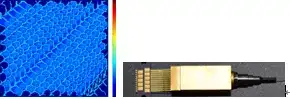
- Narrow linewidth: nonlinear phase noise is introduced after the optical signal passes through fiber transmission, and linewidth is directly related to phase noise. This is especially true for high-order quadrature amplitude modulation (QAM) transmission, which further raises the requirement on linewidth. A unique InP integrated laser with SOA is adopted to ensure high output optical power.
In addition, a unique grating design and wavelength control scheme are adopted to achieve ultra-narrow linewidth and high-stability wavelength locking. Furthermore, by optimizing the gain medium and tunable grating of the laser, a tunable laser covering the Super C-band is achieved. The figure below shows the high-performance laser.
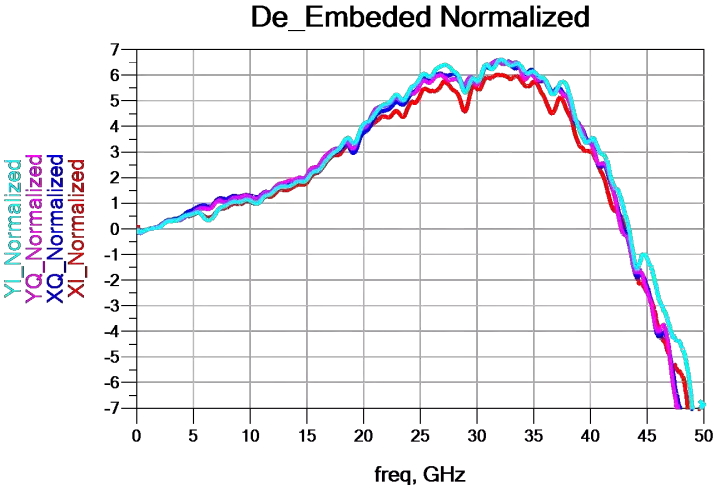
● High-performance modulator. Usually, the modulator is created using one of the following three technologies: lithium niobate (LiNbO3), indium phosphide (InP), or silicon photonics technology. Each has its own strengths and weaknesses. LiNbO3 is a mature optical component platform that can achieve high bandwidth and low drive amplitude, but the component size is relatively large. InP supports high-bandwidth modulation and can integrate SOA to achieve high output optical power. However, InP is very sensitive to temperature, and temperature control requires a TEC. On the other hand, silicon photonics modulators reduce physical size while integrating polarization multiplexing functional units at the chip level, but require a larger drive voltage. The 400G MSA uses a semi-insulating substrate and a unique Mach-Zehnder modulator to achieve high-bandwidth InP I/Q-MZ and SOA integration. In this way, high modulation bandwidth and high output optical power are achieved. The figure below shows the high modulation bandwidth supported by the InP modulator.
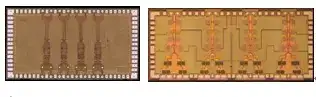
● High-performance optoelectronic or RFIC. At the Tx of the coherent optical receiver, a driver is needed to amplify the electrical signal to drive the optical modulator. At the Rx end, a TIA is needed to convert the current signal into a voltage signal and amplify the voltage signal. The coherent system adopts QAM; therefore, the Driver and TIA need to have higher bandwidth and better linearity. Based on innovative circuit architecture and active equalization design, linear drivers and TIAs with ultra-high bandwidth, ultra-high linearity, and ultra-low noise are achieved. Coherent driver modulators (CDM) and ICR also provide high bandwidth. The figure below shows the TIA and driver.
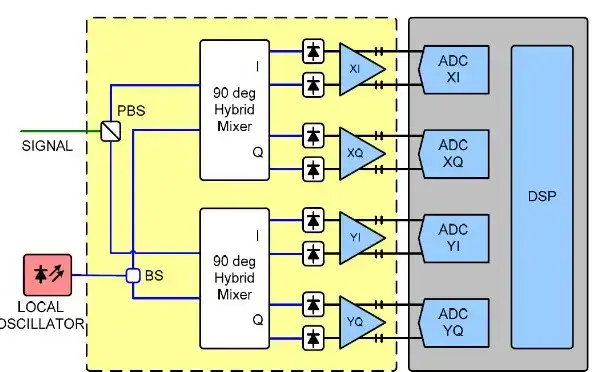
● High-performance ICR. In the coherent optical receiver, the ICR is used at Rx to receive the optical signal. This process also involves an optical mixer and PD for converting the optical signal into an electrical signal. ICR-related technologies include: silicon-on-insulator (SOI) technology for ICR integration; planar lightwave circuit (PLC) technology for the optical mixer; and an InP PD. An optical mixer based on SiN technology can be used to achieve good fiber coupling and polarization handling for the best optical mixing effect. The InP PD with high bandwidth and high sensitivity is mounted on the SiN chip through a unique flip-chip package, forming a highly integrated, high-performance, and small-size ICR. The ICR diagram is shown below.
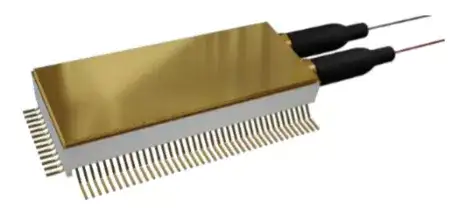
● High-performance packaging. The 400G MSA uses a high-performance charged device model (CDM) package. The high-bandwidth driver and modulator are packaged in one component, reducing the trace length of high-speed RF signals, thereby ensuring the integrity of high-speed signals and the high bandwidth of the component. Some electrical ports use pins to ensure stable connection and bandwidth of the access signal, thereby improving the performance of the CDM component. The figure below shows a schematic of the high-performance component packaging.
● 200-800G elastic rate, single-wavelength 800G large-capacity transmission. With powerful oDSP and high-bandwidth optical components, this micro module supports high-order QAM. At the same time, constellation shaping 2.0 is used to support 200-800G adjustment. In addition, the built-in OA can ensure the output optical power under higher-order modulation. The figure below shows the flexible modulation format.
The demand for higher capacity, lower cost per bit, and lower power consumption is driving the transmission rate of optical modules higher and higher. As the mainstream technology of the previous generation, 100G has entered the mature and stable stage of its life cycle, and the reduction in unit cost is extremely limited. At present, mainstream 400G optical modules have been applied to various network scenarios such as data center networking, metro integrated bearer networks, and large-capacity long-distance transmission networks.
This article comes from the Internet and was organized and published by the “Communication Encyclopedia” WeChat official account.
[Communication Encyclopedia * Knowledge Planet] Massive technical solutions, e-books, technical documents, equipment vendor product books…
1. 400G+ Technology White Paper.pdf 2. 5G Fronthaul Interface eCPRI Analysis.pdf 3. Basic Principles of Optical Modules.ppt 4. ROADM Principles and Applications.ppt 5. 5G Fronthaul Manual.pdf 6. SDN Basic Training Courseware.ppt 7. Fronthaul and Fiber Multiplication Solutions for 5G Integrated Bearer 8. CRAN Networking Solution and Construction Principles.pptx 9. Communication Principles – E-book.pdf 10. China Mobile 5G Fronthaul Solution Exchange.pptx 11. Basic Structure and Working Principle of OXC.ppt 12. OTN System Design Exchange Material.ppt 13. SPN Overall Technical Requirements.pdf 14. Overview of 400G Technology.ppt …….High-value resources are being uploaded continuously…
Related Reading
- MSA’s 800G Optical Module – Technical Analysis of 8x100G in SR Scenarios
- 400G Line Transmission Solution
- Transmission Mode of Time Synchronization 1588 in DWDM/OTN
Enjoy this article?
Subscribe to get new optical communication insights delivered to your inbox. Free, unsubscribe anytime.