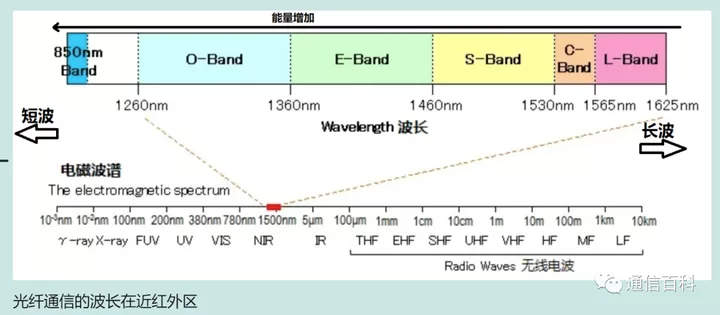
It was not until 1930, when the first silica filament was drawn, that we truly entered the optical fiber era. So can all light propagate in optical fiber and effectively transmit information? The figure below is the spectrum chart of optical fiber communication; the wavelength of optical fiber communication mainly works in the near-infrared region.
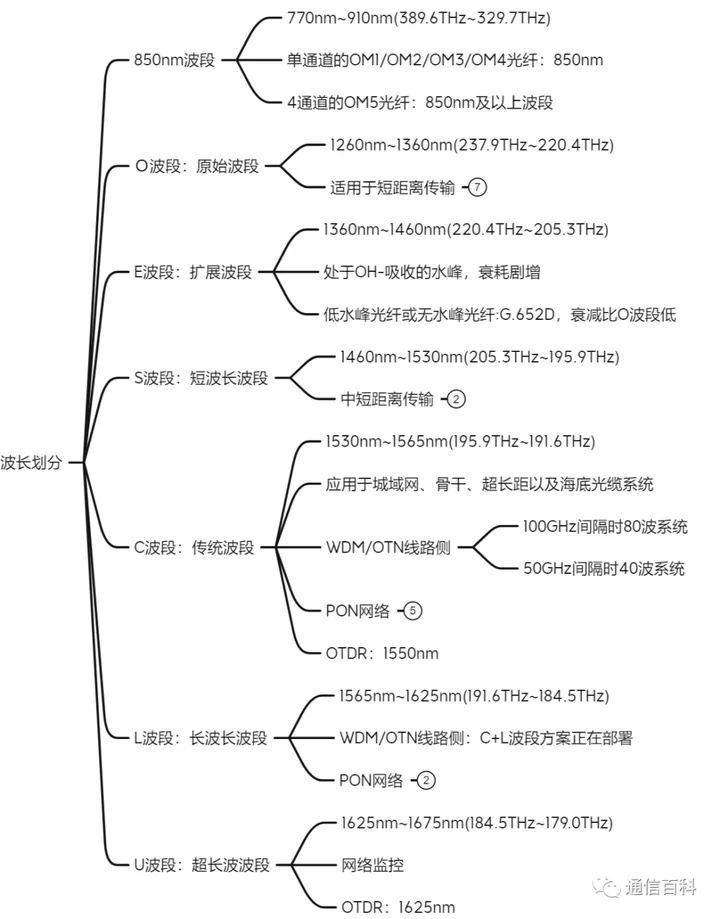
Different transmission wavelengths have different loss attenuation and application scenarios.
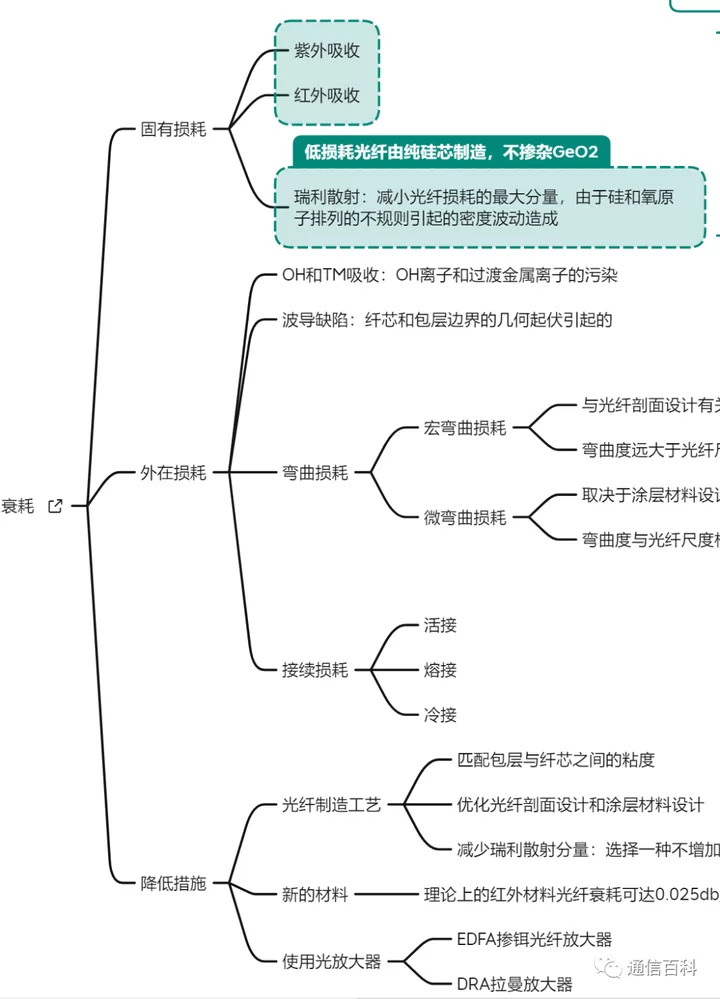
These transmission bands have different transmission attenuation in the fiber. There are many causes of fiber loss, including intrinsic loss and extrinsic loss.
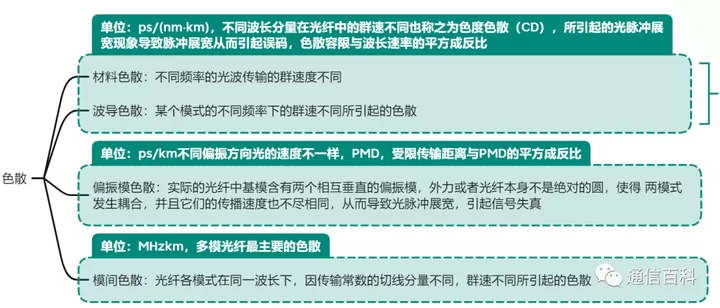
In terms of dispersion, it is divided into material dispersion, waveguide dispersion, polarization mode dispersion, and intermodal dispersion. The unit of intermodal dispersion is MHz·km, and it is the main dispersion of multimode fiber.
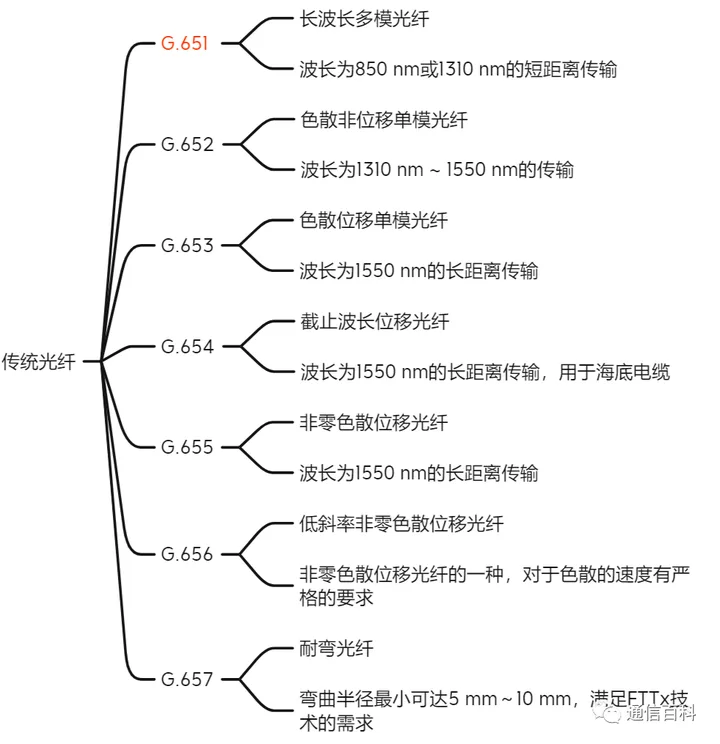
According to the differences in attenuation, dispersion, and other characteristics, their application scenarios also differ. The main classification of optical fiber is as follows:
Traditional optical fiber consists of an inner layer and an outer layer. To protect the fiber from moisture erosion and mechanical abrasion, a coating is added to the outermost layer. To achieve total internal reflection, the refractive index N1 of the inner layer must be greater than the refractive index N2 of the outer layer; N1 greater than N2 is a necessary condition for optical signals to be transmitted in the fiber.
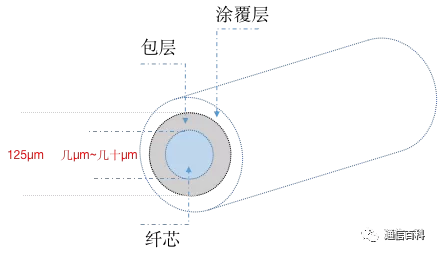
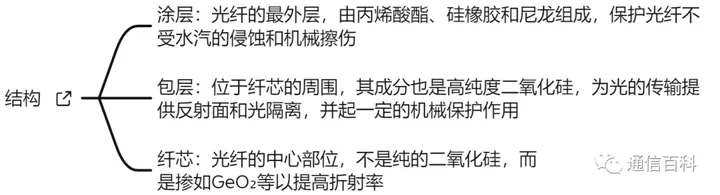
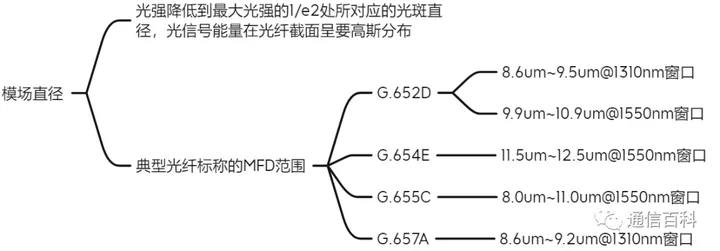
The structure of optical fiber involves many important parameters, such as core diameter, cutoff wavelength, mode field diameter, and effective area. The core diameter is relatively easy to understand, as shown in the figure above. The mode field diameter refers to the spot diameter corresponding to where the light intensity drops to 1/e² of the maximum light intensity. The optical signal energy is Gaussian-distributed across the fiber cross-section, and different fibers have different nominal mode field diameters.
We have discussed the effective area of fiber many times. Here, from another angle, it is proportional to the wavelength; the core diameter can also be appropriately increased without breaking single-mode properties, and the cladding diameter has little relation to the effective area. As for the cutoff wavelength, it involves concepts such as mode cutoff, the fundamental mode, and the operating wavelength. Simply put, the cutoff wavelength refers to a certain group of solutions to the wave equation that always exists when all other modes are cut off under certain conditions, that is, a certain mode can continue to propagate in the core; this solution (mode) is called the fundamental mode.
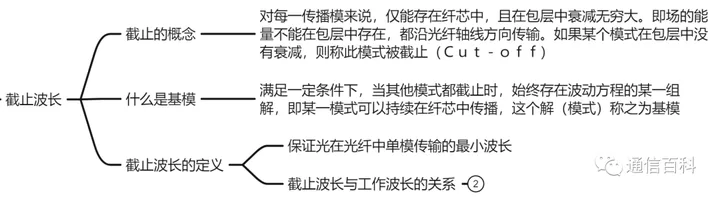
- Operating wavelength λ > cutoff wavelength λc: single-mode fiber transmitting only the fundamental mode
- Operating wavelength λ < cutoff wavelength λc: multimode fiber that can propagate higher-order modes in addition to the fundamental mode
There are many types of optical fiber nowadays, and many new types of fiber have emerged, such as SDM multicore fiber, hollow-core fiber, and polarization-maintaining fiber. Among them, polarization-maintaining fiber, as a special fiber, is mainly used in sensors such as fiber optic gyroscopes and fiber optic hydrophones, as well as DWDM, EDFA, and other optical fiber communication systems. The figure below shows the basic structure of polarization-maintaining fiber.
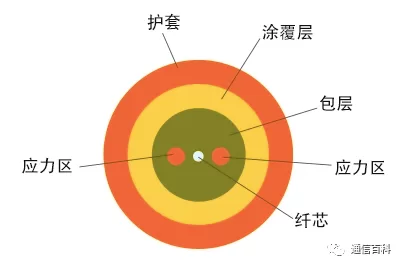
Polarization-maintaining fiber, as the core component of fiber optic gyroscopes and fiber optic hydrophones that can be used in military inertial navigation and sonar, was once placed on the embargo list by Western developed countries against China. Of course, some domestic fiber manufacturers can now produce it.
Related Reading
- What Is the Transmission Path of Light in an Optical Fiber?
- Optical Fiber Communication: The Structure of Optical Fiber
- Optical Fiber Communication: Mode Field Diameter and Cutoff Wavelength
Enjoy this article?
Subscribe to get new optical communication insights delivered to your inbox. Free, unsubscribe anytime.