Over the weekend I saw some interesting topics. When talking about Apple’s new purple iPhone, Boss Zhang said: purple does not exist in the sun’s spectrum, and the purple produced by the human eye requires re-superposition of the spectrum. As someone working in optical communication, I always feel something is off.

Let’s break down this expert’s statement into two aspects:
(1) There is no purple in the solar spectrum;
(2) The purple produced in the human eye is an addition to this spectrum. Regarding the first view that “there is no purple in the solar spectrum,” let me first give a conclusion: it is definitely wrong. Because a few days ago when we were talking about the characteristics of optical fiber communication, we put up a solar spectrum chart, and I clearly remember that there is a spectrum range around 380 nm, as shown in the red box below:
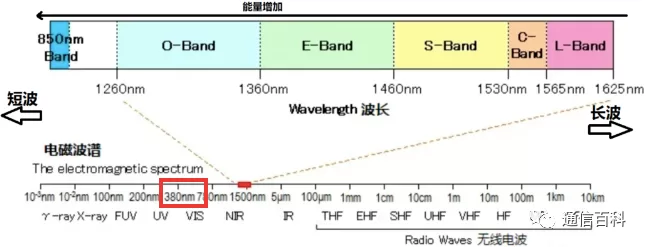
According to the first definition of purple light, in the visible light of the spectrum above, the wavelength range of 380 nm-420 nm is the shortest light that humans can see in the spectrum, called Violet in English, which is a single-wavelength purple light.
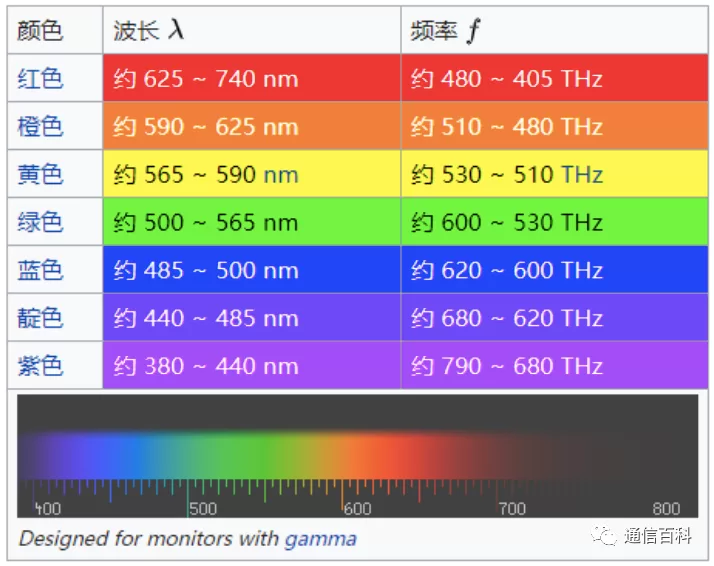
Shorter than it is the ultraviolet light (UV: Ultra-Violet) we often mention. Ultraviolet light has many uses; thanks to the solar-blind region, high signal-to-noise ratio, and scattering characteristics, ultraviolet communication is a military short-range anti-interference communication method. In addition, as we learned in junior high school physics, after natural sunlight passes through a prism, it is decomposed into red, orange, yellow, green, cyan, blue, and purple.
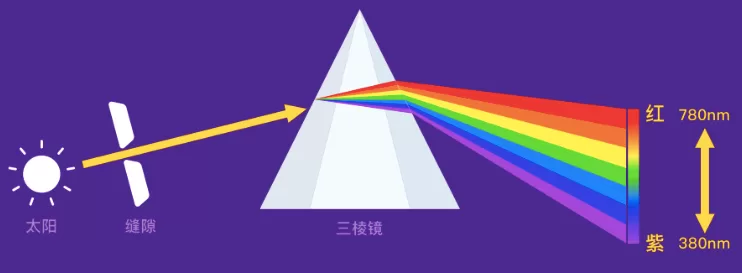
This phenomenon also shows that light can be dispersed, and the reason for the dispersion is that light of different wavelengths has different refractive indices in the medium, resulting in different propagation speeds (paths). In our optical fiber communication, this creates the dispersion effect. Therefore, purple definitely exists in the solar spectrum.
The second view: the purple produced in the human eye is an addition to this spectrum. This is both right and wrong. It is wrong because we can truly see purple things in nature, such as eggplants (in vegetable gardens), etc.

It is right because purple has another definition: it refers to a color fused from red (610 nm-760 nm) and blue (450 nm-485 nm) light, called Purple in English. For example, the purple we see on a computer in daily life (the color of the eggplant in the image above) is actually obtained by combining different frequency intensities of the RGB three primary colors.
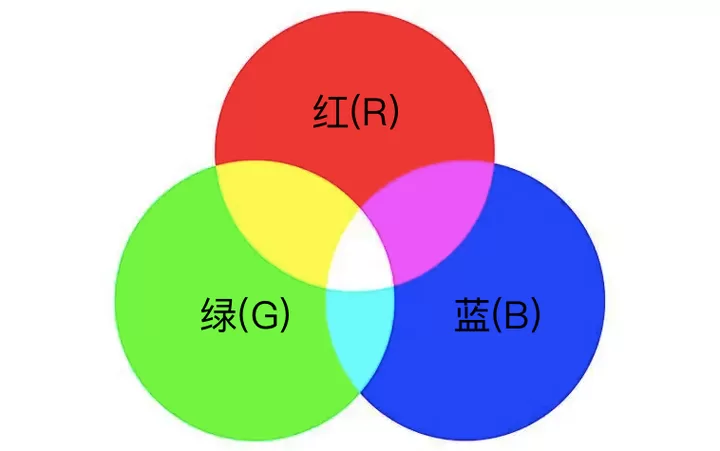
This is mainly related to the human visual system. We only need three types of cone cells S/M/L, corresponding to three different wavelengths (S for blue B, M for green G, L for red R). I won’t go into detail about the RGB principle; those interested can look it up online. So Boss Zhang’s statement that the purple produced by the human eye requires re-superposition of the spectrum is also acceptable.
Enjoy this article?
Subscribe to get new optical communication insights delivered to your inbox. Free, unsubscribe anytime.