Our optical communication industry has recently had a lot of business connections with the LiDAR industry. The “laser” in the LiDAR industry and the “laser” in optical modules have too many overlapping parts.
Yesterday we talked about the principles of laser, modulator, and detector chips.
By the way, I also wrote about the differences between communication lasers and LiDAR lasers, the differences between phase control technology in modulators for the communication industry and phased arrays in LiDAR, and the differences between communication detectors and LiDAR receiver detectors.
These three types of chips can almost all be used in LiDAR, just with slight differences.
Today let’s briefly distinguish TOF, AMCW, and FMCW in the LiDAR industry – what exactly are they?
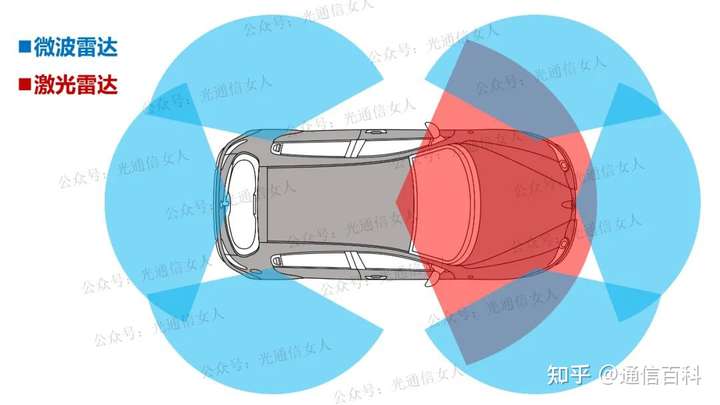
Radars installed in cars come in two types: microwave radar and LiDAR, and these two radars coexist.
The difference between microwave and laser is the wavelength of the electromagnetic wave.
The invention of the laser in 1960 was coherent optical-wave amplification based on microwave coherent amplification. Later, the optical-wave coherent amplifier was given a name: “laser,” the stimulated radiation optical amplifier.
The milestone of optical fiber communication in 1966 was also optical-wave communication implemented on the basis of microwave communication principles.
Microwaves are millimeter waves.
Light waves are micrometer waves.
Both are electromagnetic waves, so their basic principles as radar are also similar.
The three words TOF, AMCW, and FMCW in LiDAR seem understandable literally, yet also not quite understandable.

Converted into the language of our optical fiber communication:
AM is the IM/DD direct-modulation direct-detection optical module, which transmits with a PRBS pattern, re-detects the reflected optical signal, and then uses “autocorrelation” technology to improve sensitivity. What is autocorrelation? I’ll draw a diagram in a moment.
FM is the basic principle of coherent optical modules. What is a wavelength-tunable laser? It is a frequency-tunable laser. Wavelength x frequency = C, where C is a constant, the speed of light in vacuum. Tuning the wavelength is equivalent to tuning the frequency; different fields use different customary terms.
TOF uses pulse signals, while AMCW and FMCW use CW signals. CW here is different from the CW DFB we usually talk about.
The pulse of TOF is similar to the burst transmission and burst reception mode of our PON optical modules – there are pulses sometimes and no pulses at other times.
CW is relative to pulse. Ethernet modules/coherent modules that continuously transmit signals are CW, i.e., continuous wave, relative to burst pulses.
For PON ONU optical modules, there is a saying that the transmitter is in burst mode and the receiver is in continuous mode. In the LiDAR industry, this is called pulse mode at the transmitter and continuous-wave mode at the receiver.
TOF – Time of Flight
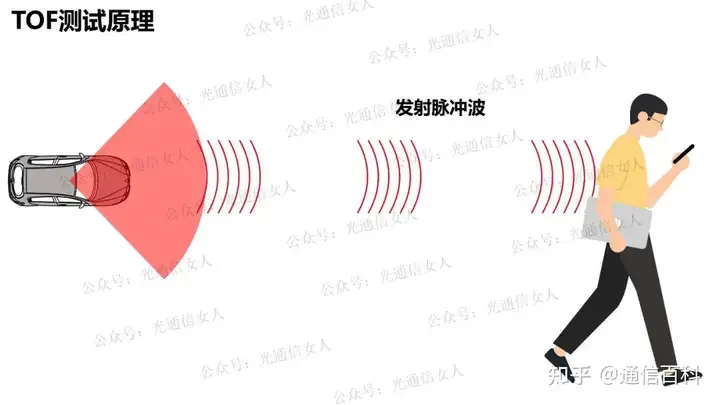
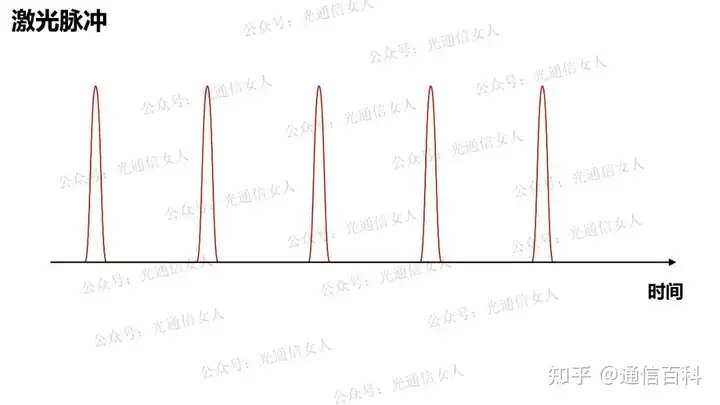
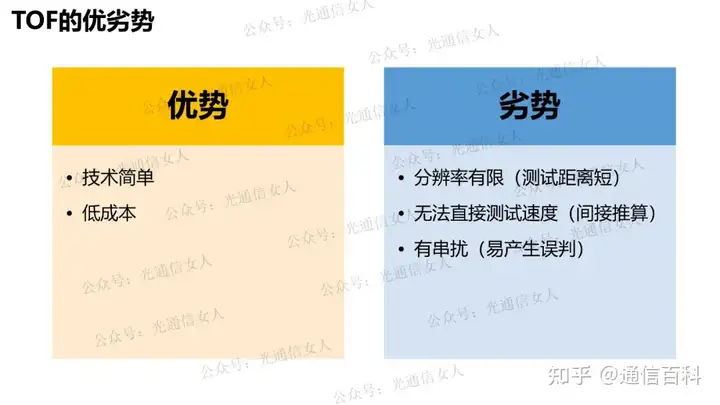
Light reflects when it encounters obstacles; detect the reflected signal and calculate the time. Distance = speed of light x time, from which the physical distance can be derived. The test accuracy is not high because the speed of light is very fast, requiring extremely high time-recognition precision to achieve a certain distance measurement accuracy.
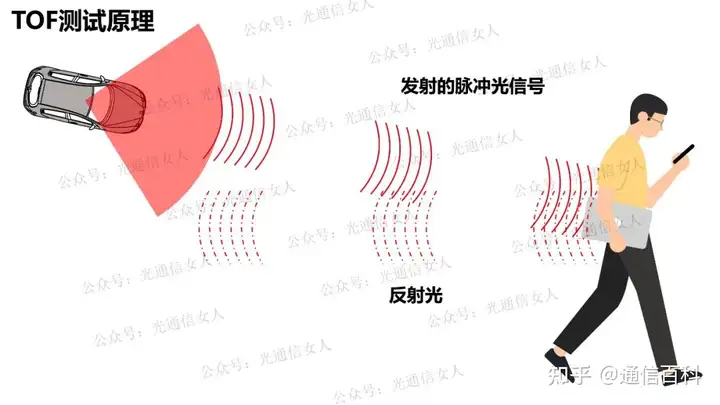
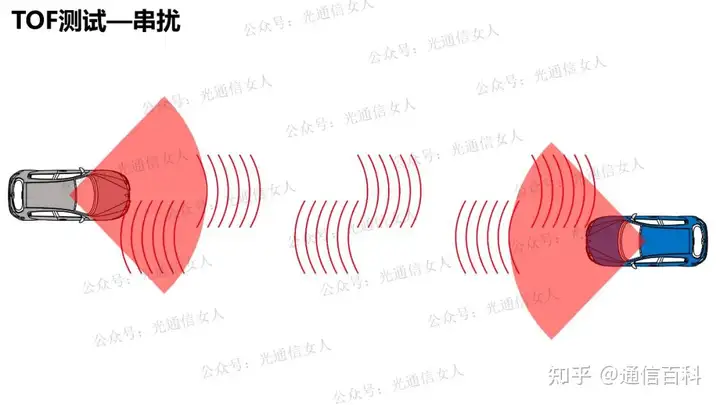
TOF has optical crosstalk; the transmitted light and received light were originally the same beam with the same wavelength. If many cars are equipped with LiDAR in the future with the same industry standard, it will be difficult to identify whether it is one’s own reflected signal or another car’s signal.
The biggest advantage of TOF is that it can quickly build a test environment using the existing optical industry chain, and the industrialization process is very fast.
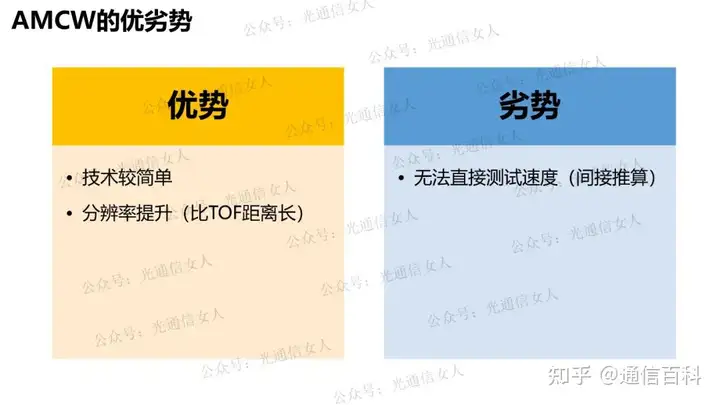
AMCW is the set of methods of conventional optical modules in our industry that perform IM/DD based on NRZ PRBS codes.
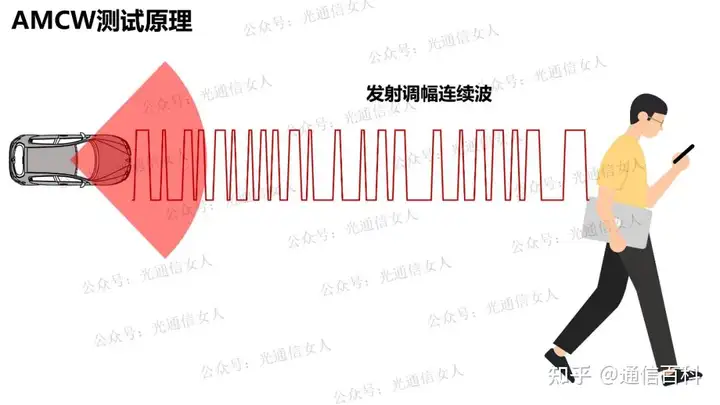
NRZ is often also called PAM2, to distinguish it from PAM4, i.e., based on second-order or fourth-order amplitude modulation. The AM in the middle of PAM2 is the AM in LiDAR’s AMCW – amplitude modulation.
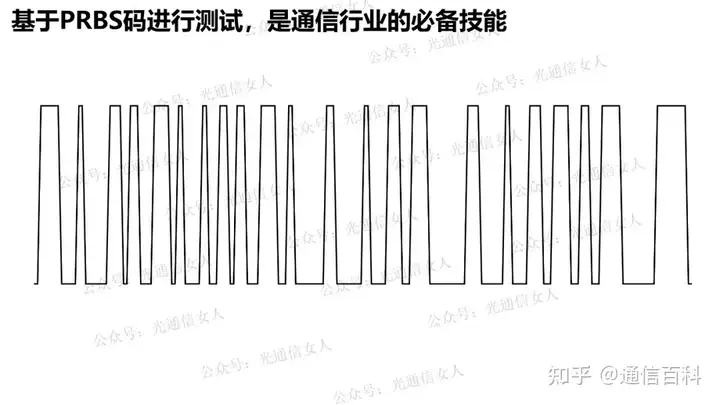
Let’s briefly talk about how AMCW’s PRBS improves sensitivity and extends detection distance. If the detection distance is very long, the signal we receive is almost buried in noise, right?

Optical modules normally don’t use autocorrelation algorithms, because autocorrelation needs a period of time to accumulate before improving sensitivity, and optical modules have too much information to process with no redundant time for the algorithm.
In our optical fiber communication, those who have worked with OTDR understand autocorrelation very well.
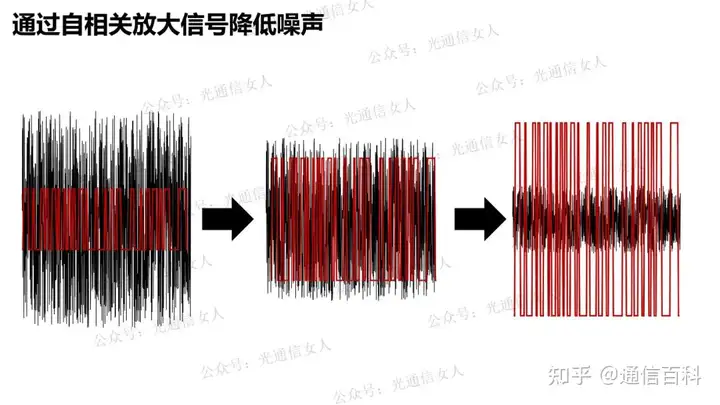
Its basic principle is also very simple. Let me mark the previous figure with two colors. The reflected signal buried in noise cannot be identified by the detector at this point – the noise amplitude is large and the signal amplitude is small, so in the detector’s view, it is as if there is no signal.
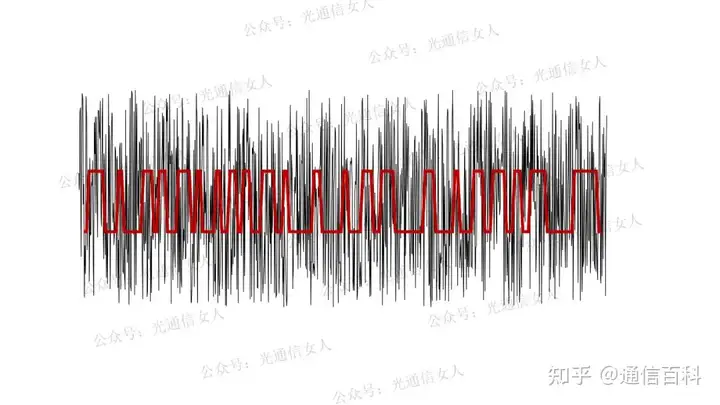
But noise is random, and the signal is our own. If there is an operational amplifier, it can be analog or digital.
Our signal has high and low levels; we divide the amplitude into two categories, “1” and “-1”. Since we know the arrangement order of our own signal, we subtract when encountering -1: 1 – (-1) = 2, and the signal increases. But noise has no positive or negative distinction, so in subtraction it is a (noise – noise) calculation.
After many operations, the signal grows larger and larger while the noise becomes smaller and smaller. This is the process of extracting signals through autocorrelation.
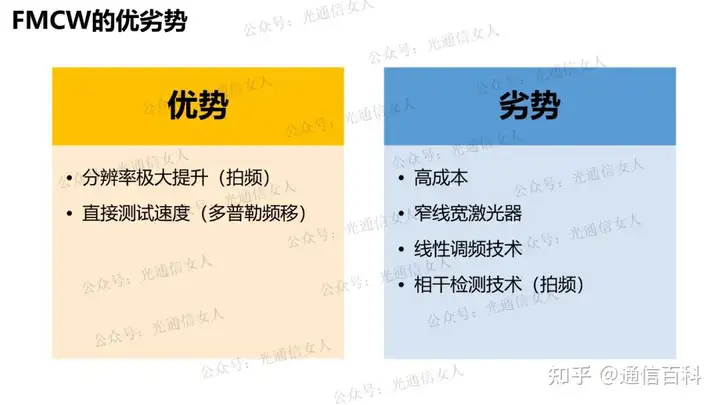
FMCW, Frequency-Modulated Continuous Wave, changes the frequency of the light wave, which in our industry is changing the wavelength of light – a wavelength-tunable laser. The difference is that our industry does not care about the “linearity” of frequency change, while the LiDAR industry cares about the linearity of frequency change.
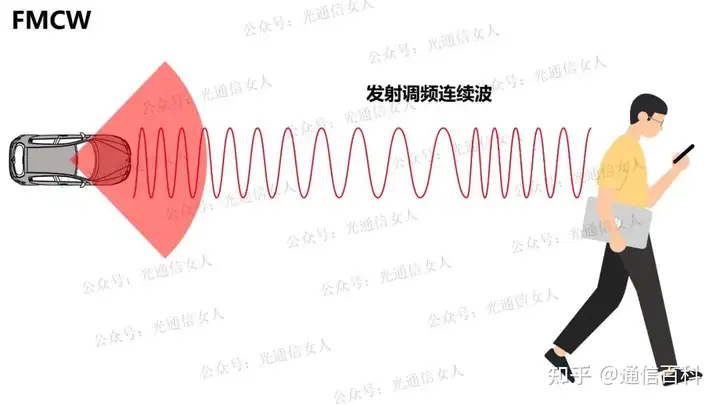
Using frequency modulation has two huge benefits: one is that Doppler frequency shift can directly calculate the moving speed of the detected object, and the other is that coherent reception can greatly improve sensitivity.
For the same single-wavelength 100G optical module, direct-modulation direct-detection has a short transmission distance, while coherent modules have a fairly long transmission distance, using coherent reception for signal extraction, and this extraction sensitivity is much better than AMCW.
What our industry calls coherent reception is what LiDAR calls “beat frequency.”
Enjoy this article?
Subscribe to get new optical communication insights delivered to your inbox. Free, unsubscribe anytime.