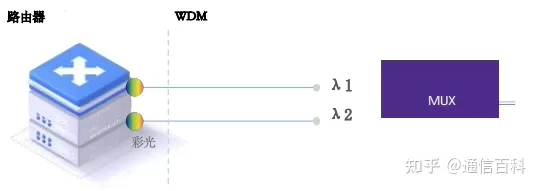
IPoWDM and IP+WDM Architecture
IPoWDM as a concept is not new; it has existed for many years. Its basic premise is the ability to deploy transport optical systems within router platforms, achieving layering and network simplification.

In addition, IPoWDM is said to reduce costs, mainly by eliminating short-distance network element interconnect optical devices and the optical common equipment that houses them. Attracted by its so-called network simplification and economic improvement, some communication service providers (CSPs) have already chosen IPoWDM.
Since network and operational requirements for CSPs are far more complex than the basic needs of cloud service providers, once CSP network needs and requirements are taken into account, the prospects of IPoWDM collapse, leaving CSPs with a multivariable problem: for IPoWDM to work, very small pluggable devices are needed. But to reduce pluggables to QSFP-DD size, key functions and performance must be sacrificed.
CSP Network/OAM Challenges
Compared with the market positioning of cloud SPs, communication service providers (CSPs) have more complex network requirements. The requirements of CSP optical networks include:
- Meeting requirements from DCI, metro, backbone, and submarine;
- Rich ROADM networks, meaning wavelengths must pass through many ROADMs;
- The desire to maximize spectral efficiency;
- The desire to maximize total system capacity;
- The need to support multiple client speeds: legacy sub-rate, 1G, 10G, 25G, 50G, 100G, and FlexE;
- The desire to support the maximum line speed per distance, using programmable modulation formats for both legacy and proprietary line rates: 200G, 400G, 600G, 800G, etc.
Therefore, the industry’s attraction to IPoWDM is somewhat shaken; it will only succeed in a very narrow niche. At the same time, because optical devices are too large and consume too much power, they cannot be practically applied to router platforms. Large optical devices with high power consumption will reduce the basic routing capability of IP network elements, which will be unsustainable for many CSP networks and applications. Compared with IPoWDM, large-scale deployment still belongs to IP+WDM and its mature feature ecosystem.
The Enduring Value of IP+WDM
From an economic perspective, a dedicated optical platform can match performance with the required combination of power and form factor.
- MSA modules: submarine, long-haul, and high-performance metro-regional routes can adopt MSA, with maximum transmission capability and performance;
- CFP2 modules: metro-regional can use CFP2, matching form factor and power, reducing transmission performance requirements, but with complete client-side and line-rate support options and good ROADM pass-through capability;
- QSFP-DD: specialized market positioning, P2P, spine-to-spine, and greenfield networks.

Through less stringent form-factor requirements, the optical platform can support more powerful transmission capability to pass through all ROADM deployment scenarios. Transmission can support up to regional and ultra-long-haul distances.
In terms of maximizing spectral efficiency and total system capacity, in the IPoWDM solution, spectral efficiency requirements are relaxed as part of the design trade-off to minimize space and power. For IPoWDM, achieving 400G transmission requires 100 GHz spacing, and this may be acceptable where service providers are very fiber-rich (for the foreseeable future). However, with IP+WDM, spectral efficiency is significantly improved with 800G transmission at 100 GHz spacing. For most CSPs, maximizing spectral efficiency is a long-term requirement.

In addition to spectral efficiency, CSPs usually also seek to maximize the use of available spectrum. Currently, 80 wavelengths are already very maturely used within the C band. The industry has increased the available spectrum within the C band to Super C, transmitting 120 wavelengths. At the same time, the L band is also developing rapidly. Service providers have already requested support for C+L to expand system capacity.
In terms of client-side and line interface requirements, the IPoWDM architecture requires all different client traffic to be aggregated through specific IP router ports, such as 400G, which may not be the most economical choice for many operators. The IP+WDM solution can leverage aggregation capabilities within the access network and use the optical transport network (OTN) switching capability to efficiently match different client-side speeds to different wavelength speeds.

In addition, in data center scenarios, IPoWDM claims it provides greater flexibility, but it actually introduces rigidity into the system. After the demand for 400G ZR emerged, its technology maturity and volume delivery were delayed by more than two years, so much so that the main supporters of 400G ZR have shifted their strategy to adopting 200G in the short term, planning 800G for the long term, and intending to skip 400G ZR entirely.
So, is it IPoWDM or IP+WDM? What do you think?
For more detailed content, join the “Communication Encyclopedia * Knowledge Planet” to download and access a vast collection of documents.
Related Reading
- Modular WDM Technical Solution (Document)
- Huawei WDM Training Materials
- N x 25Gbit/s WDM-PON for 5G Fronthaul
Enjoy this article?
Subscribe to get new optical communication insights delivered to your inbox. Free, unsubscribe anytime.