Foreword: Pigeon post is quite interesting. It is said that during the Chu-Han War, Liu Bang was surrounded by Xiang Yu, and at that time Liu Bang used pigeon post to request reinforcements from headquarters, ultimately escaping danger.

In fact, this makes use of the homing instinct of pigeons. Therefore, in ancient times, armies would carry trained pigeons. When there was urgent news to report to headquarters, a pigeon would be taken out of the cage, a letter stuffed into the small bamboo tube on the pigeon’s foot, and after stroking the pigeon’s head and tossing it into the sky, the pigeon would immediately fly to the target recipient. When the other party caught the pigeon, took out the letter, and frowned, a communication was thus completed.
In the pigeon post communication method, one place is the “source,” the headquarters is the “destination,” and the pigeon is the “channel.” This constitutes the three elements of our communication system: source (transmitting-end device), destination (receiving-end device), and channel (transmission medium).

Of course, modern communication is not this simple. Based on the model above, a great deal of work has been done on the transmission, reception, and transmission medium. For example, we have to agree on the communication protocol at the transmitting and receiving ends in advance, choose the appropriate transmission medium (wireless and wired), try to make the channel as wide and fast as possible, and also cope with information distortion caused by complex external and internal environments (do well in noise resistance and interference prevention). I will slowly talk about these contents in this series.
Back to the topic of the article, according to the different transmission media used, we divide communication into wired communication and wireless communication. As the name suggests, wired communication must have a real physical medium, such as cable, network cable, or optical fiber.
Wireless communication uses electromagnetic waves. Here, further summarized, the wired communication method using optical fiber and the wireless communication method using electromagnetic waves are essentially both communication using light, collectively called optical communication. Among them, wired communication with optical fiber as the medium, that is, optical fiber communication, is our topic today.

So why is optical fiber used as the communication medium, and why has it become the mainstream, especially for long-distance communication?
To become a transmission medium for communication, two indicators are mainly evaluated: transmission distance and information capacity.
Among them, transmission distance is closely related to loss, and of course the lower the loss, the better. Coaxial cable has a transmission loss of more than ten dB per kilometer, while the loss of optical fiber is much lower. According to the latest G.654E fiber, the attenuation in the 1550 nm window has reached below 0.17 dB/km, which is conducive to the deployment of 400G optical fiber communication systems and is also the best choice for submarine communication transmission media.
Another factor is “information capacity,” that is, communication capacity. Here, communication capacity refers to the amount of data transmitted per unit time. The higher the frequency, the larger the amount of data that can be transmitted per unit time, and the larger the communication capacity. The highest frequency used by general communication cables is about 10⁶ Hz, while the operating frequency of optical fiber is between 10¹⁴-10¹⁵ Hz. It can be seen that the frequency of optical fiber is several orders of magnitude higher.
For optical fiber communication, we generally use the product of bit rate and distance, that is, the BL product (Bit rate-Distance product), where B is the bit rate and L is the repeater spacing. Its unit is megahertz × kilometer (MHz×km). The reason for using the product of these two values as the indicator is that these two values usually do not improve at the same time, and a trade-off must be made.
Therefore, it can be seen that optical fiber has a considerable advantage as a transmission medium, especially since it also has strong resistance to electromagnetic interference, which we will discuss separately later.
Having explained why optical fiber becomes the first choice of transmission medium in wired communication, let’s look at what countless scientists have mainly done over the years to realize optical fiber communication.
Still based on the communication model above. For optical fiber communication, the communication model becomes:

In the system above, the main devices are the laser involved in transmitting and receiving light sources; the transmission medium in the middle is the optical fiber and the optical amplifier to enhance the transmission distance.
In terms of lasers, there are three kinds of light sources: semiconductor lasers, semiconductor light-emitting diodes, and non-semiconductor lasers. In actual optical fiber communication systems, semiconductor lasers are used more, that is, laser diodes, denoted LD. It was invented by the Soviet scientist N. G. Basov in 1960. The structure of a semiconductor laser usually consists of a P region, an N region, and an active region forming a double heterojunction, with an operating wavelength between 700 and 900 nm.
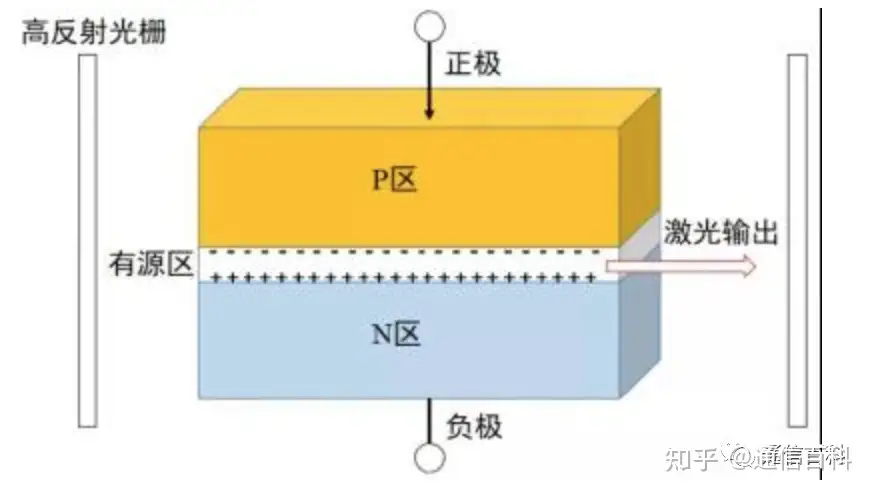
A few years later, indium gallium arsenide phosphide lasers operating at 1200-1650 nm were successfully developed at Bell Labs, finding a more suitable light source for optical fiber communication, and enabling the development of wavelength division transmission technology in optical fiber communication. At the same time, the devices at the optical receiving end also evolved from PIN photodiodes to APD avalanche diodes, depending on the specific application scenario.
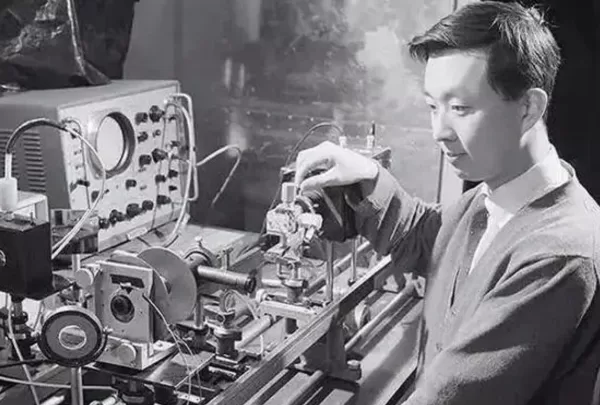
As for optical fiber, everyone is probably more familiar with it, an old topic. The breakthrough theoretical progress was the paper “Dielectric-fibre surface waveguides for optical frequencies” published by the Chinese scientist Charles Kao, making optical fiber possible as a transmission medium.

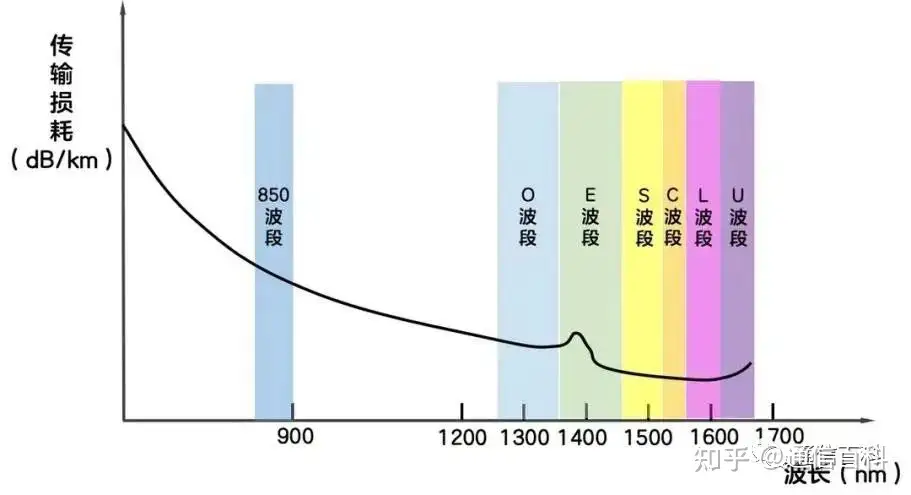
Later, Corning of the United States (a veteran glass manufacturer founded in 1851 that first made the glass bulb for Edison’s electric light) quietly started R&D and successfully produced optical fiber of about 20 dB/km in 1970. Not long after, Corning produced a multimode fiber with loss as low as 4 dB/km, pushing optical fiber communication from theory to application. Let’s briefly look at how fast the fiber loss was reduced:
- 1970: 20 dB/km
- 1972: 4 dB/km
- 1974: 1.1 dB/km
- 1976: 0.5 dB/km
- 1979: 0.2 dB/km
As mentioned above, the loss of the current commercial G.654E fiber has reached below 0.17 dB/km. Below is a fiber loss chart for easier understanding.
The last key factor is the optical amplifier. Of course, not all optical fiber communication uses optical amplifiers, such as SDH and CWDM, but here everyone can just get a basic understanding.
Optical fiber communication operates in the low-loss region of the optical fiber, that is, within a certain wavelength range. To transmit over longer distances, the signal needs to be amplified at some position in the middle (there are two kinds: electrical repeater and optical repeater, and what is discussed here is optical repeater). This is like when driving long distances, needing to refuel or charge the car at a service area.

Some cars need 92-octane gasoline, some need 95-octane, and some are electric. For long-distance transmission systems in optical fiber communication, the mainstream dense wavelength division multiplexing system DWDM mainly operates in the C-band. So what substance can “refuel” the C-band signal?
This is like Edison inventing the light bulb — scientists kept “digging” in the periodic table, and finally in 1985, the University of Southampton in the UK first successfully developed the erbium-doped fiber amplifier EDFA, composed of erbium-doped fiber (about 10-30 m long) and a pump light source. The erbium-doped fiber is made by doping a small amount of rare-earth element erbium (Er) ions into pure fiber, and then amplifying the optical signal through the stimulated radiation of the pump light and erbium ions.

With the foundation laid by the above three main aspects, optical fiber communication systems were able to develop and be promoted. The first optical fiber communication system was built by the United States, with a bit rate of 45 Mb/s and a repeater distance of 10 km. In 1980, the United States built a 140 Mb/s multimode fiber communication system. In 1989, the world’s first trans-Pacific submarine optical cable system was built. In 1993, SDH technology products began commercial deployment. In 1997, wavelength division WDM technology achieved major breakthroughs in 20 Gb/s and 40 Gb/s products.
It can be seen that the evolution speed of optical fiber communication is quite fast. To this day, we are still trying to improve the transmission capacity of optical fiber communication systems. I have specifically talked about this in previous articles, mainly based on the Shannon formula, and the main methods now are as follows.
We use a highway system as an analogy.
First, increase the single-wavelength rate to make the cars run faster. Wavelength division systems have gone from 10G, 40G, 100G, to the currently large-scale deployed 200G, and the 400G transmission system about to be deployed at scale. Later there will be 800G, 1.2T, etc., which also places higher requirements on the spectrum. Second is the modulation format. High-order modulation can greatly improve spectral efficiency.

Third is the spectrum expansion direction. When a single wavelength develops to 400G and above, broader spectrum resources are needed. Currently for 400G, at a baud rate of about 130 GBaud, the channel bandwidth will reach a maximum of 150 GHz. This is like running an oversized vehicle on the highway: the original small car only needs a 50 GHz lane, but now needs a 150 GHz width. Therefore, to transmit 80 or even 96/120 wavelengths, a broader spectrum is needed. The C+L expansion has now been achieved, with a spectrum bandwidth reaching 12 THz.
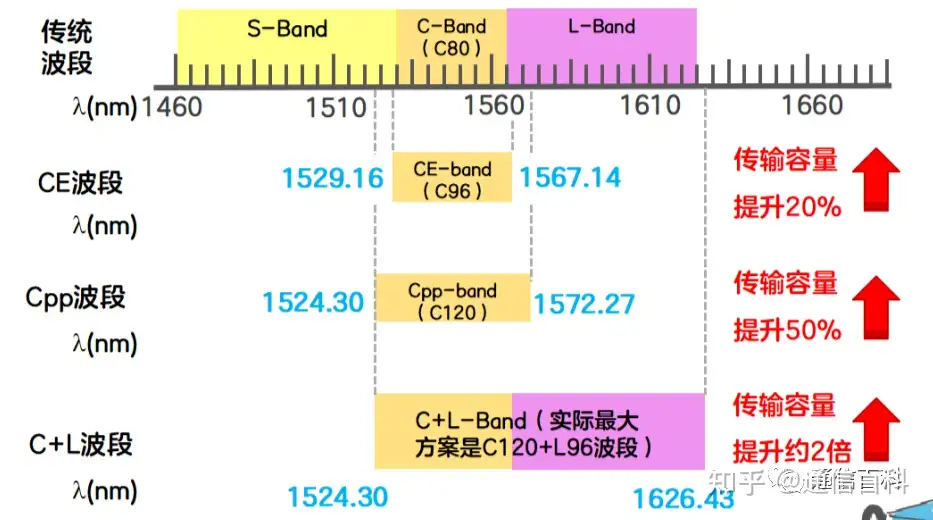
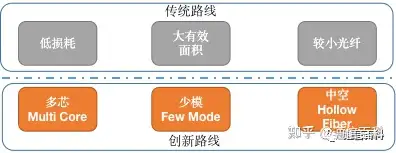
(This image is sourced from the internet.) Fourth is working on the fiber. To get rich, first build roads — the same goes for optical fiber communication systems. There are currently two major routes to improve fiber capacity: the more mature route such as reducing fiber loss, increasing effective area, and reducing fiber size; and the innovative route such as using multi-core fiber, few-mode fiber, and hollow-core fiber.
Thanks for reading. In the next issue we will talk about wavelength division technology. Welcome to follow and share! At the same time, there are many related documents in our Knowledge Planet, and joining now is the most worthwhile.

Related Reading
- What Is the Transmission Path of Light in an Optical Fiber?
- Optical Fiber Communication: The Structure of Optical Fiber
- Optical Fiber Communication: Mode Field Diameter and Cutoff Wavelength
Enjoy this article?
Subscribe to get new optical communication insights delivered to your inbox. Free, unsubscribe anytime.