Route 1: The EML Route
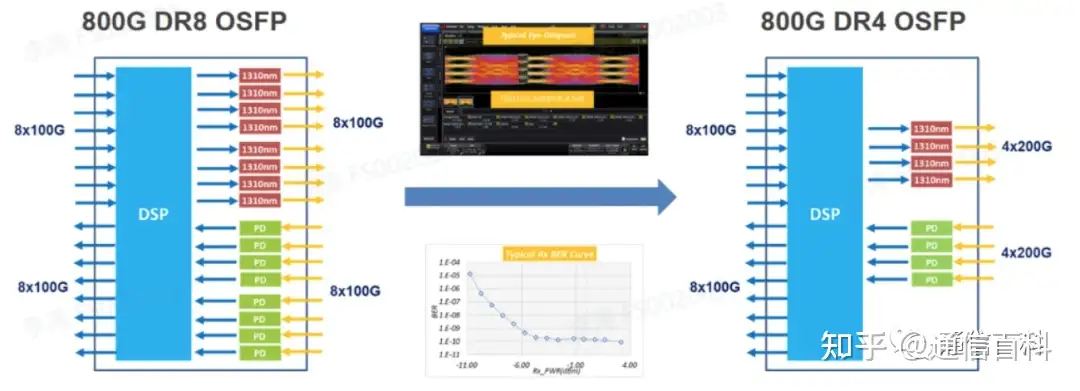
The 800G DR8 OSFP optical transceiver uses eight 100G EML lasers. The large number of lasers means high cost, and it is currently the most technically mature scheme. In the future, an 800G DR4 OSFP is expected, with the number of lasers halved and the cost reduced, and in the long term it is expected to approach the price of 400G optical transceivers.
Route 2: The Silicon Photonics Route
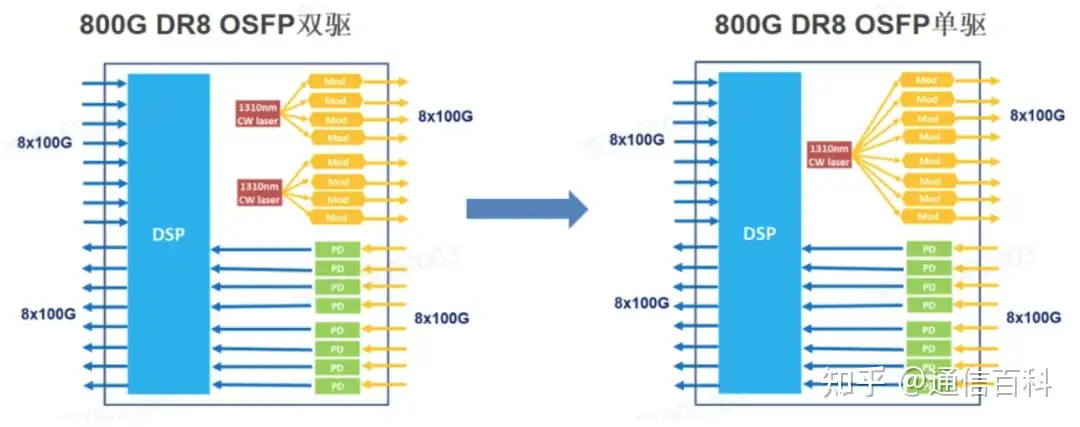
800G silicon photonics currently mostly uses a dual-laser drive scheme, reusing the current 400G DR4 scheme. Its cost is lower than the EML scheme. In the future it will develop into a single-laser drive scheme, using thin-film lithium niobate modulators to reduce optical path loss, which can achieve a single CW laser driving 8 optical signal channels. It is still in the sample stage, and the mass production time is undetermined.
The silicon photonics single-laser scheme is expected to achieve mass production in 2025, at which point the cost of the 800G DR8 silicon photonics module will be further reduced. But at present, the mainstream is still the dual-laser silicon photonics scheme.
800G 2xFR4 OSFP Evolution Roadmap
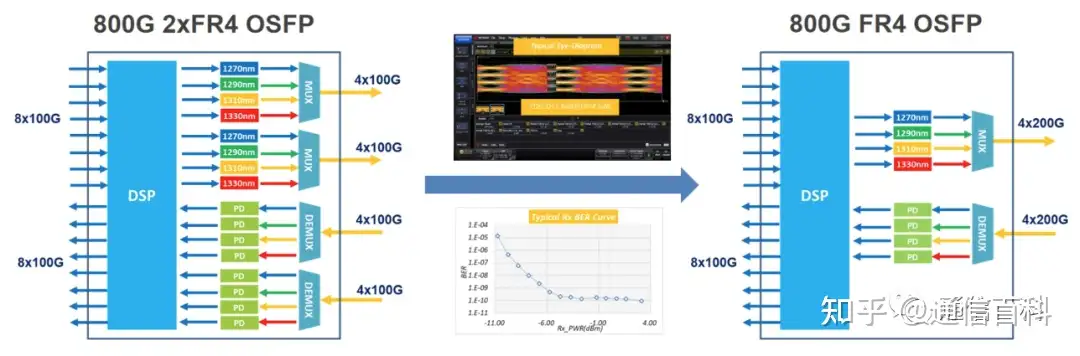
800G 2xFR4 uses two sets of 100G EML lasers at four CWDM wavelengths, each set containing four lasers. In the future, FR4 will develop into using four 200G EML lasers at CWDM wavelengths, Analysis of 4x200G Technology in the FR Scenario of MSA’s 800G Optical Transceiver.
Because 800G FR4 requires four CWDM wavelength lasers, the silicon photonics scheme will also need four CWDM wavelength lasers, so the silicon photonics scheme has no cost advantage. The mainstream is the EML scheme, and no manufacturer is currently researching a silicon photonics scheme.
800G SR8 OSFP Evolution Roadmap
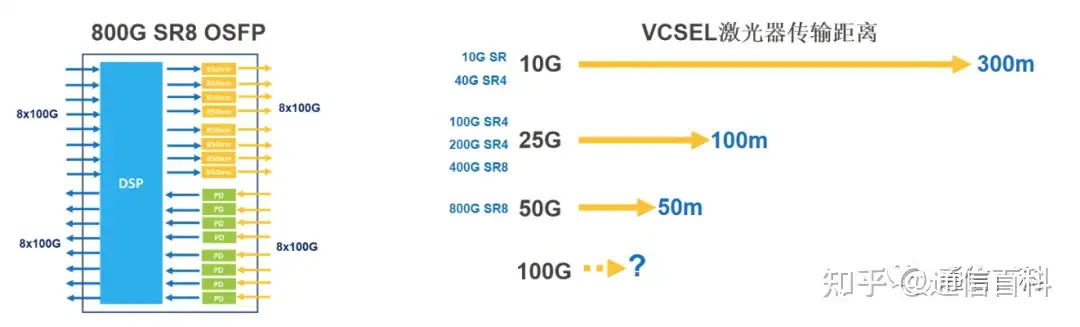
800G SR8 uses eight VCSEL lasers with a transmission distance of 50 m (OM3). Because the distance is short, its application scenarios are more limited than those of 400G SR8. By comparing the transmission distances of 10G, 25G, 50G, and 100G SR optical transceivers, we can see that the higher the single-channel rate of a VCSEL laser, the more its transmission distance is almost halved.
As the single-channel rate of optical transceivers gets higher and higher, VCSEL has entered a bottleneck period. It is expected that by the 1.6T optical transceiver era, if 1.6T optical transceivers use VCSEL lasers, the distance will shrink further. For customers, the 1.6T cable scheme would be a more cost-effective choice, so it is expected that VCSEL lasers will withdraw from the 1.6T optical transceiver market in the future.
From CPO to LPO
- CPO
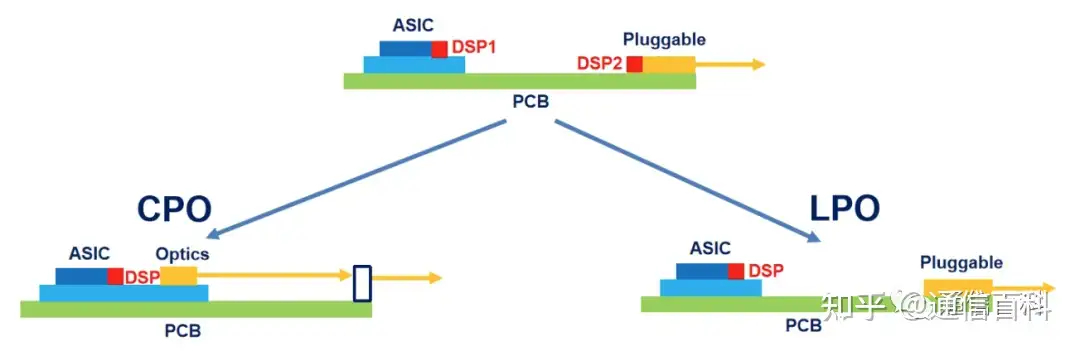
Compared with the traditional scheme, as can be seen from the figure above, the CPO scheme eliminates one DSP chip, further reducing power consumption and cost. At the same time, the CPO scheme uses the co-packaged optics form, directly packaging the switch chip (which realizes the optical-electrical conversion function) onto the optical module, reducing the electrical signal loss from the switch to the optical module, thereby lowering latency and overall power consumption.
Because of co-packaged optics, problems also arise. Since the switch chip has to be packaged onto the optical module, the question of whether this packaging is done by the optical module manufacturer or the switch manufacturer becomes a problem. At the same time, if an optoelectronic chip group fails, how to repair it and who repairs it are questions, with many technical issues. Therefore, true large-scale mass production application is at least three years away, and it may even remain in a conceptual state for a long time.
- LPO
As an alternative to the traditional scheme, the LPO scheme attracted widespread attention as soon as it was introduced. The LPO scheme uses LPO linear direct-drive technology to replace the DSP, using TIA and DRIVER chips with high linearity and EQ functions, greatly reducing power consumption. But the latency increases, and the system bit error rate and transmission distance are somewhat sacrificed. Therefore, LPO is temporarily used in specific fields (short distance), but in the future it may be used within 500 m to meet the largest demand of data centers.
LPO technology is highly dependent on the opening and improvement of switch chip performance, such as the improvement in signal recovery of the 51.2T Tomahawk 5. Overall, LPO, as a packaging form of optical transceivers, is a downward evolution technology route of pluggable optical transceivers, and is easier to implement and more certain than the CPO scheme.
Summary
- The EML laser scheme will be the mainstream scheme for 800G optical transceivers in the next two years, and EML demand will increase substantially.
- The silicon photonics scheme has more cost advantage than the EML scheme, but mass production still faces some challenges, and long-term reliability needs further verification.
- The next-generation 4X200G 800G optical transceiver will bring greater cost advantages, and long-term cost is expected to approach that of 400G optical transceivers.
- LPO optical transceivers have power consumption and cost advantages, bringing value to users, but face many technical challenges and still need some time to mature.
Previous Recommendations:
- Looking at 800G Data Center Upgrades from 400G Deployment Experience
- Does 800G in Data Centers Use PAM4 or Coherent Technology?
- 800G Coherent and PAM4 Optical Transceiver Architectures
- The Commercial Feasibility of the Single-Wavelength 800G Scheme
Related Documents:
- 800G Optical Transceiver Industry Report.pdf
- High-Speed Optical Transceiver 400G 800G QSFP-DD Hardware Protocol.pdf
- Nokia 800GE Routing Application Analysis.pdf
- 400G Technology Overview.ppt
- Single-Wavelength 400G Long-Haul Optical Transmission Technology White Paper.pdf
Related Reading
- Analysis of 8x100G Technology in the SR Scenario of MSA’s 800G Optical Transceiver
- Ciena: 800G and Higher-Rate Coherent Pluggable Optical Transceivers
- Liquid Cooling Scheme for 1.6T OSFP Standard Optical Transceivers
Enjoy this article?
Subscribe to get new optical communication insights delivered to your inbox. Free, unsubscribe anytime.