
Foreword: A piece of paper full of distress information needs to be seen by the person across the road. We could let the paper drift over, but that is usually hard to make work; or fold it into a paper airplane and fly it over, but it is hard to guarantee the distance and landing point. Of course, a better approach is to wrap the paper together with a suitable small stone and throw it at the opposite side, which should be the most effective.

The same applies in communication systems. The original information is usually a spectrum component with a very low frequency, which is generally not suitable for direct transmission on the channel. Without processing, it is difficult to transmit effectively and guarantee sufficient distance. So how do we solve this problem?
People found that we only need to transform the original signal into a frequency signal suitable for channel transmission, usually a high-frequency signal. This high frequency is the carrier of the signal. What does modulation do? In plain terms, it performs spectrum shifting, causing certain characteristics of one waveform to change according to another waveform or signal. For example, the baseband signal (original information) controls the change of one or more parameters in the carrier signal, and these parameters change according to the law of the baseband signal.
For example, suppose we have a simple binary signal containing only two states: high level and low level. In optical fiber communication, we can map the high level to the peak of the light wave and the low level to the trough of the light wave. In this way, we can encode this binary signal onto the light wave and transmit it through the fiber.
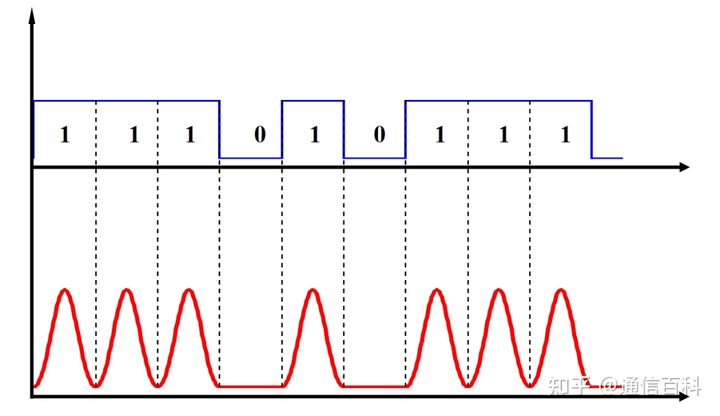
In the field of wireless communication, we rely on electromagnetic waves to transmit information. Through modulation, we can shift the spectrum of the original signal, that is, change its frequency. The signal obtained after modulation is called the modulated signal, which not only carries information but is also more suitable for transmission in the communication channel. Modulation in wireless communication is mostly analog modulation.
In optical fiber communication, we use modulation technology to shift the spectrum of the digital signal to the low-loss wavelength region of the fiber. Within the window of this region, the transmission loss of the optical signal is low, enabling long-distance transmission. Modulation in optical fiber communication is basically digital modulation.
So what is the carrier of modulation? It is equivalent to the paper being thrown out through the small stone carrier mentioned at the beginning of the article. In a communication system, which parameter changes can represent the changes of 0 and 1? We use the electric field formula of the optical carrier to explain: E = A * sin(2πft + φ), where E represents the electric field strength, A represents the electric field amplitude, f represents the frequency, t represents time, and φ represents the initial phase angle. This formula describes how the electric field strength of the optical carrier changes over time, where the frequency f and the initial phase angle φ can be used to describe the periodic oscillation of light, while the electric field amplitude A reflects the intensity of light.
Based on the different parameters of the above formula, we can have different modulation methods, mainly divided into ASK, FSK, and PSK, etc. These modulations were initially mainly used in wireless communication systems, and were later applied to optical fiber communication systems.
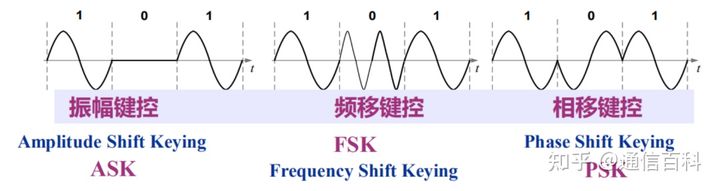
- ASK Amplitude Shift Keying; 2ASK is also called On-Off Keying (OOK); multi-level amplitude shift keying M-ASK such as PAM4, PAM8, etc.;
- PSK Phase Shift Keying: DPSK, DQPSK, BPSK, QPSK, PM-QPSK;
- FSK Frequency Shift Keying;
- PolSK Polarization Shift Keying.
Based on the above basic modulations, many composite modulations have been derived. For example, PM-QPSK modulates in multiple dimensions of polarization, phase, and waveform, and composite modulation methods such as Quadrature Amplitude Modulation (QAM) have also been widely applied and become the mainstream of optical fiber communication modulation methods. For example, 16QAM and 64QAM are widely used in WDM systems at rates such as 200G and 400G.
In modulation, there are two concepts we cannot avoid: baud rate and the related bit rate.
- Baud rate: the number of signal changes transmitted per second, that is, the symbol rate B, representing the number of symbols transmitted per unit time, in units of baud (Bd). One digital pulse is one symbol; if the width of a symbol is T seconds, then B=1/T.
- Bit rate: the number of bits transmitted per second, that is, the data transmission rate R, in units of bits per second (b/s or bps).
It can be seen that bit rate and baud rate are both related and different. Below is an example of passing information with colored balls.
- Baud rate: You and your friend agree on a method to transmit information. You use balls of different colors to represent different information. Every second, you can throw one ball to your friend. So if you throw one ball per second, the baud rate is 1 Bd. The baud rate actually describes the speed at which you throw balls per second.
- Bit rate: Although you only throw one ball per second, the ball can have many colors, each with its own specific meaning. For example, red may represent “00”, blue “01”, green “10”, and yellow “11”. So although you only throw one ball per second (baud rate 1 Bd), each ball can actually transmit 2 bits of information, so the bit rate is 2 bps. Simply put, the bit rate describes the amount of data you transmit per second.
Of course, bit rate and baud rate can be quantitatively converted through the following formula: R = 1/T * log2M, where R is the bit rate, T is the symbol period, B is the baud rate, and M represents the base (number of levels).
Let me give two examples. For On-Off Keying (OOK), the presence or absence of amplitude represents 1 and 0, and the number of discrete values carried by one symbol is M=2. Given that the baud rate of the modulator’s electrical signal is at the 10G rate level, that is, B=10. The bit rate of the modulated output signal is: R = B*log2M = 10*log2(2) = 10*1 = 10Gbps. For 16-order Quadrature Amplitude Modulation (16QAM), as shown in the figure below, the number of symbols M=16. Also given that the modulator’s electrical signal baud rate is at the 32G rate level, then B=32, and the bit rate of the modulated output signal is: R = B*log2M = 32*log2(16) = 32*4 = 128Gbps.
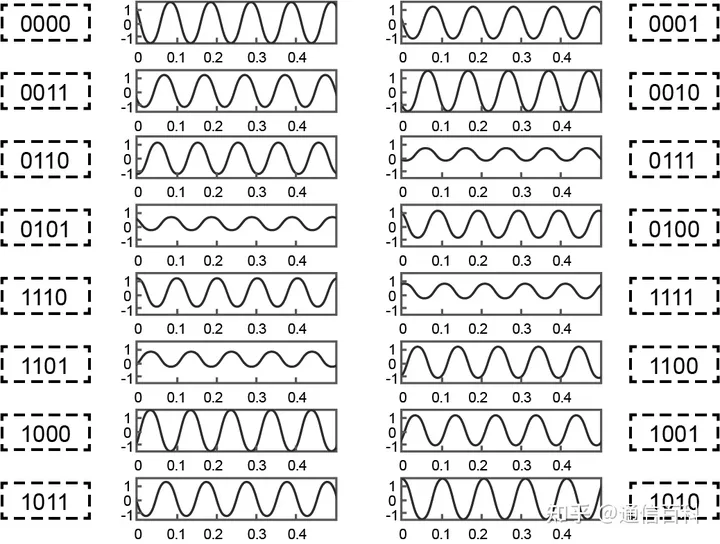
In general, the bit rate is higher than the baud rate to transmit as much information as possible. In high-order modulation, such as 16QAM above, one signal symbol carries 4 bits or more. At this time, each signal symbol encodes more than 1 bit of data, so the bit rate is greater than the baud rate.
In addition, a parameter strongly related to modulation is spectral efficiency (bit/s/Hz), defined as the bit rate that can be transmitted per second over a unit bandwidth transmission channel. Generally speaking, high-order modulation can bring higher spectral efficiency, but the improvement in spectral efficiency/modulation in turn limits the transmission distance.
We will discuss the topic of spectral efficiency in detail later. I have been typing all afternoon; please forgive any inaccuracies.
Related topics:
- What benefits can complex optical modulation bring?
- What is an IQ signal, and what is IQ modulation?
- For optical transmission, choose high-order modulation or higher baud rate?
- Modulation technologies in mobile and optical communication: QPSK and QAM
The related materials are as follows. You can join the Communication Encyclopedia knowledge community to obtain them and download other 10,000+ documents!
- Everything you need to know about complex optical modulation.pdf
- Sine carrier digital modulation system 190 pages.ppt
- Analog modulation system 109 pages 1.9M .ppt
- Optical coherent modulation and demodulation research.pptx
Related Reading
- How Much Bandwidth Gain Can Raising the Modulation Order Add?
- 400G+ Optical Transmission Systems: Baud Rate, Modulation, and Spectrum Technology
- 5G NR Modulation and Coding Schemes – Modulation and Code Rate
Enjoy this article?
Subscribe to get new optical communication insights delivered to your inbox. Free, unsubscribe anytime.