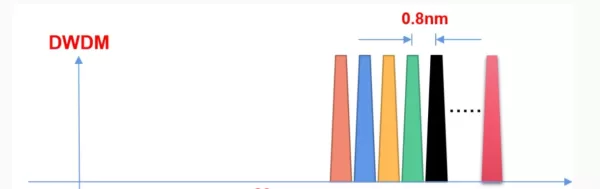
In the previous article, we discussed coarse wavelength-division multiplexing (CWDM) and dense wavelength-division multiplexing (DWDM). The channel spacing of CWDM is 20 nm, while DWDM has several channel spacings, with about 0.4 nm and about 0.8 nm being the most commonly used.

Regarding wavelength, we know that temperature changes have a relatively large impact on the output wavelength of a laser. As temperature rises, the threshold current of the laser increases, causing the output wavelength to drift toward longer wavelengths; as temperature drops, the center wavelength shifts toward shorter wavelengths. Therefore, the operating temperature range of optical-module lasers is limited. For example, the storage temperature of industrial-grade lasers is -40 to 85°C, and they operate at -5 to 65°C.
In the low-loss window of optical fiber, the wavelength shift of an FB laser is about 0.05 nm/°C, and the wavelength drift of a DFB laser is 0.08 to 0.1 nm/°C. Therefore, the wavelength drift over -40 to 85°C can be roughly calculated as about 10 to 13 nm. At the same time, one-third of the minimum channel is considered as the guard band. Taking these factors together, under the principle of maximizing the number of wavelengths, G.694.2 established the rule that uncooled lasers require a nominal center wavelength spacing of no less than 20 nm.
When it comes to the center wavelength of CWDM, the original G.694.2 specified 18 multiplexed wavelengths from 1270 nm to 1610 nm. In practice, most laser manufacturers define the center wavelength at 23°C, so in the range of 0 to 70°C, 23°C is not the midpoint—it differs from the midpoint of 35°C by 12°C, meaning the laser operates in an asymmetric wavelength-drift state. Therefore, it was once considered to change the maximum wavelength shift to -5.5 to 7.7 nm to resolve the discrepancy between the laser’s nominal center wavelength temperature and the actual operating temperature.
Let us calculate how much drift these 12°C cause, that is:
0.08 nm/°C * 12°C = 0.96 nm, approximately 1 nm.
Therefore, based on the actual device conditions, ITU-T increased the center wavelength by another 1 nm, and the CWDM center wavelength became as shown in the table below.

So what about the center wavelength/spacing of DWDM?
The center wavelength and wavelength spacing of DWDM are defined in G.694.1. According to practical applications, there are two grids: the fixed grid and the flexible grid. Because the center wavelength spacing of DWDM is an approximate number when calculated in nm, it can be converted to an integer frequency based on f = C/λ, which is easier to remember and express. For example, 100 GHz spacing is equivalent to 0.8 nm, and 50 GHz spacing is equivalent to 0.4 nm. Below, we will use frequency to replace center wavelength/wavelength spacing in the explanation.
For the fixed grid, there are four spacings: 12.5 GHz / 25 GHz / 50 GHz / 100 GHz, and the allowed channel frequency is 193.1 + n*M, where M is the spacing value. The center frequencies of the four spacings are listed as follows:
- 193.1 + n*0.0125 THz;
- 193.1 + n*0.025 THz;
- 193.1 + n*0.05 THz;
- 193.1 + n*0.1 THz.
There is a table in G.694.1 that lists in detail the nominal center frequencies of the C and L bands under these channel spacings. The table is too long to list here. Different vendors also define them slightly differently.
Now let us look at the wavelength drift of DWDM lasers. As mentioned above, the wavelength shift of a laser is about 0.1 nm/°C, and in industrial-grade applications, its wavelength drift range will exceed 7 nm. Obviously, this range exceeds the DWDM wavelength spacing above and will cause inter-channel crosstalk.
Therefore, DWDM optical modules use TEC temperature-control technology to cool or heat the laser, avoiding wavelength drift and crosstalk—equivalent to equipping the optical module’s laser with an air conditioner.
For the flexible grid, it is defined at a granularity of 6.25 GHz, so its nominal center frequency is:
193.1 + n*0.00625 THz.
In addition, the flexible grid has a concept called Slot Width, which we will talk about next time.
You are invited to join the [Communication Encyclopedia] Knowledge Planet, which has established 30 columns and offers access to 10,000+ high-quality documents. Some columns are shown below:

Enjoy this article?
Subscribe to get new optical communication insights delivered to your inbox. Free, unsubscribe anytime.