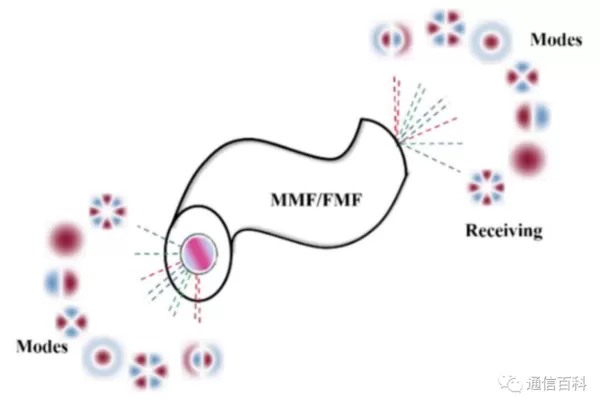
In the research and development of new optical fiber technology, SDM space-division multiplexing has attracted great attention. The application of SDM in optical fiber mainly has two directions: core-division multiplexing (CDM), which transmits through the cores of multi-core fiber, or mode-division multiplexing (MDM), which transmits through the propagation modes of few-mode or multimode fiber.
Core-division multiplexing (CDM) fiber principally uses two approaches.
The first is based on the use of single-core fiber bundles (fiber ribbons), where parallel single-mode fibers are packaged together to form fiber bundles or ribbon cables, providing up to hundreds of parallel links.
The second approach is based on transmitting data through single cores (each core single-mode) embedded in the same fiber, that is, in MCF multi-core fiber. Each core is treated as an independent single channel.

MDM (mode-division multiplexing) fiber refers to transmitting data on different modes of the fiber, where each mode can be treated as an independent channel.
The two common types of MDM are multimode fiber (MMF) and few-mode fiber (FMF). The main difference between the two lies in the number of modes (available channels). Because MMF can support a large number of modes (dozens), the inter-mode crosstalk and differential mode group delay (DMGD) become large.

In addition, photonic crystal fiber (PCF) can also be said to belong to this type. It is based on the properties of photonic crystals, confining light through the bandgap effect and transmitting it using the air holes in its cross section. PCF is mainly made of materials such as SiO₂ and As₂S₃, introducing air holes in the region around the core to change the refractive-index contrast between the core and cladding.

CDM fiber can be said to be a simple addition of parallel single-mode cores, carrying information, embedded in fiber with the same cladding (multi-core fiber MCF or single-core fiber bundles). MDM mode-division multiplexing uses multiple spatial optical modes in the transmission medium as single/separate/independent data channels, generally for short-distance interconnection transmission.
Related topics:
- SDM Space-Division-Multiplexing Fiber
- Discussion PPT on Key Technologies of High-Speed All-Optical Networks and New Fiber
- Fiber: The Relationship Between Large Effective Area and Bending Loss
Related Reading
- Space-Division-Multiplexing Fiber
- Progress of Various MCF Fibers and Their Practical Applications
- Sumitomo: A Multi-Core Fiber with Low Polarization-Mode Dispersion
Enjoy this article?
Subscribe to get new optical communication insights delivered to your inbox. Free, unsubscribe anytime.