Next-generation ASIC-based switch/router platforms will adopt 800G I/O port speeds. Therefore, in this article we will briefly talk about the key requirements of 800G MSA pluggable modules. Currently, multiple standards organizations, including OIF, Open ROADM, and IEEE, are also carrying out related work in parallel to promote the standardization of 800G optical transmission and the 800GE (Gigabit Ethernet) protocol.
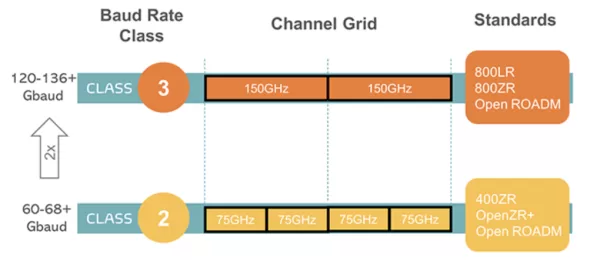
For 400G MSA pluggable module products, the industry, through OIF, tends to adopt a Class 2 ~60Gbaud rate range and 16QAM modulation with 4 bits/symbol, so as to achieve 400G transmission within a 75GHz optical spectrum, as shown in the figure below.

Open ROADM also requires the same modulation order and a similar baud rate, plus additional transmission flexibility defining more modulation modes, such as QPSK with 2 bits/symbol, to achieve longer transmission distances for 200G.
As shown in the figure above, at the 800G stage, the industry has tended to double the baud rate, thereby achieving a Class 3 ~120 Gbaud rate. The channel spacing requirement for 800G doubles to 150GHz, supporting transmission distances similar to those of 400G Class 2 equipment.
To achieve Class 3 120+Gbaud modulation capability, progress is needed in high-speed optical modulation and supporting components, as well as high-speed 112G per-electrical-lane functionality, to enable 800G MSA pluggable devices in a compact form factor.
Main characteristics required by 800G MSA pluggable modules
To meet customer needs and drive future adoption, 800G coherent MSA pluggable modules should have many key features and functions related to optical transmission, client-side traffic, low power consumption, and interoperable module management.

OIF 800ZR and high-performance interoperable PCS modes: OIF is defining an interoperable standard-performance 800ZR variant for coherent line interfaces of amplified, single-span, DWDM links over 80km, using Class 3 optics operating with ~4 bits/symbol modulation (equivalent to 16QAM).
For higher-performance 800G solutions, Open ROADM is defining enhanced performance modes, including interoperable probabilistic constellation shaping (PCS) implementations using Ethernet and OTN framing. Probabilistic Constellation Shaping PCS (2)
Multi-rate capability: In current Class 2 ~60Gbaud MSA pluggable solution designs that can adjust the modulation mode, long-distance 200G functionality can be achieved by setting the modulation order to QPSK (2 bits/symbol) instead of 16QAM (4 bits/symbol) used for 400G transmission.
This capability is standardized in Open ROADM and adopted by OpenZR+. Class 3 ~120Gbaud solutions can be used for 800G metro/regional coverage, as well as multiple different standard and proprietary modes for 400G and 600G, to meet a wide range of network requirements.
High transmit optical power capability: Just like the high Tx (>0dBm) optical power capability introduced in 400ZR+ QSFP-DD modules, 800G coherent MSA modules will require optical amplification to operate on traditional brownfield networks with ROADM network elements. Internal optical amplification is a key functional variant of this generation supporting these types of networks.
Client-side traffic capability supporting 800GbE client traffic. A key client-side traffic protocol supported by 800G-generation coherent MSA pluggables is 800GbE. IEEE P802.3df is intended to define native Ethernet traffic requirements at 800G data rates. To support native 800G Ethernet traffic from switch/router I/O ports, 800G-generation coherent MSA pluggables must support this protocol.
Multiplexing of low-speed 100/200/400GbE client-side traffic: It is expected that 100GbE, 200GbE, and 400GbE will continue to be widely deployed client traffic speeds when 800G coherent MSA pluggable devices are introduced. Therefore, 800G pluggable devices need to support multiplexing these low-speed protocols into 800G transmission, with requirements established by standards organizations. For networks using OTN, FlexO for 800G can be supported.
Power consumption and management – low power consumption. As with other MSA pluggable solutions, optimizing low-power operation is the top priority. Leveraging Moore’s Law, CMOS node sizes continue to shrink and ASIC functionality continues to improve, which is one reason for the success of coherent pluggable cables – providing high-capacity links in a small form factor.
Power-optimized design remains the top priority for the new generation of Class 3 baud-rate coherent MSA pluggables, not only to meet 800G requirements but also for backward compatibility with lower-rate 400G legacy ports that have stricter power requirements.
Multi-vendor interoperability: Besides industry standardization at the optical transmission and client-side traffic levels, joint efforts through the CMIS defined in OIF ensure multi-vendor interoperability of the module management interface. This ensures a common and predictable management signaling interface between the module and the host switch/router from one module vendor to another.
CMIS compliance is a key requirement of 400G MSA modules and will also be extended to 800G, Commercial viability of single-wavelength 800G solutions.
Interoperable PCS Modes
PCS uses an algorithm to shape the optical transmission by weighting the constellation to use inner points more than outer points, thereby improving OSNR performance while minimizing the increase in overhead. Although previous PCS implementations have been proprietary, in the past year several major DSP vendors collaborated to bring the industry’s first interoperable PCS for 800G MSA pluggables.

Driven by Open ROADM, the 800G interoperable PCS implementation provides a power-optimization method to boost performance above 800ZR, similar to how oFEC boosts performance above 400ZR in OpenZR+ modules. This enables 800G implementations to reach peaks similar to 400G implementations based on 16QAM transmission.
This Open ROADM interoperable PCS mode operates in the 130+Gbaud range, slightly higher than the 800ZR mode, but can still transmit within a 150GHz channel. Compared with the initial 400G point-to-point products of the previous generation, through interoperable PCS, network operators can benefit from the larger network implementation range of the initial 800G MSA pluggable products.
In short, operators are looking for the following key functional requirements to transition to 800G coherent MSA pluggable devices.
- Support OIF 800ZR and high-performance interoperable PCS modes
- Support multi-rate transmission
- High transmit optical power
- Support 800GbE client-side traffic
- Multiplex low-speed 100/200/400GbE client-side traffic
- Low power consumption
- Multi-vendor interoperability
This solution can be directly plugged into switch/router ports to further drive the adoption of optical network architectures based on IP-over-DWDM routers. The deployment of the first batch of 800G pluggable modules is expected to be completed in 2024.
Related Reading
- Ciena: 800G and Higher-Rate Coherent Pluggable Optical Modules
- MSA 800G Optical Modules – Analysis of 8x100G Technology in SR Scenarios
- 800G OSFP Optical Module Evolution Roadmap
Enjoy this article?
Subscribe to get new optical communication insights delivered to your inbox. Free, unsubscribe anytime.