We know that since the 1990s, WDM wavelength-division-multiplexing technology has been used in long-distance fiber links of hundreds or even thousands of kilometers. For most countries and regions, fiber infrastructure is their most expensive asset, while the cost of transceiver components is relatively low.
However, with the explosive growth of network data transmission rates such as 5G, WDM technology is becoming increasingly important in short-distance links, and short links are deployed in far greater numbers, making them more sensitive to the cost and size of transceiver components.

Currently, these networks still rely on thousands of single-mode fibers transmitting in parallel through space-division-multiplexed channels, with a relatively low data rate per channel of at most a few hundred Gbit/s (800G), and T-level applications are few.
But in the foreseeable future, the concept of ordinary spatial parallelization will soon reach its scalability limit and must be supplemented by spectral parallelization of the data streams in each fiber to sustain further increases in data rates. This may open up a whole new application space for WDM technology, where the maximum scalability of channel count and data rate is critical.
In this context, the optical frequency comb generator (FCG), as a compact, fixed multi-wavelength source, can provide a large number of well-defined optical carriers and thus play a key role. In addition, a particularly important advantage of the optical frequency comb is that the comb lines are intrinsically equally spaced in frequency, which relaxes the requirement for inter-channel guard bands and avoids the per-line frequency control required in conventional schemes using DFB laser arrays.

It should be noted that these advantages apply not only to WDM transmitters but also to their receivers, where a discrete local oscillator (LO) array can be replaced by a single comb generator. Using an LO comb generator further facilitates digital signal processing of WDM channels, thereby reducing receiver complexity and improving phase-noise tolerance.
Furthermore, using phase-locked LO comb signals for parallel coherent reception can even reconstruct the time-domain waveform of the entire WDM signal, thereby compensating for impairments caused by optical nonlinearity in the transmission fiber. Besides these conceptual advantages of comb-based transmission, small size and cost-effective mass production are also key for future WDM transceivers.
Therefore, among the various comb-generator concepts, chip-scale devices are particularly attractive. When combined with highly scalable photonic integrated circuits for data-signal modulation, multiplexing, routing, and reception, such devices may become key to compact, efficient WDM transceivers that can be mass-produced at low cost, with transmission capacity of tens of Tbit/s per fiber.
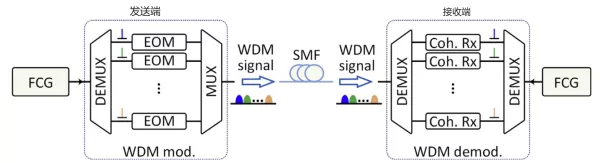
The figure below describes a schematic of a WDM transmitter using an optical frequency comb (FCG) as the multi-wavelength source. The FCG comb signal is first separated in a demultiplexer (DEMUX) and then enters EOM electro-optic modulators. To obtain the best spectral efficiency (SE), advanced QAM quadrature-amplitude modulation is applied to the signals.

At the transmitter output, the channels are recombined in a multiplexer (MUX), and the WDM signal is transmitted through single-mode fiber. At the receiver, the WDM receiver (WDM Rx) uses the LO local oscillator of a second FCG for multi-wavelength coherent detection. The channels of the input WDM signal are separated by a demultiplexer and then sent to a coherent receiver array (Coh. Rx), where the demultiplexed frequencies of the local oscillator LO serve as the phase reference for each coherent receiver. The performance of such a WDM link clearly depends heavily on the basic comb generator, especially the optical linewidth and the optical power of each comb line.
Of course, optical frequency comb technology is still in the development stage, and its application scenarios and market scale are relatively small. If it can overcome technical bottlenecks, reduce costs, and improve reliability, it may achieve large-scale application in optical transmission.
Related Reading
- Basics: Kerr Optical Frequency Combs and Optical Solitons
- Probabilistic Constellation Shaping PCS (2)
- For Data Center 800G, PAM4 or Coherent Technology?
Enjoy this article?
Subscribe to get new optical communication insights delivered to your inbox. Free, unsubscribe anytime.