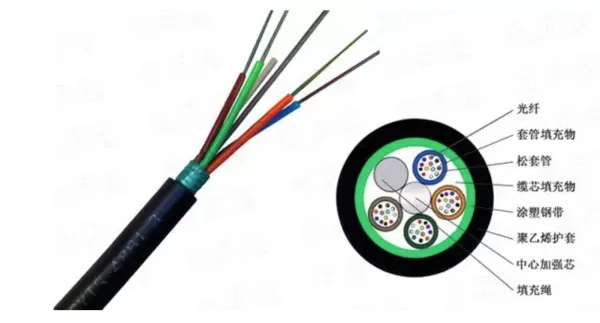
1 What Are Optical Fiber and Optical Cable
Optical fiber, fully called light-guiding fiber, is a fiber made of glass or plastic. In optical fiber communication, optical fiber is used to transmit optical signals, and it can guide light to transmit along the axis direction.

- Optical cable is a structure made from one or more optical fibers or fiber bundles that meets chemical, mechanical, and environmental characteristics, which can house and protect communication optical fibers from mechanical and environmental impact and damage, adapting to use in different occasions.

- Optical fiber uses the “total internal reflection of light” to transmit optical signals. When a light beam travels from an optically denser medium to an optically rarer medium, if the incident angle is continuously increased, the refraction angle can reach 90°, and this angle is called the critical angle. When light travels from an optically denser medium to an optically rarer medium, and the incident angle is greater than the critical angle, total reflection occurs. Optical fiber uses this total reflection to transmit optical signals.
2 Development History of the Optical Fiber and Cable Industry
The optical fiber and cable industry has undergone multiple technological innovations and market changes, with a history of more than sixty years. In the early stage of the industry, the main technical challenge was how to reduce the loss during optical fiber transmission and improve transmission performance. To this end, the industry formulated a series of technical standards and specifications, such as the G.651 standard suitable for multimode, and the G.652, G.655, G.657 standards suitable for single-mode.

Source: Yidu Data, Shanghai Securities Research Institute
With the continuous progress of technology, the optical fiber and cable industry has achieved multiple technological breakthroughs, such as wavelength division multiplexing technology, which greatly improved the transmission capacity of optical fiber and cable and the physical limit of transmitted information. These technological breakthroughs laid a solid foundation for the large-scale commercial application of the optical fiber and cable industry, making optical fiber and cable an indispensable and important component of the modern communication field.
Optical Fiber and Cable and Optical Modules
Ultra-Low-Loss G.654E Optical Fiber
Next-Generation Communication Fiber: Space-Division Multiplexing Fiber & Hollow-Core Fiber
Discussion on Key Technologies of High-Speed All-Optical Networks and New Types of Fiber
3 Industry Scale
The demand for China’s optical fiber and cable market has gone through three stages: rapid demand growth, severe supply surplus, and market return to balance. Due to the dual promotion of the “Broadband China” policy and 4G construction, the demand for optical fiber and cable exploded during 2013-2017; during 2018-2020, as the fiber-to-the-home penetration rate approached saturation, 4G construction was basically completed, and 5G construction had just started, overcapacity led to a relative decline in demand; starting from 2021, operator optical cable procurement warmed up, and market prices returned to rationality. In the future, the optical fiber and cable industry will usher in transformation and upgrading and the gradual implementation of 5G and data center applications, which will effectively support market demand. According to Yidu Data’s prediction, the scale of China’s optical fiber and cable market will reach 27.27 billion yuan in 2026.
2016-2026 China optical fiber and cable demand trend and forecast:

China optical fiber and cable market scale forecast:

4 Industrial Chain Structure
The upstream of the optical fiber and cable industry mainly includes raw material and equipment suppliers, where raw materials mainly refer to optical fiber preforms, optical fiber coatings, cable bundle materials, etc., and equipment suppliers include production equipment, testing equipment, etc. In the market, there are mainly two modes: professional optical fiber and cable equipment manufacturers, and independent R&D by optical fiber and cable manufacturers.
The midstream optical fiber and cable manufacturers are highly competitive, and there are many Chinese enterprises in this field, with large scale and strong competitiveness. These enterprises mainly engage in the production and sales of optical fiber and cable.
The downstream mainly includes telecom and data center operators. These enterprises are the end users of optical fiber and cable, while the application of optical fiber and cable in emerging industries is gradually expanding, such as smart transportation and automotive electronics, which also provides new opportunities for the development of the optical fiber and cable industry.

Optical Fiber and Cable Industrial Chain Schematic
5 Competitive Landscape
The global optical fiber and cable market concentration is steadily progressing, and the market is highly concentrated. From 2018 to 2023, the global CR10 was above 85%, and the share of large manufacturers remained stable.

2018-2023 Optical Fiber and Cable Market Concentration (CR10)
Chinese optical fiber and cable manufacturers have performed impressively, and competition is relatively fierce. In the recent “2023 Top 10 Most Competitive Enterprises in Global Optical Communication”, Chinese enterprises accounted for more than half of the list.

2023 Global Optical Fiber and Cable Enterprise Market Share Comparison Chart
In 2023, Yangtze Optical Fibre and Hengtong ranked second and fourth globally with market shares of 11.3% and 8.9% respectively, while FiberHome, ZTT, and Futong had market shares of 7.7%, 7.9%, and 6.1% respectively, with strong market competitiveness. Corning, Furukawa Electric/OFS, Prysmian, Sumitomo Electric, and Fujikura accounted for 17.1%, 9.8%, 8.2%, 7.1%, and 4.1% respectively.
Related document download:
- Optical Fiber and Cable Industry In-Depth Report – Deep Upstream-Downstream Integration – Operators Boost New Development
- Optical Fiber and Cable and Optical Modules
- Ultra-Low-Loss G.654E Optical Fiber
- Next-Generation Communication Fiber: Space-Division Multiplexing Fiber & Hollow-Core Fiber
- Discussion on Key Technologies of High-Speed All-Optical Networks and New Types of Fiber
Related Reading
- G.654E Optical Fiber and Cable Technology and Application Exploration.pdf
- G.654E Optical Fiber and Cable Technology and Application Exploration.pptx
- Optical Fiber and Cable Industry In-Depth Report – Deep Upstream-Downstream Integration – Operators Boost New Development
Enjoy this article?
Subscribe to get new optical communication insights delivered to your inbox. Free, unsubscribe anytime.