NVIDIA has taken a disruptive measure in its data center architecture design—abandoning some optical modules and using copper cables for internal interconnection. What is going on here? Some people online say the industry has been pushing “copper retreats, light advances” for years; now is it going to reverse?
So will the demand for optical modules decrease?
According to its description, based on the latest-generation NVLink Switch chip, the GB200 can connect 576 Blackwell GPUs into a computing cluster, surpassing the 256-GPU cluster scale supported by the previous-generation GH200. In the GB200 solution, each rack is equipped with 36 GRACE CPUs and 72 Blackwell GPUs, and these 72 Blackwell GPUs are interconnected through a copper-cable solution.
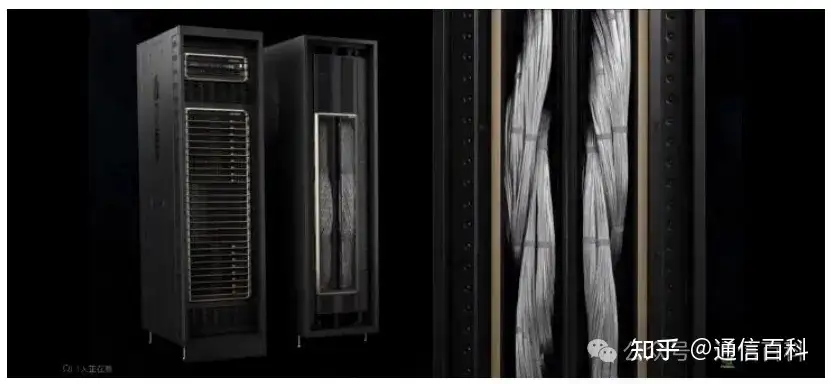
The GB200 single-rack solution uses copper cables for interconnection
Regarding the “wolf is coming” view online, I cannot help but say “but, but”—wasn’t the inside of the previous-generation GH200 rack also using copper cables rather than optical modules? So the use of NVLink 5.0 copper-cable electrical connections inside the GB200 single rack is not at all surprising.
Summarizing NVIDIA’s solution, we analyze: for small clusters of fewer than 72 GPUs, NVIDIA can use copper cables entirely for internal interconnection without any optical modules. But when the GPU count rises to the 72-576 range, that is, in cross-rack scenarios (within a single rack the interconnection is still copper), a large number of optical modules must be used, whether 800G or the future 1.6T.
For the external interconnection of clusters exceeding 576 GPUs, the third-layer network uses InfiniBand technology. Since the bidirectional bandwidth of NVLink 5.0 has increased to 1800GB, corresponding to a unidirectional bandwidth of 900GB, if 800G optical modules plus a two-layer network architecture are used, (900GB*8/800Gb)*2 = 18, meaning the ratio of GB200 to 800G optical modules is 1:18; if 1.6T optical modules are used, the ratio is 1:9, which matches the data in yesterday’s article.
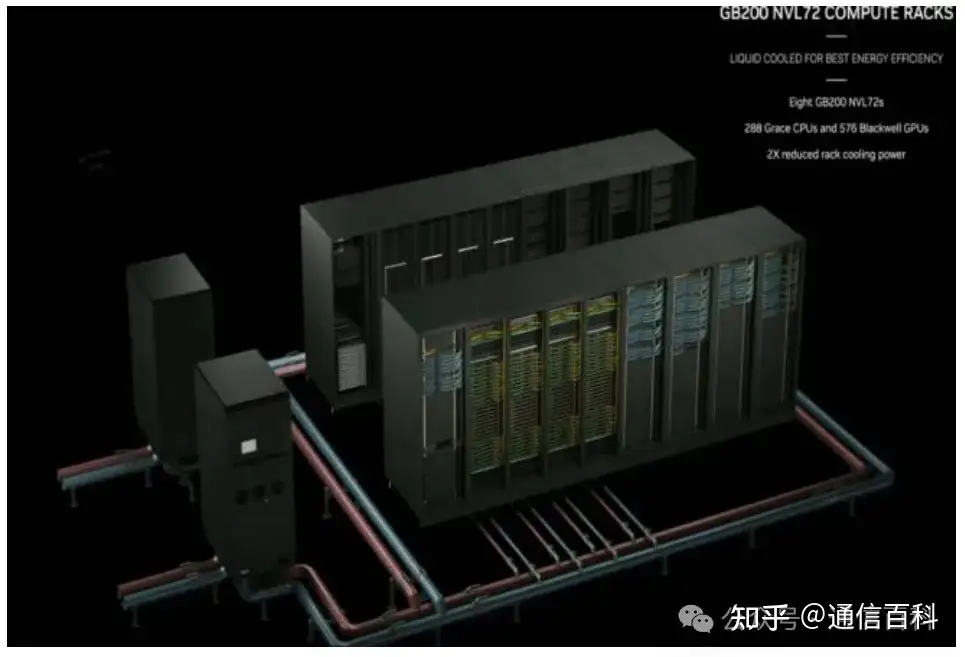
From a cost perspective, a single NVL72 rack requires 5000 copper cables at 200G rate, with a unit price of $45 at 200G, totaling $220,000. Adding the wire in the middle of the copper cables, the connectors at both ends (each $15), and the relatively low-cost cage components, it is still far more cost-effective than optical modules.
However, the current stage uses 200G copper-cable interconnection, with possible plans to upgrade to 400G later. But as the rate increases, the transmission distance of copper cables shortens rapidly—for example, 200G copper supports 7 meters, 400G copper 2.5 meters, and 800G copper is limited to 1 meter. Therefore, even for interconnection within a single rack, I believe optical modules will ultimately prevail.
The analysis holds that copper cables will remain a viable alternative for several years until the NVLink rate rises to 7.2TB.
In the market, the previous-generation GH200 had unsatisfactory sales, with a market share of only 5% and AWS as its main customer. It seems NVIDIA is still relatively optimistic about the new-generation GB200: it is said that AWS has already reserved 20,000 GB200 chips, and giants like Google and Microsoft also intend to place orders. With proper pricing, the market penetration of GB200 could reach 20-40%, or even higher.
To summarize:
Short-term effect: demand decreases. Because the GB200 solution greatly improves the computing density within a single rack through the improved NVSwitch architecture and copper-cable interconnection, the computing demand that previously required larger clusters can now be met with fewer racks. This means that within clusters of a certain scale, the number of optical modules used will drop significantly, especially in small and medium-scale cluster builds, where the demand for optical modules is largely replaced.
Long-term trend: although copper-cable interconnection is used within a single rack, as data center scale keeps expanding—especially when demand exceeds the single-rack range—interconnection between racks still depends on optical modules. Moreover, with growing demand for larger-scale computing clusters, optical modules remain indispensable, only the demand level shifts from within-cluster to between-cluster interconnection.
Technology iteration and demand matching: as technology develops and demand changes, when copper-cable technology hits I/O bottlenecks or other limitations, optical modules may well become the optimal solution again, just as mentioned above when the transmission distance of copper cables can no longer support interconnection within a single rack.
Welcome to join our paid community, which keeps updating for 800+ days!

Enjoy this article?
Subscribe to get new optical communication insights delivered to your inbox. Free, unsubscribe anytime.