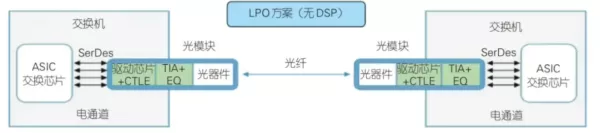
Q: What is linear pluggable optics (LPO)?
A: LPO, short for Linear Pluggable Optics, refers to a solution using low-power pluggable modules that do not contain a DSP chip. The end-to-end signal path in the link is treated as linear, achieving low power consumption through specialization. Like traditional pluggable modules with DSP, links compliant with the LPO MSA standard can be used in various network and computing equipment such as switches and network interface cards.

Q: What is the focus of the LPO MSA?
A: The LPO MSA brings together diverse members from across the network industry to define the necessary optical and electrical specifications, thereby establishing a robust ecosystem of LPO-compatible products. The market demands lower power consumption in high-density network deployments, and LPO modules are an important opportunity to achieve this goal. Ensuring the expected plug-and-play interoperability within the LPO system requires bringing together experts from different fields to jointly define these specifications. The LPO MSA will handle architectures involving linear interfaces, such as LPO-to-LPO links, LPO-to-retimed links, and semi-linear architectures (such as linear receive optics – LRO). The LPO MSA plans to build on the work initiated by OIF (CEI-112G-LINEAR-PAM4).
Q: What are the advantages of LPO?
A: By eliminating the DSP/retimer function of pluggable modules, LPO modules have lower power consumption, lower cost, and shorter latency than competing solutions.
Q: How does LPO work?
A: The ASIC in a switch or network interface card (NIC) has extremely strong transmitter and receiver capabilities that can compensate for the severe attenuation of the link. However, when connected through a retimed pluggable module, these capabilities are usually not fully utilized. When LPO modules are used, the link becomes a seamless linear channel, and the full capabilities of the ASIC transmitter and receiver are available for equalization. Compared with using retimed modules, this LPO-module-based link has much lower power.
Q: How do LPO modules differ from modules using retimers?
A: Because LPO modules operate linearly, complex digital computation and decision-making are not required. The entire signal path leverages the equalization capability of modern ASICs, achieving a simpler and more optimized solution. This is in sharp contrast to retimed modules, where the module performs complex digital computation and decision-making in the DSP in the transmit and receive paths, consuming power. Without a DSP, the module has lower power consumption, lower cost, and shorter latency.
Q: What system requirements come with using LPO?
A: Systems compatible with LPO modules require powerful ASICs and carefully designed transmission lines. Any pluggable module form factor can be used to make LPO modules, because this architecture easily adapts to the relevant power envelope.
Q: Can LPO modules interoperate with retimed modules?
A: Yes, LPO modules can interoperate with retimed modules. As part of the LPO MSA, guidelines for use with retimed modules will be provided.
Q: How does the LPO MSA relate to other industry standards?
A: The LPO MSA is a complement to and development of other industry standards (such as IEEE 802.3 and OIF) and MSAs (such as OSFP or QSFP-DD). The LPO MSA will specify product- and system-level interoperability requirements covering electrical and optical interfaces operating at 100 Gb/s per lane and above.
Q: Is LPO suitable for Ethernet traffic?
A: Yes, modules compliant with the LPO MSA are protocol-agnostic. The initial MSA specifications will be optimized for Ethernet data rates.
Q: Is LPO as robust as DSP-based solutions?
A: Yes, modules compliant with the LPO MSA standard are as robust as DSP-based module solutions. The LPO MSA will develop specifications that provide this robustness for the entire optical network ecosystem.
Q: Can the LPO MSA specifications ensure interoperability?
A: Yes, the LPO MSA will ensure interoperability between network equipment and modules compliant with the LPO MSA standard. The specifications developed by its members will ensure multi-vendor interoperability. Q: Can LPO modules work on every port of a switch? A: Yes, these specifications will ensure that any LPO MSA-compliant port on a switch or NIC (or other network equipment) can work with any LPO MSA-compliant module. Q: What is the initial focus of the LPO MSA? A: The initial focus of the LPO MSA is to ensure interoperability when links consisting only of LPO modules operate over parallel or duplex single-mode fiber (SMF).
Q: What other work will the LPO MSA carry out?
A: In addition to the initial LPO-to-LPO specification, the LPO MSA has a roadmap that will address link-interface issues between LPO modules and retimed modules, linear receive optical modules (LRO), other media such as multimode fiber (MMF), and higher rates such as 200 Gb/s.
Q: Does the LPO MSA define terminology?
A: Yes. Fully linear modules are called LPO modules, and we will define optical specifications named with “-LPO”. Links using a linear receiver and a retimed transmitter (that is, semi-linear or semi-retimed modules) are called LRO modules and will be marked with “-LRO” in any optical specification.
Q: When will the LPO MSA publish its specifications?
A: The first batch of specifications is expected to be released in Q3 2024.
Related Reading
- A Brief Discussion of CPO and LPO: What Exactly Is the Difference?
- Eoptolink: HYBRID, LPO, LRO, and DSP
- LPO, CPO, and the 1.6T/3.2T Optical Module Market
Enjoy this article?
Subscribe to get new optical communication insights delivered to your inbox. Free, unsubscribe anytime.