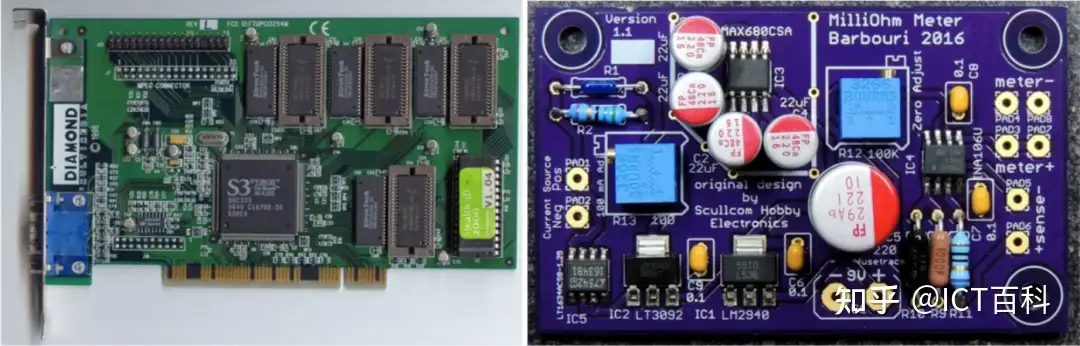
SMT (Surface Mount Technology) directly mounts electronic components (such as resistors, capacitors, and integrated circuits) onto the surface of a PCB. It is common in the electronic assembly stage, and in chip mounting processes, SMT can also be used to mount packaged chips onto a PCB.
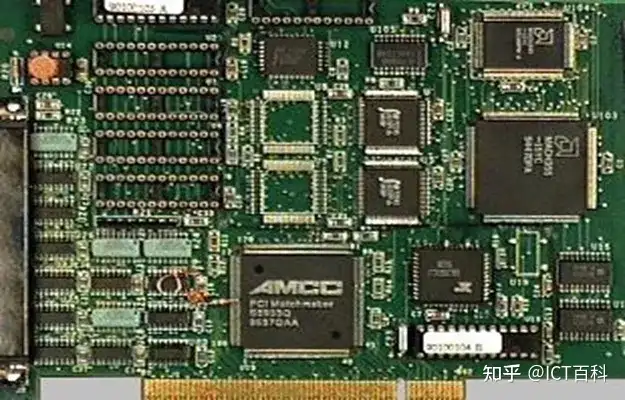
Figure: SMT mounting
By contrast, through-hole technology THT (Through-Hole Technology) is more traditional. It inserts electronic components into through-holes in the PCB via pins and solders them fixed on the other side.
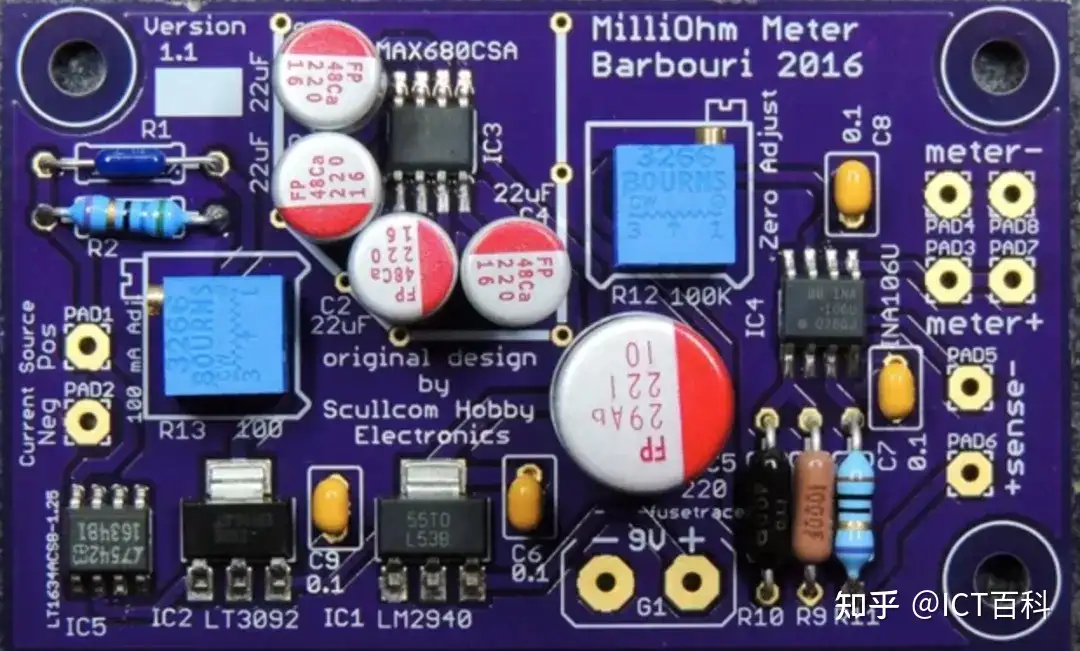
Figure: THT through-hole
The debate surrounding SMT and THT in terms of cost, assembly, and reliability has lasted for many years. Let us briefly look at their advantages and disadvantages. From the two figures above, it is clear that in form, SMT uses “mounting,” while THT uses “insertion.” On a PCB, the components and solder joints of THT are on both sides of the board; whereas on an SMT board, the solder joints and components are on the same side. Here we can see that SMT is not without through-holes; holes are drilled only when conductors on both sides of the board need to be connected, so the number of holes is much smaller and the hole diameter is much smaller. This greatly increases the assembly density of the circuit board.
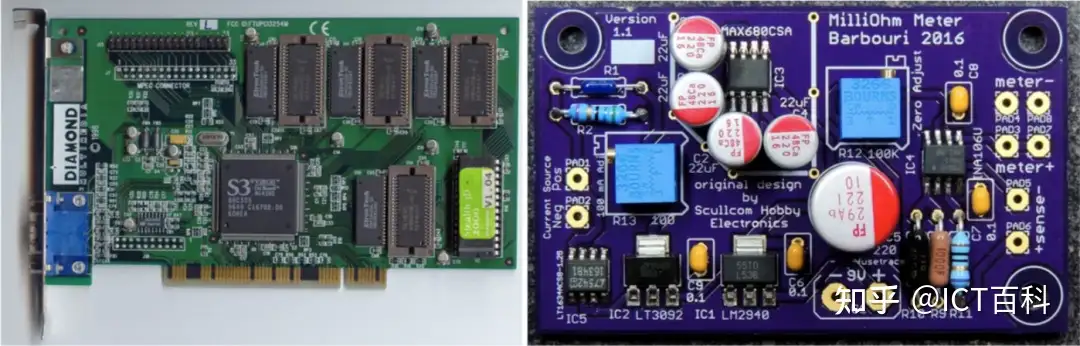
Figure: SMT mounting vs THT through-hole
In terms of mounted devices, the components used by SMT are called surface-mounted devices (SMDs), which are basically chip-type structures. This can significantly reduce the weight of surface-mount assemblies (SMA). Because of their small size, surface-mount components occupy only half to one-third of the space of different types of PCBs. Therefore, SMT is very suitable for high-density electronic packaging, such as mobile phones and tablets. Through-hole THT, on the other hand, uses through-hole insertion devices, such as dual in-line packages (DIP), single in-line packages (SIP), transistors (such as bipolar junction transistors (BJT) or field-effect transistors (FET)), as well as capacitors, resistors, and diodes.
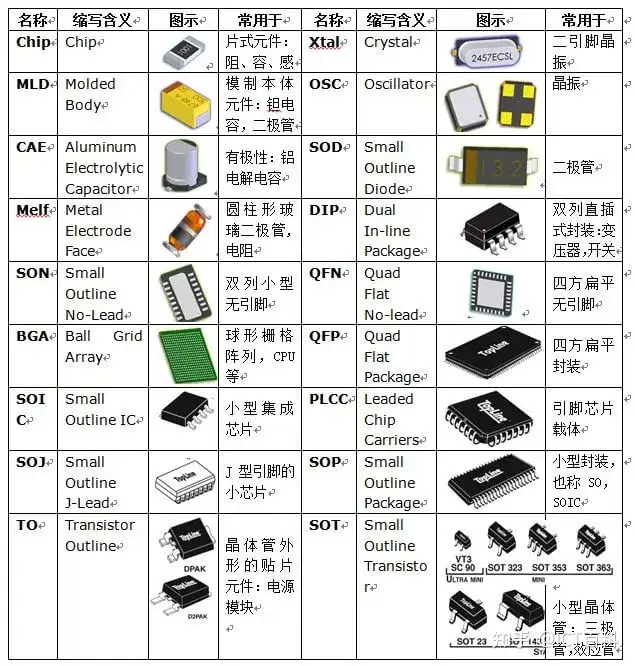
Table: Components used by SMT and THT
Therefore, the SMD devices used for SMT mounting are smaller than traditional THT through-hole components, and the weight of SMD devices is only one-tenth of traditional through-hole electronic components. In addition, the lead length of SMT circuits is generally shorter, which not only effectively reduces resistance and parasitic capacitance but also reduces propagation delay and packaging noise. Furthermore, SMT soldering typically uses reflow soldering, a lead-free process that is more environmentally friendly and produces more reliable solder joints.
Of course, with reduced routing, the board size shrinks and the number of drilled holes decreases. SMT is also cheaper than THT through-hole. Compared with SMT technology, THT is more like traditional bridge construction, emphasizing depth and stability; whereas SMT is like modern artistic creation, focusing on surface refinement and efficiency.
But this does not mean SMT has no drawbacks. Although SMT offers advantages such as high-density assembly and low cost, it is more complex in repair and rework, especially for manual operation, and SMT solder joints are more fragile than through-hole joints in the face of mechanical stress and vibration.
In addition, because the leads of SMT components are thinner, they generally cannot carry the same high current as through-hole components. And these shortcomings of SMT are precisely the advantages of through-hole THT.
Therefore, some specialized or high-power components, due to their special application needs, still mainly use through-hole packaging. So it is not that THT technology is completely useless—it mainly depends on the application scenario.
Published with the permission of Optica Fiber Communication.
Enjoy this article?
Subscribe to get new optical communication insights delivered to your inbox. Free, unsubscribe anytime.