At this year’s OFC conference, multiple vendors demonstrated the application of 400ZR, 800ZR and 400ZR+ technologies in data center interconnect (DCI) and telecom networks.
400ZR
With its 400Gb/s interface rate, based on single-carrier coherent DP-16QAM modulation, combined with a low-power DSP and concatenated forward error correction (C-FEC), 400ZR achieves a transmission distance of more than 80 km while maintaining a post-FEC error rate below 1.0E-15.
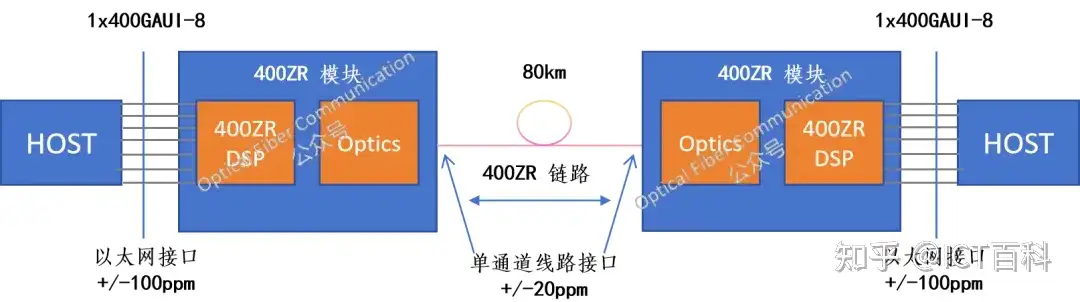
The design flexibility of this technology lies in its form-factor-agnostic nature, allowing it to adapt to different hardware form factors.
800ZR
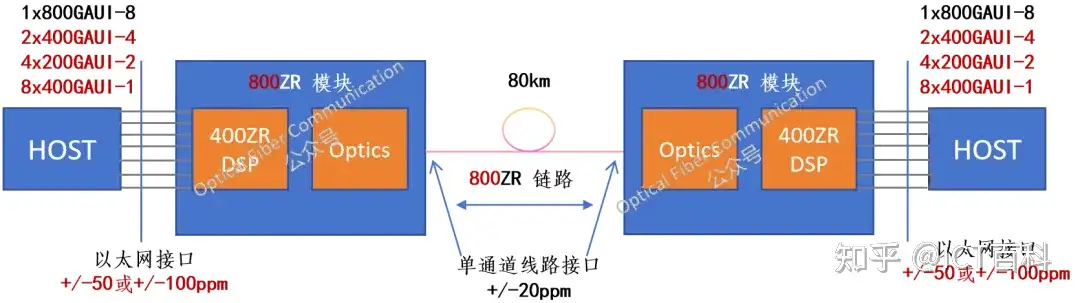
As an upgraded version of 400ZR, 800ZR raises the interface rate to 800Gb/s while retaining the same technical core, including single-carrier coherent DP-16QAM modulation and low-power DSP.
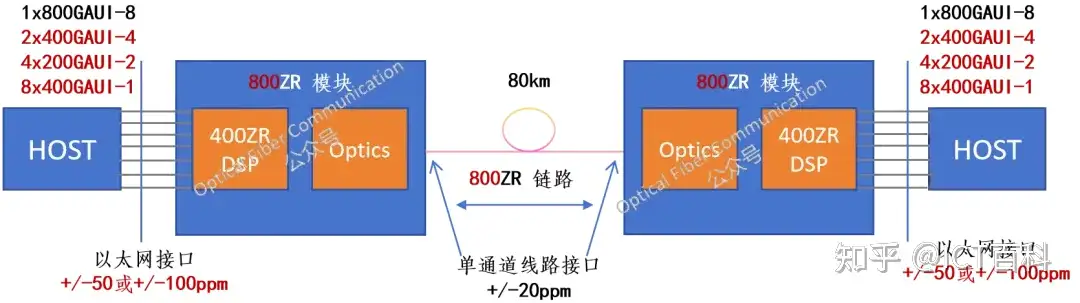
In addition, 800ZR adopts open forward error correction (O-FEC) technology, which can achieve a post-FEC error rate below 1.0E-15, ensuring high reliability of data transmission.
400ZR+ is a general term representing technical capability beyond 400ZR, although it has not yet been standardized across the entire ecosystem. The launch of the OpenZR+ multi-source agreement (MSA) aims to address longer transmission distances and more flexible Ethernet rates and modulation types.
It is especially worth mentioning that, in version 3.0 released in September 2023, a high transmit output power (0 dBm) was introduced, further improving the technology’s performance. The addition of the OpenROADM multi-source agreement (MSA) added more color to the demonstration. It supports Ethernet and optical transport network (OTN) services and has similarities with 400ZR and 800ZR technologies, so it occupied a place in the OFC 2024 demonstration.
At this OFC conference, the compatibility and performance of 400ZR and 800ZR technologies across equipment from different vendors were demonstrated, including equipment from Cisco, Juniper, Ciena, NEC, Lumentum, Hisense, O-Net and other vendors. These devices used QSFP-DD and OSFP modules, and optical modules and routers at different wavelength frequencies.
Single-span demonstration:
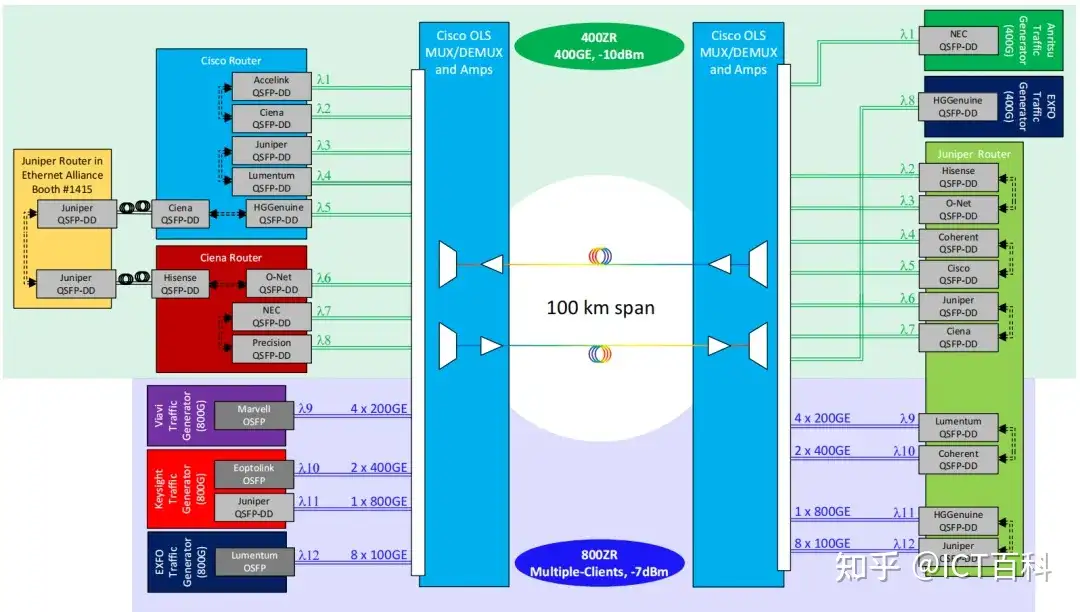
Channel planning table:
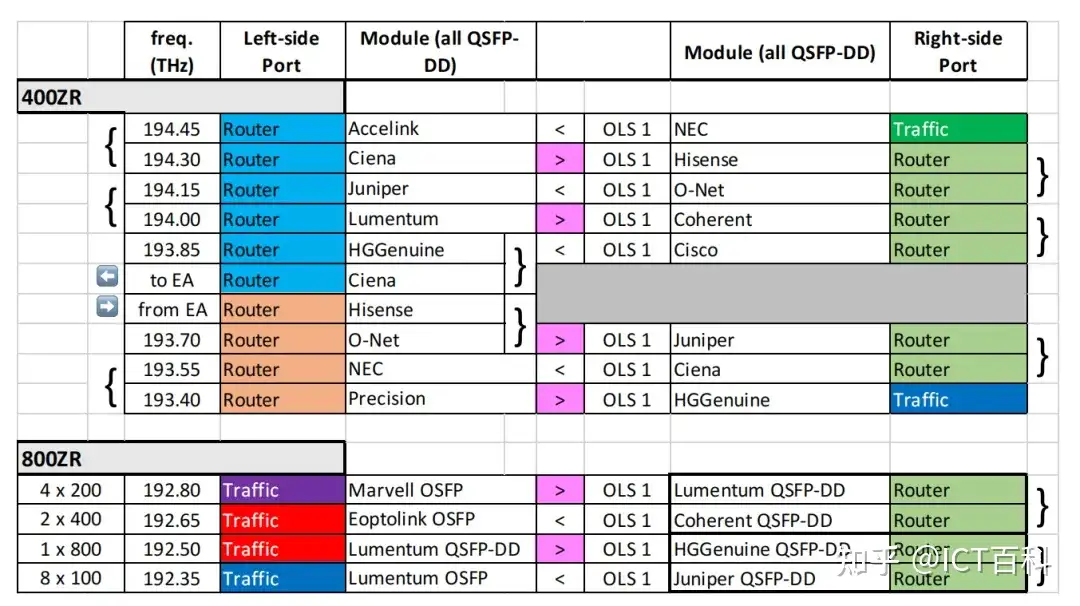
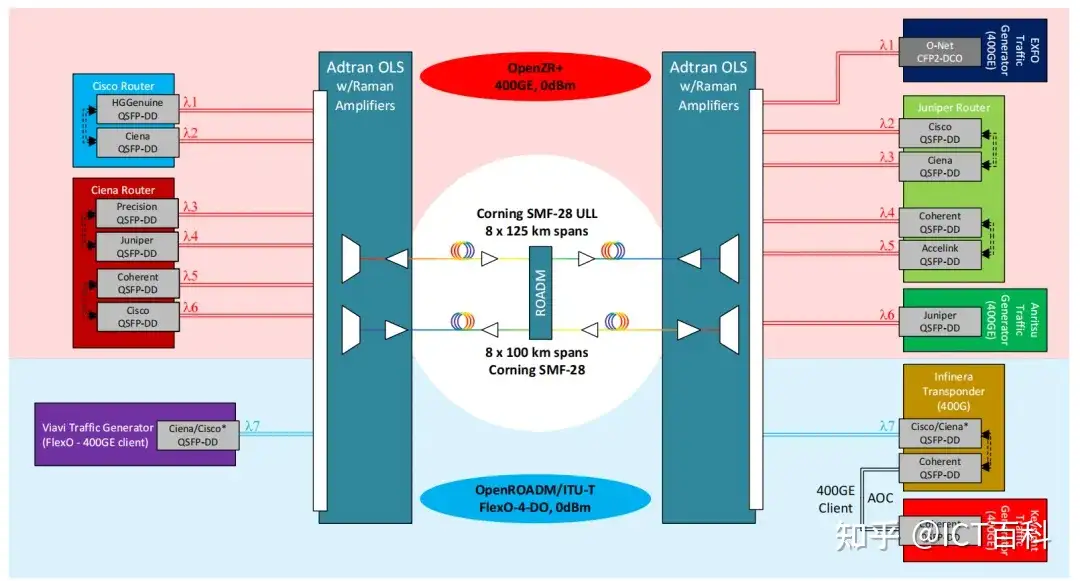
Multi-span demonstration: In the multi-span demonstration, two types of fiber were used – SMF-28 ULL fiber and SMF-28 Contour fiber – to simulate transmission paths of different lengths, such as spans of 8×100 km and 8×125 km, further verifying the long-distance transmission capability of the technology.
Channel planning table:
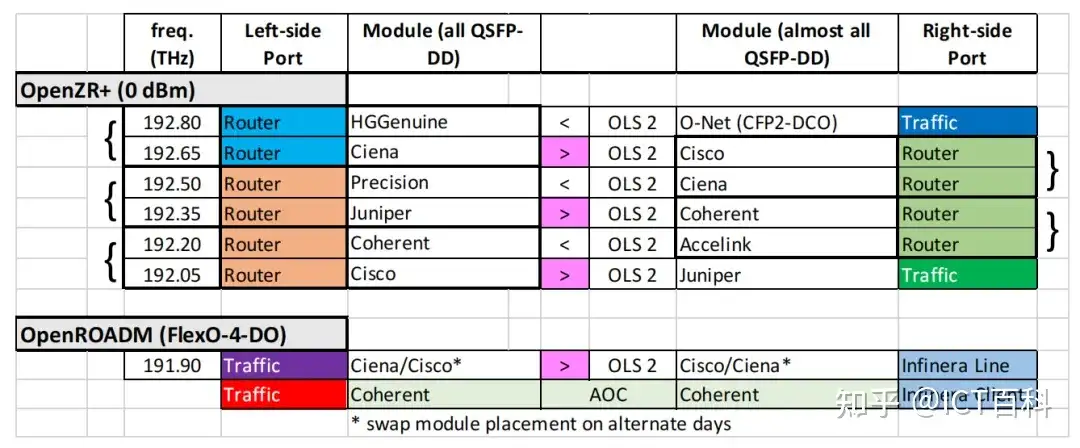
In the multi-span system, the key technical points demonstrated include the use of MUX/DEMUX and amplifiers, as well as integrated EDFA and Raman amplifiers, all of which provide support for extending transmission capacity and distance. Automatic span equalization was also demonstrated, including power equalization and scalability of multi-dimensional ROADM.
Performance Comparison
The optical fiber performance data of modules from different vendors provides in-depth insight into the performance of 400ZR and OpenZR+ technologies. By comparing receive optical signal-to-noise ratio (RxOSNR), receive power (RxPower), chromatic dispersion (CD), polarization mode dispersion (PDL), differential group delay (DGD) and bit error rate (BER), we can evaluate the performance of each module in real applications. The data is as follows:
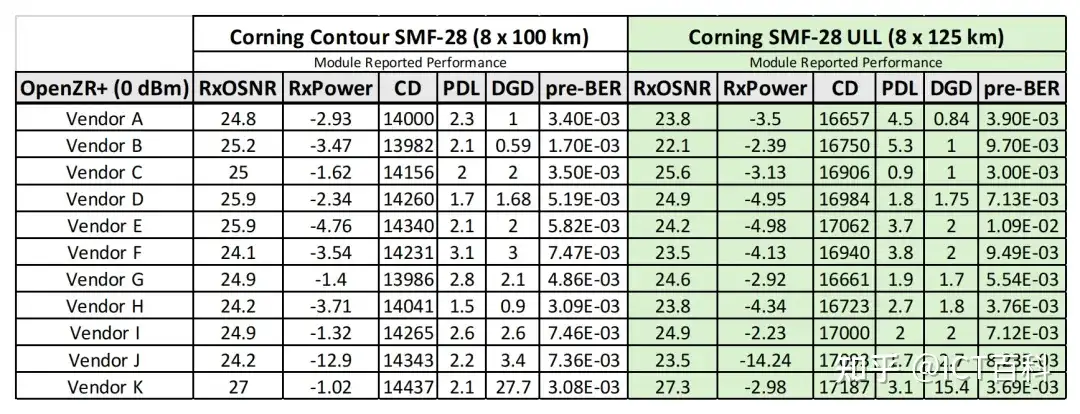
Let us interpret this table briefly (Contour fiber data). First, the receive optical signal-to-noise ratio (RxOSNR) is a key indicator for measuring signal quality and system bit error rate. Vendor F’s RxOSNR is 24.1dB, while Vendor K’s RxOSNR reaches 27dB, indicating that the latter has an advantage in the signal-to-noise ratio at the receive end and may provide better signal quality and lower bit error rate. Receive power (RxPower) is also an important parameter that affects signal reliability. Vendor J has the lowest RxPower at -12.9 dBm, while Vendor K has the highest RxPower at -1.02 dBm. Higher receive power usually means a stronger signal, which may help long-distance transmission. Chromatic dispersion (CD) and polarization mode dispersion (PDL) are two other key parameters affecting signal quality, related to the transmission characteristics of the signal in the fiber. The lower the CD and PDL values, the smaller the signal distortion. For example, Vendor K performs best in CD at 14437 ps/nm.
Differential group delay (DGD) measures the time difference between different modes in the signal, affecting signal integrity. Vendor B performs best in DGD at 27.7 ps, while Vendor H performs worst at 0.9 ps. Finally, bit error rate (BER) is an indicator that directly measures system performance – the lower the BER, the more reliable the system. Vendor K showed the lowest BER at 3.08E-3, indicating that its module has extremely high reliability under the test conditions. It can be seen that modules from different vendors differ in various performance indicators. Vendor K stands out in RxOSNR, RxPower and BER.
Curious – which vendor is Vendor K?
Related Reading
- MSA 800G Optical Modules – Analysis of 8x100G Technology in SR Scenarios
- 600G or 800G?
- 400G Line Transmission Solutions
Enjoy this article?
Subscribe to get new optical communication insights delivered to your inbox. Free, unsubscribe anytime.