For a long time, the development of optical fiber communication has been limited by the characteristics of the core material, especially the loss characteristics. Silicon dioxide has low loss in the visible to near-infrared wavelength range, matching the operating wavelength of lasers, and therefore has become the preferred core material for fiber in long-distance telecommunications applications.
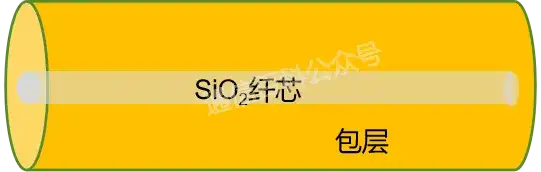
The core of this type of fiber is solid, and the transmission principle is based on Total Internal Reflection (TIR), where the refractive index of the fiber core n_core > n_cladding. Imagine a beam of light propagating in the core, striking the interface between the core and the cladding. If the incident angle at the interface is below the critical angle of TIR, the light is perfectly reflected back into the core.

This is reflection formed by refractive index difference; the interface is just like a mirror. So, can we directly make a mirror? Think about the reflective surface of the mirrors we use daily – it reflects light.
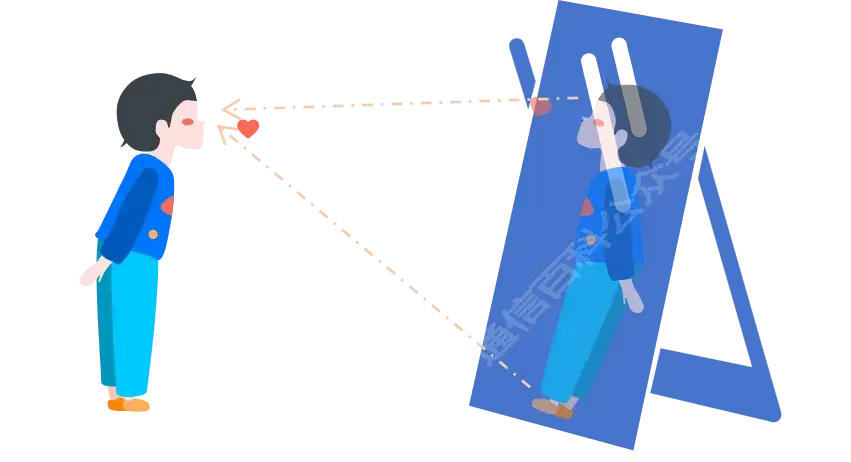
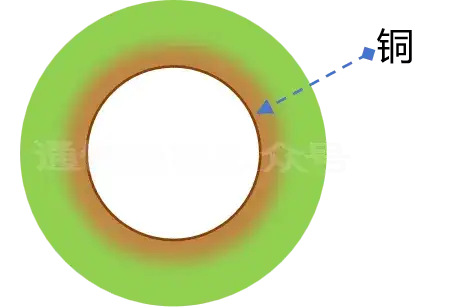
Then why not just build a mirror inside the waveguide directly? Fiber is also a kind of waveguide, a circular waveguide. The refractive index of daily-use mirrors is greater than 1, so for a hollow-core waveguide, we just need to make the refractive index of the hollow core smaller than that of the cladding material. Early on, Bell Labs coated the inside of a hollow tube with a conductive boundary of copper, with the middle of the tube being hollow. The conductive boundary formed by copper inside the metal waveguide acted as a mirror, reflecting the guided light back to the center of the tube, thereby guiding light in the core.
Mirrors used by ancient people were also made of copper, indicating that it is a high-reflectivity material. According to data, the operating frequency range was aimed at 40-110GHz, with loss less than 1 dB/km. But this thing is too expensive. Later, the warning sign “fiber has no copper” may not reflect people’s ignorance! Later, copper was changed to aluminum, in rectangular aluminum waveguides, with loss as low as about 1dB/m. It was only when Corning developed silica-core fiber with a loss of 17dB/km that the popularity of these metal waveguides faded. But the idea of hollow-core fiber continued. Besides this method, there is another physical mechanism for producing a highly reflective surface: the photonic bandgap. Photonic bandgap crystals are artificially manufactured materials in which the refractive index changes periodically between high and low refractive index values. There are mainly two types of photonic bandgap fiber:
- One-dimensional (1D) photonic bandgap fiber;
- Two-dimensional (2D) photonic bandgap fiber.
From this characteristic of periodic refractive index change, I wonder if you have thought of the fiber Bragg grating, which has a periodically changing refractive index in the axial direction and can reflect specific wavelengths.

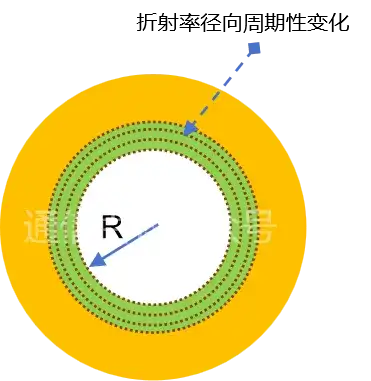
Similarly, one-dimensional photonic bandgap fiber has a periodically varying refractive index (high and low) in the radial direction.
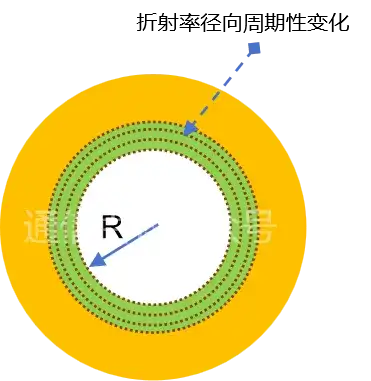
Therefore, this hollow-core fiber is also called a Bragg fiber (not a fiber Bragg grating). Then there is the two-dimensional photonic bandgap fiber, which is a mirror realized using a two-dimensional periodic photonic crystal.
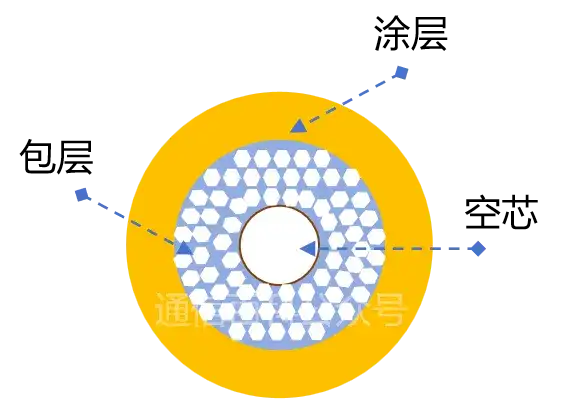
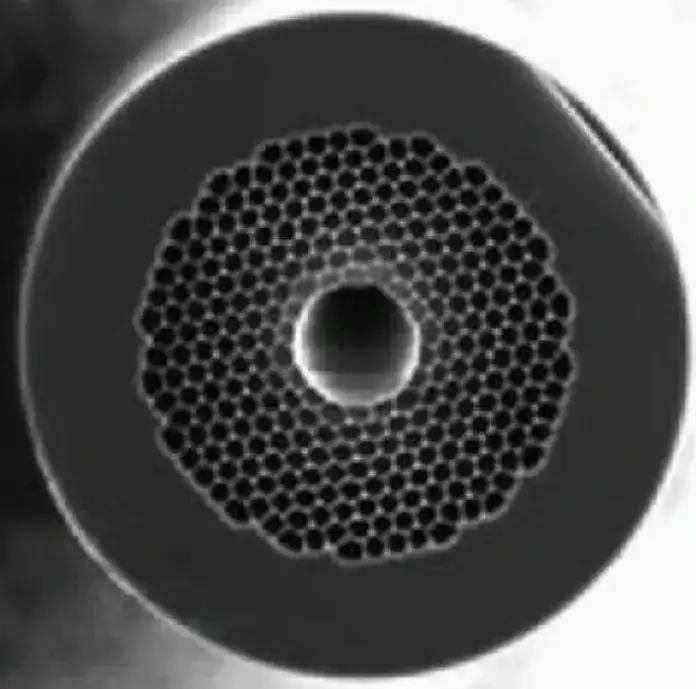
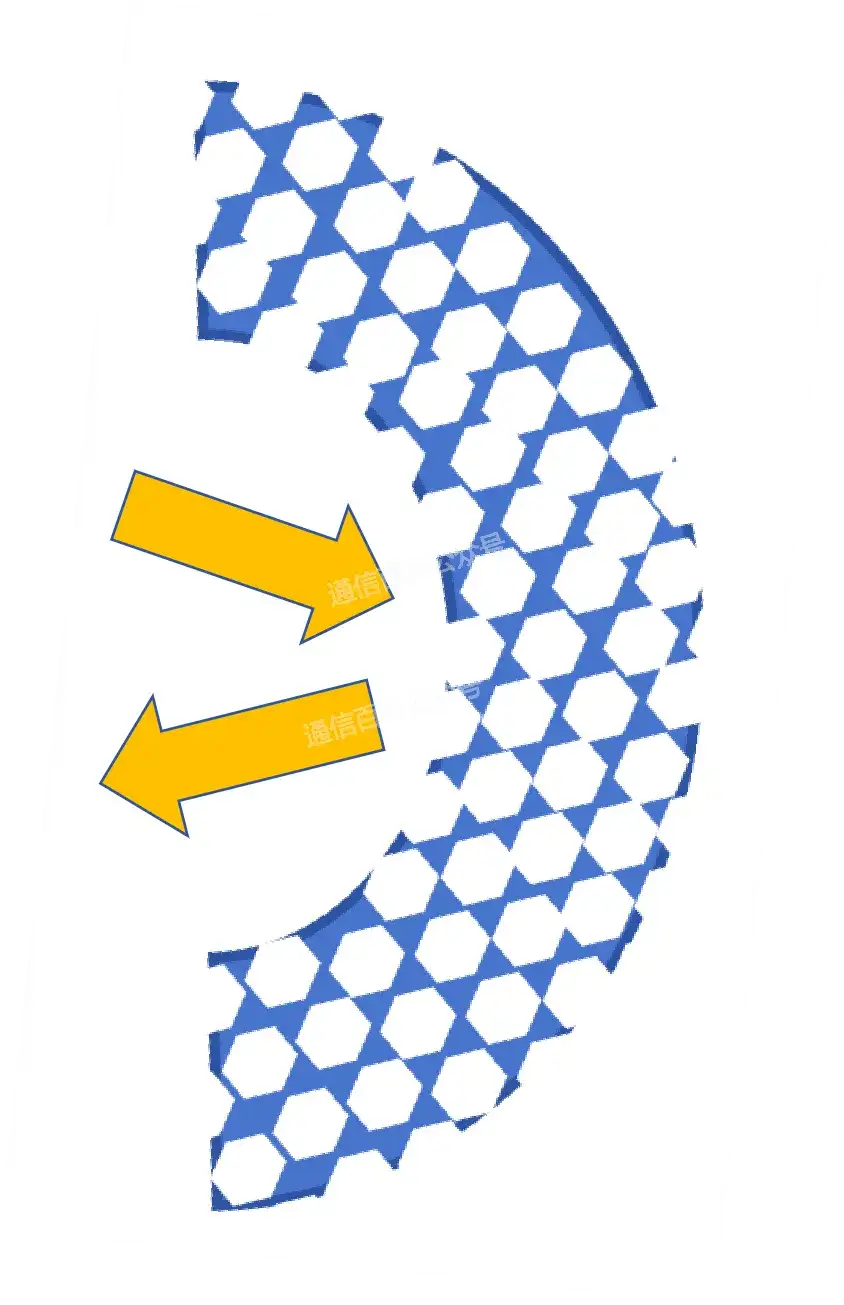
It can be simply understood as drilling many holes in the waveguide structure, and these holed areas prohibit the passage of light of specific frequencies. The hollow core in the middle allows light of those frequencies to pass through, thereby forming a waveguide.
There is also a nested antiresonant hollow-core fiber. This fiber forms a mirror by embedding glass tubes to form a resonant cavity that reflects light back into the hollow core region. We will discuss this later.
To get updates faster, please follow the Communication Encyclopedia official account:

Related Reading
- Revealed: What Is Hollow-Core Fiber?
- Hollow-Core Fiber 6: Nested and Non-Nested ANF Hollow-Core Fibers
- Hollow-Core Fiber 7: How to Reduce Surface Mode Loss?
Enjoy this article?
Subscribe to get new optical communication insights delivered to your inbox. Free, unsubscribe anytime.