
Introduction – Technological Breakthrough
In recent years, hollow-core photonic crystal fiber technology has made significant progress, reducing the attenuation of this type of fiber to a level comparable to that of all-solid silicon-based single-mode fiber.
The continued progress in this field has not only rekindled the industry’s interest in hollow-core fiber technology, but also inspired the expectation that one day hollow-core fiber will be able to realize the most transparent optical waveguide ever manufactured, covering all important spectral regions.

In this series of articles, we comprehensively review and analyze the various physical mechanisms that affect hollow-core fiber attenuation. We not only examine the traditional photonic-bandgap-based hollow-core fiber technology, but also explore the newer anti-resonant hollow-core fiber. Since both fiber types use a light-guiding mechanism different from that of traditional solid-core fiber to confine light within the central core, their attenuation processes are also dominated by a different set of physical processes.

First, we discuss the loss mechanisms inherent in ideal-state fibers, including the leakage loss of gas filling the core, absorption, and scattering caused by the surrounding glass microstructure, as well as scattering caused by the roughness of the air-glass interfaces inside the fiber. In particular, we strictly analyze the impact of the latter, since misunderstandings of these often lead to the use of inappropriate scaling rules.
Next, we explore the extrinsic factors of loss, including random microbending and the effects of other perturbations and non-uniformities that may arise during manufacturing. These factors mainly affect fiber loss by scattering light from the fundamental mode to higher-order modes and cladding modes with higher loss. Although these effects were often ignored in the past, they are becoming increasingly critical in manufacturing hollow-core fibers with loss below 0.1 dB/km and pure single-mode guiding characteristics.
Finally, in this series of columns, we propose general scaling rules for all the aforementioned loss mechanisms, combine these rules, and evaluate the performance of recently reported fibers. We also provide some general guiding principles for designing low-loss hollow-core fibers operating in different spectral regions, and conclude with a brief outlook on the future of this potentially transformative technology.
Review and Development
More than 20 years ago, an innovative fiber whose core was entirely filled with air was reported for the first time, successfully transmitting 35% of the laser light in the fundamental mode through a 40 mm long sample. This extremely exciting progress marked the first attempt to demonstrate light confinement and guiding in a long-distance, flexible hollow optical waveguide using the photonic crystal concept and its associated photonic bandgap.
The pioneering theoretical work of Yablonovitch and John inspired this fiber research. They independently proved that dielectric structures containing a three-dimensional wavelength-scale periodic refractive index distribution can suppress the existence of specific photonic states. Analogous to the electronic bandgap in solid-state physics, such structures do not even allow spontaneous emission due to the lack of allowed photonic states, and thus can be used to achieve strong light localization in deliberately created defects.
Based on these concepts, an out-of-plane photonic bandgap can be realized through the arrangement of two-dimensional periodic dielectric materials extending infinitely in the third dimension. Using this phenomenon, light can be guided in an appropriately designed core defect, even when the refractive index contrast between air and silicon is low. Because of this tradition borrowed from the photonic crystal concept, this type of fiber is commonly called photonic crystal fiber.
The first demonstration of light guiding in an air core inspired widespread optimism and opened up in-depth research on hollow-core photonic crystal fiber technology. The enthusiasm for this technology is justified, because light guiding in air not only eliminates many material limitations of traditional fiber, but also greatly reduces these limitations, while facilitating the realization of many novel photonics applications due to its unique properties.

First, the absence of solid material in the core significantly reduces the risk of dielectric breakdown damage to the fiber core under high-intensity radiation. At the same time, this almost eliminates the Kerr optical nonlinearity present in traditional solid-core fiber, significantly improving the power handling capability of hollow-core fiber and making it very suitable for transmitting continuous-wave or high-energy pulsed laser light. The substantial reduction of optical nonlinearity removes the serious obstacle of nonlinear noise in photonic fiber telecommunication systems, which is a fundamental limit on improving the data-carrying capacity of traditional fiber-based systems.
Second, because its group refractive index is very close to 1, hollow-core fiber guides light with a delay close to that of vacuum, which is becoming increasingly important in many data communication applications. In fact, hollow-core fiber can reduce latency by 1/3. Low latency is very beneficial for the deployment and operation of 5G networks, which have very strict time requirements, and the same applies to data centers and even supercomputers.
In addition, because the optical field of the guided mode in the hollow core interacts weakly with solid material, the low latency is also accompanied by very low group velocity dispersion and significant resistance to environmental changes, especially temperature changes. This unique property makes hollow-core fiber very suitable for high-precision interferometry, synchronization, and time-frequency metrology applications.
Third, removing solid material from the fiber core makes it an ideal platform for studying light-matter interactions in the liquid or gas phase, whether in the linear or nonlinear regime. Here, the long interaction length and the simultaneous confinement of light and fluid material lead to the realization of many applications, including frequency conversion, supercontinuum generation, and pulse shaping. The low-loss confinement of light in the hollow core also opens up the possibility of suspending and guiding particles over long distances in these structures. However, the enthusiasm for hollow-core fiber technology mainly stems from the hope that removing solid material from the fiber core will lead to lower propagation loss than standard single-mode fiber. The attenuation of the latter is basically caused by Rayleigh scattering, which arises from density fluctuations due to the disordered nature of glass. This disorder can be quantified by the fictive temperature, which is usually higher in fiber than in bulk silicon.
Physical Mechanisms and Loss Factors
Over the years, the difference in fictive temperature between bulk glass and fiber has narrowed significantly, and it is now generally believed that significantly reducing the loss in silicon fiber below about 0.14 dB/km is impossible.
Therefore, further loss reduction must use a medium that is not easily scattered, and air, with its density nearly three orders of magnitude lower, is the ideal medium. In addition to low scattering, low-loss guiding in air/vacuum is also possible at wavelengths where glass is opaque, as long as the fiber is designed to avoid strong overlap of the guided mode field with solid glass material. This opens up the prospect of low-loss light guiding on a single solid material platform from ultraviolet to mid-infrared. Although all these prospects are attractive, achieving hollow-core fiber loss levels comparable to or lower than those of traditional fiber has always been a huge challenge.
Within a few years after the first report of hollow-core fiber, researchers quickly discovered that the physical mechanism used to guide light in the hollow core introduced some unique loss mechanisms.
First, unlike traditional fiber, where total internal reflection ensures that the guided optical mode is truly confined, guiding light in microstructured fiber, especially hollow-core fiber, is always accompanied by some leakage; that is, the modes are leaky, and part of the optical power is lost from them as it propagates along the fiber axis. This leads to leakage or confinement loss, similar to the loss in traditional solid-core fiber due to partial reflection when bent.
A fundamental aspect of leakage loss is that it increases with the order of the transverse mode, leading to differential loss among guided modes. Second, in hollow-core fiber, the presence of many air-glass interfaces leads to a unique surface scattering mechanism that contributes to loss.
Researchers realized very early that in photonic bandgap fiber, the roughness at these interfaces, although very small, can cause substantial scattering loss when light propagates over long distances. This was considered to set a fundamental limit on the loss that these fibers can achieve. In the newer hollow anti-resonant fibers, this contribution seems to no longer dominate, but still plays a role in determining the total fiber loss.
In addition to these two unique and distinct loss mechanisms, other intrinsic loss mechanisms present in solid-core fiber also contribute to hollow-core fiber loss.
The first is Rayleigh scattering, which may originate from glass or when the hollow region is filled with air or other gases. Rayleigh scattering in gas is nearly three orders of magnitude lower than in glass, making its contribution negligible. In hollow-core fiber, a very small fraction of the optical power is guided in glass, which largely suppresses the loss contribution of Rayleigh scattering within the glass region.
The second is absorption, which may also occur in the glass or in the potentially filling gas. Like scattering, glass absorption is highly suppressed because of the small overlap between the guided mode field and the glass material. Absorption in the potential filling gas depends on the specific gas composition and operating wavelength, but can in principle be eliminated by evacuation.
A series of extrinsic loss mechanisms present in solid-core fiber also affect hollow-core fiber loss. For example, leakage loss increases when the fiber is bent or deployed in a coiled configuration for applications such as sensors or interferometers. This is called macrobending loss. When the fiber axis deviates from a straight path due to random lateral loads, such as when wound on a rough drum or pressed against rough strength members in a cable, it produces additional loss called microbending.
In addition to these bending-induced loss mechanisms, random fluctuations during fiber manufacturing cause small structural perturbations or non-uniformities in the fiber structure. As in solid-core fiber, the consequence of such perturbations is to cause power transfer between core guided modes, and between these core guided modes and radiation modes, leading to additional loss.
The purpose of this series of articles is to present, as completely as possible, the current understanding, or sometimes misunderstanding, of the physical mechanisms contributing to hollow-core fiber loss. The mechanisms providing the main loss contributions are closely related to the relevant guiding mechanism and fiber type.
We broadly distinguish two categories of fiber.
The first category is fibers that guide light through the photonic bandgap effect, which can be further distinguished into 1D photonic bandgap fibers, whose cladding consists of omnidirectional dielectric mirrors, and 2D photonic bandgap fibers, whose cladding has a 2D periodic honeycomb structure.

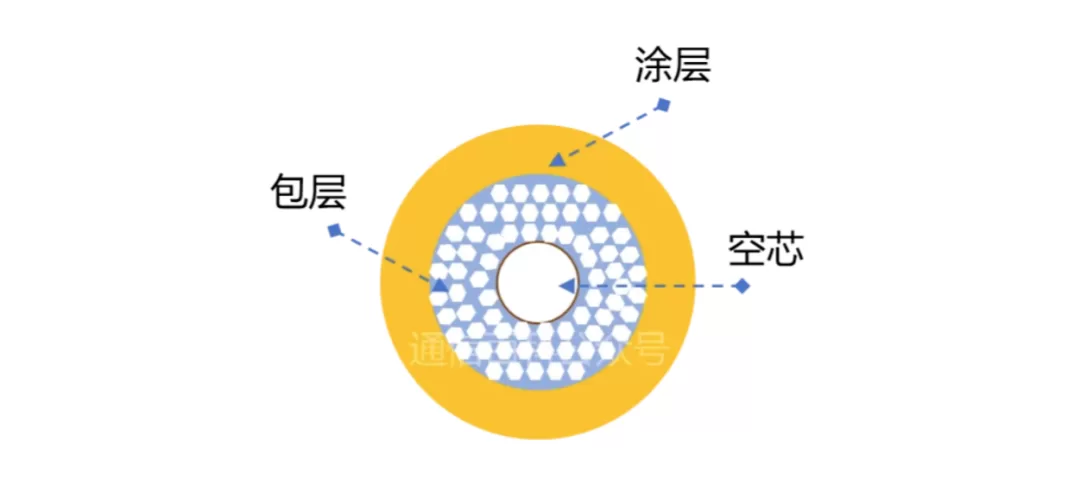
The second category is fibers with a cladding usually composed of an arrangement of thin glass membranes, guiding light through a mechanism called anti-resonance, or often called inhibited coupling.
Although these may not include all types of hollow-core fiber, we focus on 2D photonic bandgap fibers and anti-resonant fibers, because they demonstrate the potential for loss below 1 dB/km from visible to near-infrared wavelengths.
In addition, we pay more attention to anti-resonant fibers, because they have been the focus of intensive research over the past few years and have now demonstrated sub-0.2 dB/km loss over multi-kilometer spans.

In the following Articles 2 and 3, we briefly outline the current performance status of the two fiber types.
Hollow-Core Fiber 2: Photonic Bandgap Fiber
Hollow-Core Fiber 3: Anti-Resonant Hollow-Core Fiber
Related Reading
- Revealing: What Is Hollow-Core Fiber?
- Hollow-Core Fiber — What Is Photonic Bandgap Fiber?
- Hollow-Core Fiber 6: Nested and Nodeless ANF Hollow-Core Fiber
Enjoy this article?
Subscribe to get new optical communication insights delivered to your inbox. Free, unsubscribe anytime.