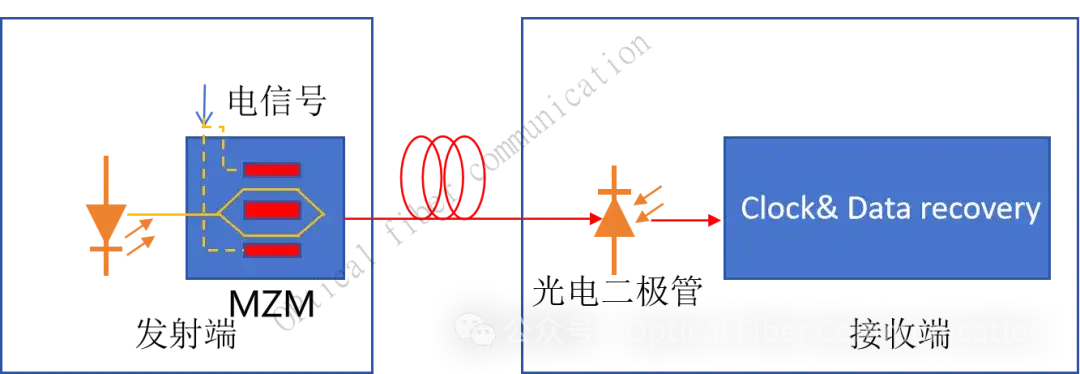
A directly modulated laser (DML) can be used to modulate optical power. In a DML, the laser output power is adjusted by changing the pump current in the laser gain medium. As shown in the figure below, the pump current is controlled by an electrical drive signal. The modulation format of this type of direct detection (DD) system typically uses on-off keying (OOK). In other words, the pump current of the DML is varied by a binary signal.
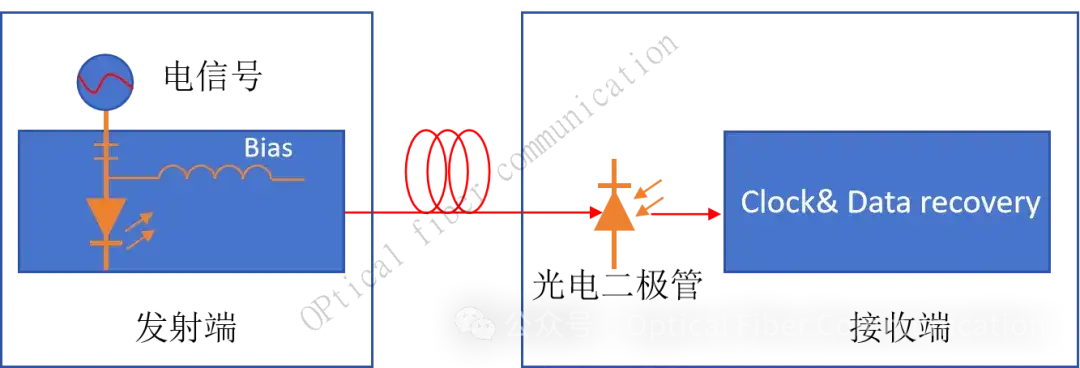
After transmission through the fiber and photoelectric detection, the receiver performs clock recovery and sets an appropriate threshold to determine whether the received symbol is a logic 0 or 1. In general cases, adaptive digital filtering is not adopted, and if inter-symbol interference exists, it is not mitigated before symbol decision. In addition, for short-distance transmission, forward error correction (FEC) coding is usually not used.
The advantage of the DML is that its modulation process is implemented inside the laser source, requiring no optical coupling between the laser and the modulator. This approach can minimize manufacturing and packaging costs. DML-based DD systems are suitable for 10 Gb/s systems. Research and laboratory demonstrations show that the DML can achieve a bandwidth exceeding 50 GHz and can modulate data at rates exceeding 100 Gb/s. However, the application of DML-based DD systems is mainly limited by the finite extinction ratio of the DML and issues such as laser chirp, that is, modulation directly changes the laser frequency.
Higher signal integrity can be obtained by using an external modulator, as shown in the figure below.
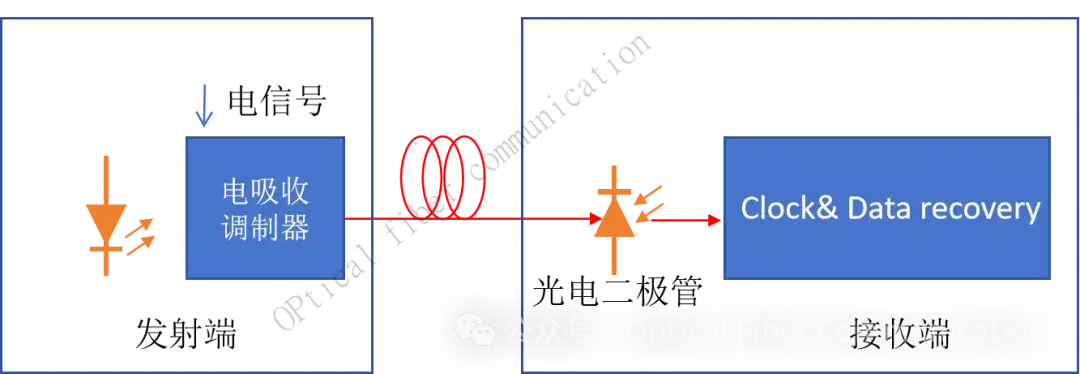
For DD systems, a popular external modulator is the electro-absorption modulator (EAM). The EAM is usually manufactured in the form of a semiconductor waveguide and is equipped with electrodes to apply an electric field in the direction perpendicular to the beam propagation direction. The applied electric field changes the optical absorption spectrum of the semiconductor (thereby changing the modulator output power), a characteristic known as the Franz-Keldysh effect. The EAM can operate at a low drive voltage (about 2 V) and can provide a bandwidth exceeding 100 GHz. They can be integrated on the same chip with a distributed feedback laser; this combination of laser and EAM is called an electro-absorption modulated laser (EML).
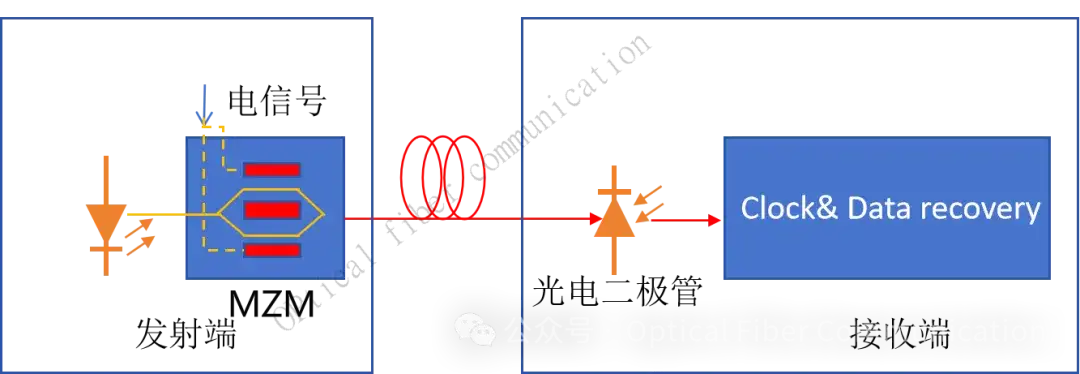
Although the EML has a better extinction ratio than the DML, it still produces modulation chirp. To avoid this, a Mach-Zehnder modulator (MZM) can be used. The MZM is a different type of external modulator that achieves intensity modulation by combining two phase modulators in a Mach-Zehnder interferometer scheme. Using differential drive or a push-pull configuration, the MZM can achieve chirp-free modulation. The figure below shows a schematic of an MZM-based IM-DD system.
Related Reading
- What is Direct Detection?
- Probabilistic Constellation Shaping (PCS) (2)
- Does 800G in Data Centers Use PAM4 or Coherent Technology?
Enjoy this article?
Subscribe to get new optical communication insights delivered to your inbox. Free, unsubscribe anytime.