PAM4 is a type of PAM (Pulse Amplitude Modulation) modulation technique. PAM signals are a popular signal transmission technology after NRZ (Non Return-to-Zero), and also a representative of multi-level modulation technology, now widely used in high-speed signal interconnection.
Typical waveforms of NRZ and PAM4 signals are shown in the figure below. On the right is a comparison of the optical eye diagrams of NRZ and PAM4: NRZ has a single-eye waveform, while PAM4 has a three-eye waveform (three eye-shaped patterns along the y-axis).
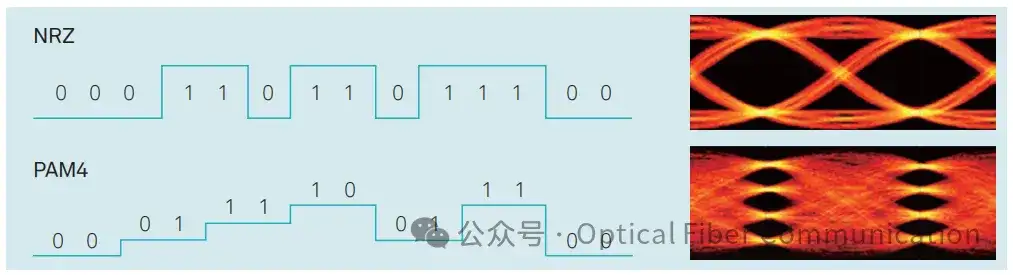
The differences between NRZ and PAM4 signals are as follows:
- NRZ signals use high and low signal levels to represent digital logic 1 and 0, transmitting 1 bit of logic information per clock cycle.
- PAM4 signals use four different signal levels for transmission, transmitting 2 bits of logic information per clock cycle, namely 00, 01, 10, and 11.
Therefore, under the same baud rate, the bit rate of a PAM4 signal is twice that of an NRZ signal, doubling the transmission efficiency while effectively reducing cost. Because of its high transmission efficiency, the IEEE Ethernet standards group 802.3 has decided to use 50 Gbps/lane (referred to as 50G) PAM4 coding technology at the physical layer of 400GE/200GE/50GE interfaces.
From 4G to the upcoming 5G, traffic has grown very rapidly, but in sharp contrast, operator revenue has continued to grow at a low rate, and the gap between the two is widening.
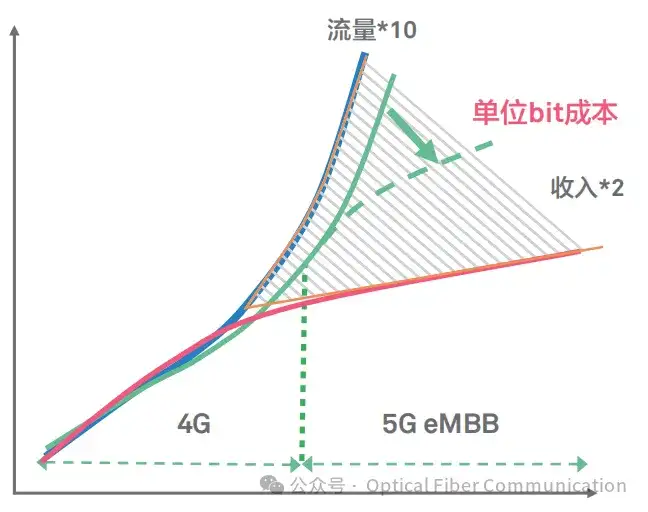
How to narrow the imbalance between traffic and revenue is a major pain point for operators. If this pain point can be solved, it will undoubtedly gain an advantage in 5G solution competition. The most effective measure to reduce the gap is to reduce costs. In the cost composition of mobile bearer network equipment, optical modules account for an increasing proportion. If the cost of optical modules can be effectively reduced, it will undoubtedly play a crucial role in reducing the cost of the entire network equipment.
At the same time, compared with previous generations of mobile networks, the capabilities of 5G networks have advanced by leaps and bounds. For example, the downlink peak data rate can reach 20 Gbps, while the uplink peak data rate may exceed 10 Gbps. In terms of infrastructure, operators should carry out end-to-end network architecture transformation, building a flexible architecture from the access network, aggregation network to the core network to enhance the bandwidth-expansion flexibility of their infrastructure.
The 400GE/200GE/50GE based on single-channel 50G PAM4 technology can well adapt to 5G’s requirements for network cost and performance, building the optimal solution from access and aggregation to the core network. Optoelectronic technology is a branch of semiconductor technology. To better improve luminous efficiency and performance, the industry generally uses III-V compound elements for optical chip design, which differs greatly from the pure silicon used in CMOS processes that only need to ensure electrical performance.
Currently, optical technology development has become the bottleneck of interface development. After decades of development, the CMOS process has become very mature, benefiting from massive applications and N iterations of optimized processes. By contrast, the development speed of III-V has significantly lagged, constrained by industry scale, with a large gap in process maturity and standardization. At present, the development speed of optical technology can no longer meet the classic Moore’s Law requirement of doubling performance every 18 months.
The development speed of optoelectronic technology in the communications field currently needs 24 to 36 months to double. To accelerate optoelectronic technology development, new process technologies such as silicon photonics, as well as algorithmic techniques such as higher-order modulation, have emerged to accelerate. PAM4 is a type of higher-order modulation technique and can be regarded as an effective method of using electrical-domain technology to accelerate optical technology development.
Related Reading
- For Data Center 800G, PAM4 or Coherent Technology?
- Broadcom: Progress on NPO Based on 200G PAM4 VCSEL
- Probabilistic Constellation Shaping PCS (2)
Enjoy this article?
Subscribe to get new optical communication insights delivered to your inbox. Free, unsubscribe anytime.